Hi
im not sure is this a "tool".
But this way i notch tubes.
https://youtu.be/9dhi_dPBoBM

Printable View
Hi
im not sure is this a "tool".
But this way i notch tubes.
https://youtu.be/9dhi_dPBoBM
<!-- BEGIN /var/www/html/homemadetools/protected/modules/zeus/views/tool/postUpdate.php -->
Thanks Tuomas! We've added your Tube Notching Method to our Tube Notchers category,
as well as to your builder page: Tuomas's Homemade Tools. Your receipt:
<div id="blocks"> <div class="block b1 pngfix"> <div class="bimg"> <div> <a href="http://www.homemadetools.net/homemade-tube-notching-method"> <img src="/uploads/169373/homemade-tube-notching-method.jpeg"/> </a> </div> </div> <div class="head pngfix"></div> <div class="left pngfix"></div> <div class="right pngfix"></div> <div class="blockover b1 pngfix"> <div class="title"> <a href="http://www.homemadetools.net/homemade-tube-notching-method">Tube Notching Method</a> <span> by <a href="http://www.homemadetools.net/builder/Tuomas">Tuomas</a></span> </div> <div class="tags">tags: <a href='http://www.homemadetools.net/tag/notch'>notch</a> </div> </div> </div> </div>
<!-- END /var/www/html/homemadetools/protected/modules/zeus/views/tool/postUpdate.php -->
Great, never have seen it detailed before, either that was some thin tubing or they had very aggressive abrasive wheels.
Thanks for posting,
Ralph
Thanks Ralph.
Tube was with 1.6mm wall. But also those 1mm thick discs cut very fast, i like those are more accurate too than 2.4mm discs.
Thanks Tuomas!
Knock out by the precision, Tuomas. From the math, to the layout, to template, to the execution of the notches. A true craftsman.
There's a product here. Design templates for standard and common tube sizes and a variety of angles of intersection, 90deg. 75, 60, 45, 30 and maybe in between. Print the templates at home on heavy paper stock and ship them by 1st class mail or via internet. Or laser cut more durable templates from a thicker flexible material, incorporate a connector of some sort. The material could be strong so not to stretch or stretchy thick rubber/elastomer with ends laser cut to form a male/female joint that you glue together with ACC. This later type could be designed to fit a small range of OD's for example: 1.75, 1.88, 1.9(schedule 40 pipe) and 2". I'm thinking this particular example in a quality silicone rubber could easily sell for $4.95 plus shipping, which if it would stand being pressed flat for shipping between two sheets of cardboard, could go first class perhaps as many as a set of 6 sizes in a first class envelope. Ed Weldon (to old to start a new business)
I forgot to mention in the product idea. I may have also produced a "poor man's patent" here by making a public disclosure in this forum of what otherwise might be a patentable idea, laser cut form and connectors that stretches to fit a variety of sizes. It could also be die cut. Careful selection or fabrication of the right material and thicknesses could accomodate the tendency for narrower widths of the template to stretch unequally. Ed W
Another thought. This form could be cut with a steel rule die, a method commonly used for cutting flat gaskets. Dies are made from special thin steel strip with a sharp cutting edge embeded in thick baltic birch plywood. Check out this process. Cheaper than buying a laser. And faster production rates.
I remember seeing, years ago, free software that creates a template you print and then wrap around the tube to cut the profile. Joining different tube diameters at different angles can be accommodated. Here is just one example . . . there are many more.
https://youtu.be/wJVwNwxCfLA
I applied a little google-fu: Tube Coping Calculator
The DOS program I remember in the 80's was called TUBEFIT. I couldn't think of it the other day when I posted. Thanks Bruce for the link above which triggered my memory. Here is more information on how Dan Hopper created the program. I wish I could find a DOS copy. Online calcs are fine but its a much more secure feeling having a floppy in the shop. Yes, I am that old!
:beer:
Here you go! Dan Hopper's TUBEFIT Program (There was a link towards the bottom of the online calc page link above.) Now all yah gotta do is find a floppy disk! ( and a floppy disk drive to read it...)
If you have an operating system that no longer supports DOS, you can use DosBox, an emulator program which emulates an IBM PC compatible computer running a DOS operating system.
It's well known enough to warrant its own Wikipedia entry...
https://en.wikipedia.org/wiki/DOSBox
It can be downloaded here...
https://sourceforge.net/projects/dosbox/
This is what I use to run my legacy DOS programs and it works very well. I also recommend it on my web page to run the DOS programs there.
On the first page I immediately though of simply writing some kind of web application to do this that will auto generate images... but I guess there is one already & there is even stand alone one available.Quote:
Originally Posted by bruce.desertrat
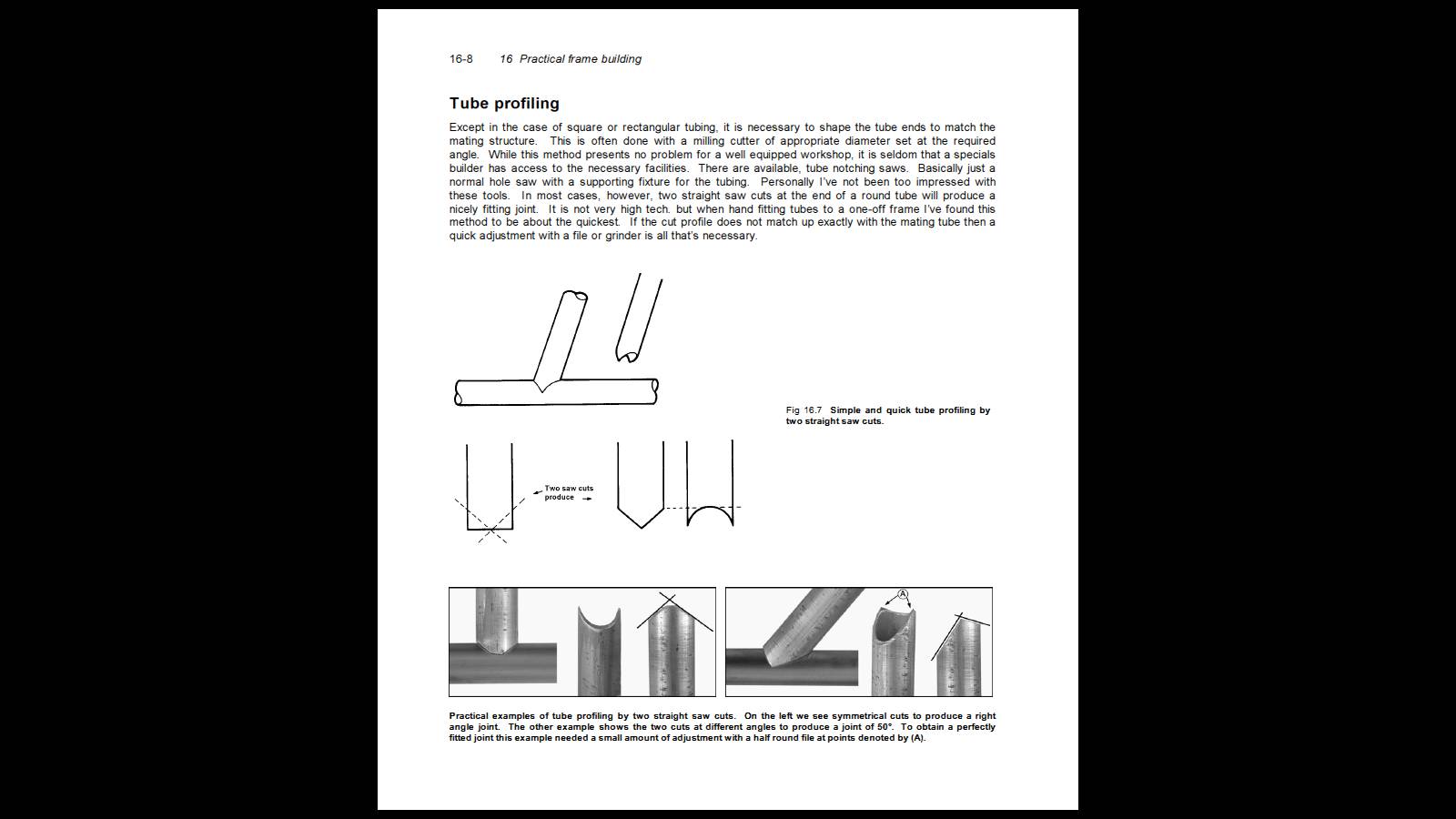
I missed this post when it was made but I have had to notch thousands of joints. In the 70s and 80s when I had a business making motorcycle chassis. Unless the wall is thick compared to the diameter then 2 straight saw cuts will get you very close to a well fitting joint. The cuts can be made with hacksaw, cutoff wheel in an angle grinder as Tuomas did or a full size cutoff saw.
This method works for 90 deg joints but also for those at different angles. For one off and for the first frame of a new design I would use a hacksaw, which was generally the fastest way. For production frames I had a list of cutoff saw angle settings so that unskilled helpers could take care of the work.
Here is a page from my book Motorcycle Handling and Chassis Design
Attachment 27581 Click for full size.
Also on my website in the freeware section there is some software "TubeMiter" which prints out templates for tube notching which handles tubes of different diameters and angles. I don't use it but only because the two cut method above works so well for me.
PS. I must mention that not everybody has success with the two cut method, you have to have a good eye for the angles and distance from the end to cut. I have a friend who has built some motorcycle chassis and he has never had success with the method.
Have fun with this Tabbed TubeNotcher Pattern Creation Tool.
It took some time to find it.
TubeNotcher Pattern Creator Tool
Good ideas, but search "Chop saw tube notching". I won't link it here because it's not original work, but I've been using the method described by "tigweld" for quite a few years. That includes building a rock crawler buggy, parts of other buggies, roll cages, bumpers, all sorts of round tube stuff. It really works well and quickly with minimal touch ups to get a nice tight fit.
You should add the link, so people can find it.Quote:
Originally Posted by Baddog
There is many methods to make things, this one was just a one of them.
I have used this method at my work, with large diameter pipes. ( around 20" )
We need to work with them sometimes, but not so often that making a specific tool for that would be necessary.
Its easy to draw lines to the pipe and cut with the plasma, torch, grinder..
Shared it, because it doesn't require any special tools, after drawing the lines its possible to make the shape even with files if time ain't problem. :D
If you search "chop saw tube notching", there are lots of examples out there. The one I first saw provided by tigweld is very simple and straightforward.
This is a post I made years ago, and it references the original tigweld post.
I've used the template approach before, but I like this because with a single print out you can quickly make cuts with many different intersecting angles. I don't actually use a chop saw most of the time due to noise and mess. And as you say, lots of different ways depending on goals, project, and tools available. It's always good to have a selection of ways to do something.