 LinkBack URL
 About LinkBacks
CNC routing a stack of laminate.
Previously:
Edge banding machines - GIFs
Laminate cutter - GIF
Spiral routing jig - GIF
CNC routing a logo and filling it with resin - GIF
Ellipse routing jig - GIF



CNC routing a stack of laminate.
Previously:
Edge banding machines - GIFs
Laminate cutter - GIF
Spiral routing jig - GIF
CNC routing a logo and filling it with resin - GIF
Ellipse routing jig - GIF
New: BuildThreads.com - 300+ build posts/day (with photos)
nova_robotics (Mar 19, 2022)



I Guess it wasn't cut right the first time
Never try to tell me it can't be done
When I have to paint I use KBS products

Oh that's nice. I have a little 2 ft x 4 ft router table and when I try to do cuts deeper than a few mm it chatters like crazy. But x-y-z is on the head. This one has the end mill supported at both ends so it doesn't chatter, and the workpiece moves. That's pretty good.
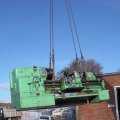
Likely has extraordinarily higher RPM range, and swarf isn't helical, so that's probably a D-bit cutter.Originally Posted by nova_robotics

Sincerely,
Toolmaker51
...we'll learn more by wandering than searching...
nova_robotics (Mar 19, 2022)
, but just out of the thirty oddball small end mills or so I had on hand. I'm using carbides right now, not for any reason other than it worked slightly bette "Pin It")
I'm just a newbie and have never used a d-bit cutter. I tried out a bunch of HSS and carbide on plastic (acetal), but just out of the thirty oddball small end mills or so I had on hand. I'm using carbides right now, not for any reason other than it worked slightly better than the HSS end mills I found in the junk drawer. I have a water cooled 2HP spindle on my little router and I can't quite figure out how to get the inverter to work properly, so it's just maxed out all the time at 24,000 RPM. I'm cutting acetal and it's a little fast. The chips come off pretty hot. You figure a d-bit would be better? I'm slightly worried about balance because the thing is running at a kajillion RPMs.
Generally, carbide milling cutters are slightly sharper than HSS, partly because higher density. Solid D-bits are available in either material, larger diameters are cemented (brazed).
D-bits are de rigueur for engraving. depending on diameter-material-depth. RPMs can exceed 24k. They are typically tapered and ball end.
A D-bit is technically 100% clearance, providing straightest, shortest chip ejection compared to helical, but restricts maximum depths. As depth increases, the need of efficient chip ejection increases at greater ratio because volume and heat retention. Thermo-sets are less problematic than thermo-plastics.
The balance issue is counteracted by mass in the drive, especially round belt types of full size pantographs.
I'd suspect armature and distance between bearings is good for any bits your spindle (and collets) accommodate.
Last edited by Toolmaker51; Mar 20, 2022 at 09:06 AM.
Sincerely,
Toolmaker51
...we'll learn more by wandering than searching...
nova_robotics (Mar 20, 2022)

[QUOTE=Toolmaker51;199850]Generally, carbide milling cutters are slightly sharper than HSS, partly because higher density. Solid D-bits are available in either material, larger diameters are cemented (brazed).
I've always understood HSS cutters are sharper than carbide. But carbide tooling is harder, so you can (and should) increase the depth of cut and/or surface speed, and carbide tooling holds a decent edge longer. On the lathe, I sometimes switch over to HSS from carbide on a final skim pass to make the finish nicer. Of course, that could be because I'm on the bottom end of the recommended power, speed, and material removal ranges for carbide cutters and right in the sweet spot for HSS. On the wood lathe, too, carbide cutters give a reasonably good finish, while a sharp HSS tool can give a really fine finish.
Am I misunderstanding or misremembering something? It could easily be I've got all this confused...I mean, there was this one time I thought I was wrong, but it turned out I was mistaken. (buh-dum-bump!)
For topical application, only. Not to be taken internally or used in com-
bination with other drugs or alcohol, except as directed by your shaman.
Do not operate heavy equipment, unless you actually know how to.
I did mis-phrase statement of carbide vs HSS.
HSS starts out sharper, carbide will normally maintain edge longer; but when it starts to chip the decline is rapid. This is noticeable in cutters that actually 'cut', such as endmillls.
Razor edged carbide turning tools are a minority, it doesn't find simultaneous side and radial loads a kindly environment. That is a better way to observe how they work removing material; HSS cuts, carbide pushes.

Last edited by Toolmaker51; Mar 24, 2022 at 05:42 AM.
Sincerely,
Toolmaker51
...we'll learn more by wandering than searching...
There are currently 1 users browsing this thread. (0 members and 1 guests)
 Posting Permissions



 Reply With Quote
Bookmarks