Working on a dial indicator
https://www.youtube.com/watch?v=qf6eBrMnIAo

Printable View
Working on a dial indicator
https://www.youtube.com/watch?v=qf6eBrMnIAo
Thanks bstanga! We've added your Dial Indicator Repair to our Cleaning category, as well as to your builder page: bstanga's Homemade Tools. Your receipt:
<div id="blocks"> <div class="block b1 pngfix"> <div class="bimg"> <div> <a href="http://www.homemadetools.net/dial-indicator-repair"><img src="https://www.homemadetools.net/uploads/237426/homemade-dial-indicator-repair.jpeg" /></a></div> </div> <div class="head pngfix"></div> <div class="left pngfix"></div> <div class="right pngfix"></div> <div class="blockover b1 pngfix"> <div class="title"> <a href="http://www.homemadetools.net/dial-indicator-repair">Dial Indicator Repair</a> <span> by <a href="/builder/bstanga">bstanga</a></span> </div> <div class="tags">tags: <a href="http://www.homemadetools.net/tag/ultrasonic">ultrasonic</a>, <a href="http://www.homemadetools.net/tag/dial-indicator">dial indicator</a>, <a href="http://www.homemadetools.net/tag/repair">repair</a></div> </div> </div> </div>
Nice fix Brian. Gutsy but like you said not much to lose. I keep some of the Boeshield T9 lube on my bench. It's the best light lube I've ever used, doesn't collect dust and a great rust preventative too.
I think HFT has a dial remover for pretty cheap...Got my Dad's instrument ones after he passed. That screw driver method made me hold my breath. :eek:
Been eyeballing one of those cleaners. Seemed to do a darn good job. My buddy Ghostses reviewed it a while back and now Haligan has one too for his mill rebuild. Have to watch the sales and use a coupon.
Give Zeek another treat for me. Thanks for sharing!! ~PJ
Thanks for the kind words PJ, yeah nothing to lose on that DI, and I've had it apart twice before, trust me when I say I would not disassemble any of my nice DI's that roughly.. this one was a pawn shop find thanks again for watching
Brian
Very intriguing fix Brian. I have a couple of DI's that have been giving me fits because one was cheap and the other has sat for who know how long. So I guess I'm going to add that to the list next time I take the trek down to HFT.
[QUOTE=PJs;56068I think HFT has a dial remover for pretty cheap...Got my Dad's instrument ones after he passed. That screw driver method made me hold my breath. :eek:
Been eyeballing one of those cleaners. ~PJ[/QUOTE]
Well I'll be dipped, HFT sells a ultrasound cleaner, and it works! I went on the site and as usual there's some good tips, like sealing around the metal tub so condensation etc doesn't get into the case and short it out. It was also interesting all the different concoctions used to clean. I have a chainsaw carb that I've been wanting to tackle and according to the reviews this is the ticket! What a great find for a lot of different reasons, thanks!
"Dial remover"? Like to pull the arms or for the bezel PJs?
BTW, Amazon sells Starrett oil. Seemed to make all my DI's work better and I didn't remember it being expensive.
Brian, PJs and C-Bag,
Thank you for the tip about HFT selling a ultrasound cleaner.
Many of the newer watch and instrument oils are synthetic oils that seem to last longer without getting gummy. I like the Boeshield T-9 spray lubricant and works well. I spray my lathe chucks with the Boeshield before storing them close to the concrete floor and never see any rust.
Thanks, Paul
thanks for watching, I think the dial remover must be a tool to remove the "hands" or pointer, I haven't seen one it would have to be very small :-)
thank you Paul for introducing me to this wonderful resource of tools an ideas. this is a great site.
thanks again
Brian
Hmm, Boesheild, never heard of that, looked it up and it was in the bike section of Amazon. Sounds like I'm going to have to add that to the list too as it sounds like a worthy replacement for the chain lube I've been using. Thanks again PJ's and Paul.
Boeshield is new to me, though I've used Boelube in the past for precision drilling and reaming of aluminum. The stuff came in handy on my airplane project years ago.
Ken
Boelube? ��
Now I'm throughly confused/intreaged. So in the case of the DI innards should you lube or shield? I still have a many lifetime supply of Starrett oil but just like tools, you can't have too many oils.
Sorry to hyjack the OP but you just never know what wonderful tip is going to pop up when guys start chipping in.
Boelube comes in several forms (liquid, paste, and solid). This is the stuff I used (a kind of waxy solid):
http://orelube.com/wp-content/upload...9/70200_13.jpg
Ken
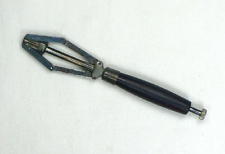
Hi All, Great tips flying all over here. I didn't know the name of the tool but knew it was for removing needles/hands from watches or instruments. I found this picture on the net although dad's is more antique and its in my storage shed in an old tool box.
Attachment 8991
I remember using it a few times with him and on an old Weston meter that got dropped and jarred the needle loose. It made it easy to remove a needle and get it started going back on. Don't think it would be an issue with the tiny one on the DI in Brians video as the claws are quite small. Thought I had seen one at HFT with their small tools and watch stuff but it doesn't show up on their website. Their are newer "C" style and some spring steel types now available through watch/clock tool supplies, and under $10 from what I saw.
Thanks Ken for the tip on Boelube. Is it for drilling rivet holes in AL sheet? Looks pretty good and cheaper than that green stuff (can't remember name) everyone on YT is using.
Good tip on storing the chucks with Boeshield, Paul.
Looks like we're all on board for the ultrasonic cleaner...maybe we can get a group discount with Coupons! :bananadance:
Another great thread going here! Thanks, ~PJ
U da man Wiz! After you mentioned watches I had the old headsmack doh! Of course they would have a puller for that but I'd never thought of it on my own. It being so micro and my world being so macro. I did a quick search and there are huge price gaps for pullers but this one caught my eye for $11
http://www.clockworks.com/pics/pics-...tools/wt14.jpg
It looks to be a knockoff of one that's $60. Like the HFT equivelant I guess. If I was in the watch repair biz I could justify the expensive one but the cheap one will probably hang together for the couple of DI's I want to try and save. And who knows maybe HFT does have one and it's not in their catalog only in the store. At least when I'm down trying pick up the US cleaner I can root around in the other racks and see if the hand puller is there. HFT is getting to be like Costco where stuff magically shows up and sometimes it's there when I do my next bi annual pilgrimage and sometimes it goes away :(
I used it more for drilling and reaming plate than sheet. I suppose that using it for sheet might slightly extend the useful life of drill bits, but I never bothered.Quote:
Originally Posted by PJs
Ken
Thanks Ken...thought it might be useful to minimize burrs on sheet but makes sense on plate too and countersinks.Quote:
I used it more for drilling and reaming plate than sheet. I suppose that using it for sheet might slightly extend the useful life of drill bits, but I never bothered.
C-Bag, I saw that style and seemed to be the new style for a good price. Amazon had it for $9 Prime. Paul probably knows more about that kind of tools than me for sure. Like you said for a few times use they probably do fine. I found the one in my picture above on a UK site for 4-7 pounds...shipping would be atrocious. Found that type is called a Plunger Style the other is a Presto style.
It might help with burrs, though all of my holes in sheet stock get manually deburred on both sides as a matter of course. In the airplane, most of the ~12K+ holes wound up also being dimpled or countersunk (as appropriate based on stock thickness) for flush rivets. Fun times… :lol:Quote:
Originally Posted by PJs
Ken
I had another doh! moment just a little bit ago. I was coming back from my ride down the post office and saw my buddy out in his garage so I stopped in. He is a wonderful old German retired instrument tech that PG&E still calls in a couple of times a year with checking and calibrating all instruments at Diablo Canyon Nuke plant. I always stop and shoot the breeze as he's a RC model and aircraft enthusiast and is just a fascinating guy.
In the course of shooting the breeze the doh! hit me. I asked if he had any tools for pulling pointers(that's what he called it) and he had several. One of the guys he used to work with was a watch maker and he learned and got a lot of tools off him. He also has mucho experience with working on DI's and using US cleaners. As he'd have to work in a clean room doing work and assembly on the instruments. He started out doing aircraft instruments.
With DI's he said the main problem with them sticking(besides old sticky oil and dirt) was the slide mechanism that's on the side of the case with the rod that goes into it. He said there is a ruby or something like that in there that would get rough or flake and the only way to fix that was to replace it. So something to look out for.
Think that is starting to approach Avogadro's number by the time all the op's are done...That's a fair bit I would say. WoW! :bow: I'd have been snow blind and arthritic after that. Skinned the side of a 30' Airstream trailer once...nuff rivets at one sitting for a lifetime for me. :pQuote:
In the airplane, most of the ~12K+ holes wound up also being dimpled or countersunk (as appropriate based on stock thickness) for flush rivets. Fun times…
Great story and tip from your friend about the bar slide, C-Bag. Interesting how things show up when you start to think about them. Like your friend my dad taught instruments and was a tech before OCS in the early 50's on the F86...hit home with me! Did he say anything about the proper lube to use? I think most modern DI's & DTI's have multiple jeweled bearings, 7 if I remember correctly?Quote:
With DI's he said the main problem with them sticking(besides old sticky oil and dirt) was the slide mechanism that's on the side of the case with the rod that goes into it. He said there is a ruby or something like that in there that would get rough or flake and the only way to fix that was to replace it. So something to look out for.
I concur with PJ's, WOW Ken.....we had to re skin one wing of a 150 in aircraft school and i quickly realized I was not cut out for that kind of soul crushing work.
Cool story about your dad PJ's.
My neighbor IS an amazing guy. But he's getting up there in years and he's a little like talking to my dad. Kinda like an old tube radio. A little slow and not great reception at first but once he warms up, watch out. He started pulling stuff out of his toolbox that he couldn't remember the last time he got in there. We started talking about oils and he dug out a long plastic box that had this assortment of little needle oilers, and one so fine I couldn't see it without my glasses which I leave at home when I ride. He also pulled out some small bottles of oil. I think he mentioned at least 3 or 4 weights for different size watches. He had some really old little bottles of oil that of course I didnt recognize the makers and in talking to him and from the OP's vid I could see how those tiny bottles would last somebody a lifetime. This is truly a whole 'nuther world to me.
I've gone down a time or two and asked him for some help/advice. Cool thing is he's lived here for a long time and some of the guys he worked with at Diablo that are retired also he's still in touch with. So if he doesn't know(which is not that often) he calls one of his buddies. Then it's a full on man cave party, talking shop and war (work)stories. Good times :) My saving grace is they think I'm special because I'm a musician and for some reason that has some cache with these guys. That and I learned to keep my mouth shut .
I'm going to go back down there and drop off a cd for him and if I know him our excursion into his old passion will trigger finding some more goodies and my brain will be unloaded enough to maybe absorb some oil info. He can quickly swamp me as he's spent a lifetime messing with little mechanisms. To him it's no big deal and probably boring to other people.
One of my friends recently complained about having to do a project with about 1K rivets. Pop rivets, mind you, done with a pneumatic puller. I had to laugh and refer him to my RV project photos. On the plus side, I've got an excellent collection of clecos! :lol:Quote:
Originally Posted by PJs
Yeah, it can get that way sometimes. The key (for me, anyway) was to get into a rhythm with each operation. Measure, layout, drill, deburr (both sides), dimple/countersink, drill to structure, deburr (both sides), dimple/countersink, and rivet. Repeat daily for 2.5 years. :rolleyes:Quote:
Originally Posted by C-Bag
Ken
C-Bag: Look forward to hearing about his thoughts on lube for instruments. People like that are a real treasure in my book and make me feel alive with wonder, yacking about all kinds of "stuff". I recently had the pleasure of talking at length with someone who worked at Aerojet during the early years (Mid 50's to mid 60's)...still get a buzz a week later.Quote:
I'm going to go back down there and drop off a cd for him and if I know him our excursion into his old passion will trigger finding some more goodies and my brain will be unloaded enough to maybe absorb some oil info. He can quickly swamp me as he's spent a lifetime messing with little mechanisms. To him it's no big deal and probably boring to other people.
Ken: Don't think I could ever complain again after your intrepid adventure building a plane...let alone your GTR. We did have a pneumatic pop rivet tool but cutting, layout/drilling, support big sheets and forming the curves and seams (Oh My Seams), was really the harder parts of the job. Funny about the clecos...I got to tour part of the McDonald Douglas plant in Long Beach with my Dad and Uncle (who worked there 30 years). They had scads of roll-a-round bins 5' high with every cleco imaginable, then there were the flush rivets...Oh my. I learned that day why Airplanes are so expensive and that was in the late 60's!!Quote:
One of my friends recently complained about having to do a project with about 1K rivets. Pop rivets, mind you, done with a pneumatic puller. I had to laugh and refer him to my RV project photos. On the plus side, I've got an excellent collection of clecos!
Feels like we have hi-jacked Brians DI repair but do hope to learn about the types of lube. Fun Thread! ~PJ
PJ's I get buzz from talking from talking to guys like this too. Problem is they don't really want to go on because like with this guy all he had was daughters and they and his wife had no interest or comprehension of what he does/did. And being retired he spends a lot of time in his garage building wooden models of old ships(from scratch!) and RC planes and electronics repair projects. I don't want annoy but I enjoy gently prodding these different things out of his past. I wouldn't be surprised if most of his family don't know this stuff.
He was young when WWll started and his family fled Prussia then came back after the war. He went to work building commercial aircraft and then instruments. When he came to the US to work for some big instrument maker and thought his limited English would be a problem but was astonished to find the whole shop full of ex-pat Poles all speaking German all day! He worked for other big co's and then landed with PG&E.
So yeah, because of this thread(thanks Brian) I may get some first hand info how an old world tech would do this. And a good excuse to learn some more first hand history. As the Greatest Generation passes they take a huge chunk with them.
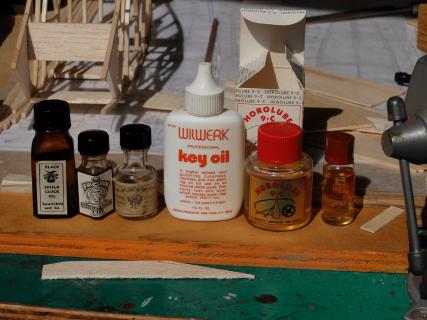
I got back from a long jog down memory lane with my buddy down the street. As usual shooting the breeze is pretty far ranging. We got onto the oils talk and he started pulling out more little bottles than the other day. The other day was applicators. Some of these bottles are really old and he couldn't remember exact age or where he got them. As you can see a couple look really old.
He had some duplicates so he gave me two bottles. One was the little bottle that says "Black Shield Clock Oil" Swartchild and Co. It's on the left in the pic.
When I asked him what he would use on DI's he said the white bottle "WilWerk Key oil" in the middle of pic. That surprised me because he said it's for lubing wind instruments and he had two bottles from when his daughter played clarinet. He said it was "bone oil" and bone oil was what they used on sextants because it resisted corrosion from the salt air and was not gummy. Who knew? And he was under the impression you could buy it in any music store that does rentals for school band or sells band instruments.
I asked him how he knew which oil to use and he said "the smaller the bottle, the smaller the watch to use it on". Ok, makes sense I guess. The one little square bottle says "Fulcrum Bracelet and Watch oil" was what he said he used on those tiny women's watches.
Horolube 9-C was for wall clocks.
I have to revise my story on him. He said he worked for a big co that made all kinds of instruments and movements and was an apprentice for 3 1/2yrs. That blows my mind because they went through the whole process of metallurgy, welding, machining, math, etc and when they finally graduated they went to the shop floor and worked under a journeyman until they were deemed competent. Nobody in biz now fully trains anybody. And you certainly don't get that kind of training in any school I know of.
Attachment 9160
[/QUOTE]So yeah, because of this thread(thanks Brian) I may get some first hand info how an old world tech would do this. And a good excuse to learn some more first hand history. As the Greatest Generation passes they take a huge chunk with them.
Looks like this thread has a life of it's own. lol
Yup. Hope you aren't offended and hopefully it helps others with this kind of repairs to save 2/3's the cost of a new indicator to send it out for repair. Did help me for sure. Thanks again for sharing your work.Quote:
Looks like this thread has a life of it's own. lol
C-Bag, Thanks for taking the time to chat with him and the great story with info on the lubes. Had no idea that instrument lube includes musical ones too. Have to keep and eye out for some of it.
Till Then, ~PJ
heck no I love long threads, and thanks for watching.Quote:
Originally Posted by PJs
BS
Brian, C-Bag, PJs, and Ken,
I learned a lot from this string of written comments and found it very useful. I also have a wonderful saying to quote from C-Bag:
"My neighbor IS an amazing guy. But he's getting up there in years and he's a little like talking to my dad. Kinda like an old tube radio. A little slow and not great reception at first but once he warms up, watch out."
That is a classic and a keeper!
Thank you
Paul
Thanks Paul, and thanks Brian, PJs and Ken.
I did feel guilty about hyjacking this thread but it was crazy how it jumped me down a rabbit hole and I felt compelled to share it with everybody. I appreciate the support of this community.
Thanks to Brian, C-Bag, Paul and Ken for going down this "Rabbit Hole". One of the Best things about this forum to me is that Quantum connection to things I've been thinking about or working on, just showing up and "Allowing" it to unfold, sometimes in surprising ways, with the great people here. I also love that we bring forward some of the old stuff/ways/people with the new, keeping it and them alive and moving forward to the tasks at hand.
Just the Best! Thanks Guys! :beer: :hattip:
Very useful tutorial