 LinkBack URL
 About LinkBacks
I am not sure what the standard name for this fixing is now. I guess we could give it an international standard via homemadetools. Any ideas please post (funnier the better)
The Home Engineer



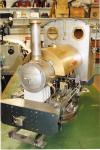

I am not sure what the standard name for this fixing is now. I guess we could give it an international standard via homemadetools. Any ideas please post (funnier the better)
The Home Engineer

Scotch key. Now that rings a bell, must be my Ozzie upbringing.Originally Posted by rasta

Hi All
This post via Wikipedia explains all about different types of keys:
https://en.wikipedia.org/wiki/Key_(engineering)
I also saw this on the web:Dutch Pins: How To? - Page 3
So it appears they are both correct. You never stop learning!A "Scotch key" or "Dutch key" also provides a keyway not by milling but by drilling axially into the part and the shaft, so that a round key can be used. If the key is tapered, it is referred to as a "Dutch pin" and is driven in, and generally cut off flush with the end of the shaft. A Hirth joint is similar to a Spline joint but with the teeth on the butt of the shaft instead of on the surface.
Now I'm curious. I can see "scotch key" meaning "cheap-ass key" but I'm wondering where "dutch" comes from.
-Roland McPhearson (Cheap-ass)
The Home Engineer
Last edited by thehomeengineer; Jan 16, 2018 at 06:16 AM. Reason: Edit text
Captainleeward (Jan 16, 2018), Toolmaker51 (Jan 17, 2018)
I believe 'dutch' might mean practical but workmanlike, alternative method. Once, I had double-hung window sills to replace that had decayed. Upper surface was OK, underside was splintered and ragged. A carpenter told me, make a "dutchman". Unstable pine wood was pared down to solid material by 4" power-saw, chisel and bullnose plane. Then replaced with poplar, then contours were shaped and painted like original. A little tedious working upside down, back in 1981. They are still in place, indistinguishable from original.
I'm not Scottish, but know a few...they are not the stereotypical cheap, they just get a lot of bang for the buck. And unlike some cultures, their products are first rate. True cheapskates don't do that!
Sincerely,
Toolmaker51
...we'll learn more by wandering than searching...
Paul Jones (Jan 18, 2018), thehomeengineer (Jan 18, 2018)
 by RetiredFAE - Browing firearms use this technique to lock screws into place, take a look at the original Browning A5 shotgun and you will see lots of them.
As mentioned, not the strongest lock, but more than adequate on the shotguns. "Pin It")
Browing firearms use this technique to lock screws into place, take a look at the original Browning A5 shotgun and you will see lots of them.
As mentioned, not the strongest lock, but more than adequate on the shotguns.

Hi Gang:
I made a soft faced hammer in trade school, back in 1973. The head and handle were threaded together and I didn't want them to un-screw. So I drilled and tapped for a set screw. Fifty years later the head is still tight. I would think the torque capacity would be quite good. The set screw could be tighter than most square keys are fitted and the shear strength of a hardened set screw should be higher than a mild steel key.
Carl.

There are currently 1 users browsing this thread. (0 members and 1 guests)
 Posting Permissions


 Reply With Quote
Bookmarks