-
1 Attachment(s)
Epoxy nozzle reamers
Two part epoxy is great stuff. It creates strong joints but, more importantly, the individual components will not set up into a solid mass in their containers like many one part adhesives will. They won't set up, that is, as long as you're careful to never let a smidgen of the hardener near the resin container or vice-versa. Like divorces, separation is the key to happiness.
I buy clear two part in the larger containers so maintaining separation is a major issue; the stuff is sort of expensive. Despite the fact that they're separated the narrow nozzles can clog. I don't understand the chemistry so I won't attempt to explain why. A ground down point on a piece of clothes hanger wire will get things flowing again but it's imperative to never use the hardener reamer on the resin container or vice-versa.
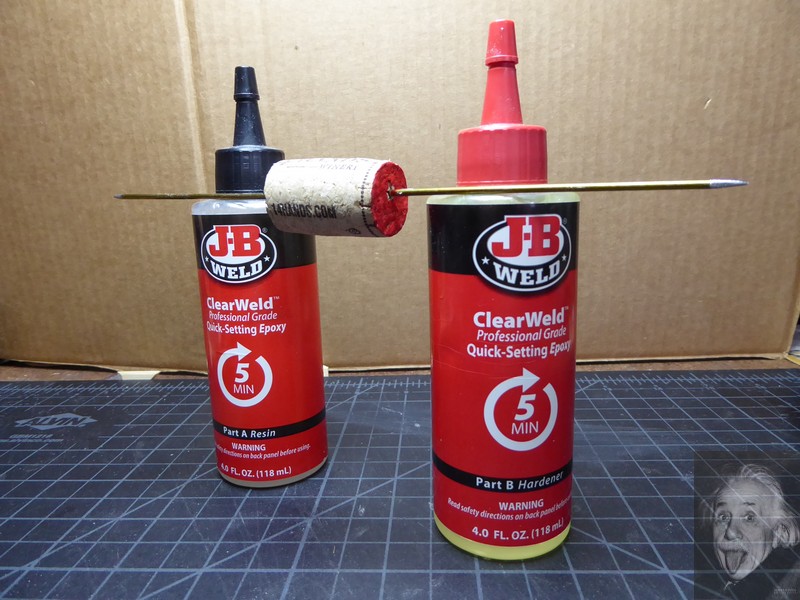
My solution was to drive the wire through a wine cork, then grind points on either end. The ends of the cork were then color coded red and black using Sharpie paint pens. This way the two required reamers are kept together but mechanically separated so they can't epoxy themselves together. The color coding guarantees they will only be used on the appropriate container.
Attachment 45100
-
The lids on these type of bottles really can't be airtight enough to completely stop the evaporation of solvents or the reaction with oxygen, moisture, etc. My guess is that is what causes the tiny drop left in the nozzle to thicken and create a clog. Storing the product upside-down seems to help slow the process in between use. This may or may not be a useful addition to your idea.
I've had some luck doing this to prolong the shelf life of polyurethane glue, which as you mentioned is less stable than two part adhesives.