Free 186 More Best Homemade Tools eBook:  
New: 300+ fresh build posts/day from 275 forums → BuildThreads.com

User Tag List

Page 2 of 2 FirstFirst 1 2
Results 11 to 18 of 18

Thread: Heat Treatment Oven (with separate control cabinet)

  1. #11
    Supporting Member hemmjo's Avatar
    Join Date
    Feb 2017
    Posts
    3,298
    Thanks
    410
    Thanked 2,127 Times in 1,228 Posts

    hemmjo's Tools
    Thanks for the input. Your log is very informative. I just ordered some proper connectors. I am building this furnace using as many of the old parts I have been collecting over the years as possible. Trying to use up the old parts I have salvaged.

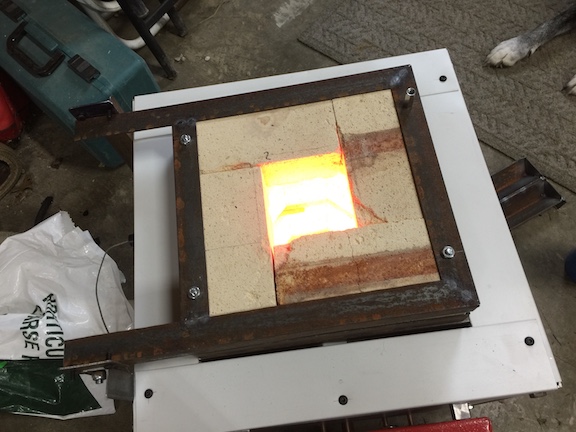
    I just began some preliminary testing of my furnace. It heated to 1200˚f in about 10 minutes, then I shut it off. The high setting draws about 24amps at 240v, about 5700 watts. There is also a LOW circuit which should draw 6 amps at 240v, about 1400watts, but the old contactor I used in that circuit was faulty so I do not have data for that yet. I am going to pause testing until the low circuit is working and the thermocouple connector installed.

    From your build log, the 1400 watts in the 3.5 liter chamber works out to about 410 watts per liter, seems about right. Live and learn, the 5700 watts is over 1600 watts per liter.

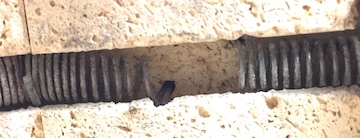
    I shut it down very soon after I removed the vent cap and peeked inside.

    Heat Treatment Oven (with separate control cabinet)-hot-furnace.jpg

    I have another question. My thermocouple has a nice braided steel shielded cable. But it is longer than necessary. Should I cut that cable then use the cut off piece inside the control box from the jack to the controller. Guessing the conductors in that nice cable are special also.

  2. #12
    Supporting Member Dr.Al's Avatar
    Join Date
    Jul 2018
    Posts
    48
    Thanks
    7
    Thanked 171 Times in 26 Posts

    Dr.Al's Tools
    Quote Originally Posted by hemmjo View Post
    I have another question. My thermocouple has a nice braided steel shielded cable. But it is longer than necessary. Should I cut that cable then use the cut off piece inside the control box from the jack to the controller. Guessing the conductors in that nice cable are special also.
    I'm most definitely not an expert, but I think that would be okay to use inside the control box. Just make sure you maintain the polarity (i.e. use the same wire as + on inside and outside) as the two wires will be different materials to each other.
    Metalworking projects site: https://www.cgtk.co.uk/metalwork
    Woodworking projects site: https://www.cgtk.co.uk/woodwork

  3. The Following User Says Thank You to Dr.Al For This Useful Post:

    hemmjo (Apr 8, 2025)

  4. #13
    Supporting Member metric_taper's Avatar
    Join Date
    Mar 2017
    Location
    Marion, Iowa
    Posts
    760
    Thanks
    281
    Thanked 410 Times in 266 Posts

    metric_taper's Tools
    Quote Originally Posted by Dr.Al View Post
    Thanks @metric_taper .

    The Nanodac is the thing that's mounted in the door; the thyristor pack on the DIN rail mount is an EPACK. Both come from Eurotherm, so they're well suited to talking to one another over the modbus TCP link. All that link does at the moment is write a set-point to the EPACK Thyristor pack and read the current back (for display).

    I also don't trust relays, and don't trust thyristors or solid-state relays either! At least with the contactor (which is just a big relay really) it isn't switching as often as the thyristors are so there's a reasonable chance the contacts won't have welded. I do like having the physical switch in line with the heater coils as a belt-and-braces thing though. At least that means I can guarantee that the coils are electrical isolated even if something goes wrong with the contactor. For an overheat event to happen, there needs to have been at least two failures: something going wrong with the thyristor pack and something going wrong with either the over-temperature detection or the contactor. I'm sure that wouldn't be enough redundancy for an aeroplane application, but hopefully it's good enough for a heat treatment oven!
    I was confused as I was seeing a LCD screen controller on the internet search of the product, and failed to look at your front panel holding the system, so I thought you had some micro-package version.
    I have had the SSR fail short, for room temperature heater using a low current controller. I end up using a conventional metal contact thermostat rated for the heater current. That's set up as a high limit off, so like you know, don't cycle current through contacts if you want reliability.
    I worked on the biz jet and commuter size aircraft. The biz jets were the BAE-HS125-800, Falcon 50/2000, SAAB2000, Piagio180, Bombardier RJ50/70/90/100/200 but started with the BeechCraft model 2000 Starship (carbon fiber pusher turbo prop, a dud design), and the BeechJet, which was a Mitsubishi Diamond II, sold to them, and now called a Hawker. they also bought the BAE125-800 jet design.
    The auto pilot I worked on was dual-dual, fail passive. Cant' use that for auto land. The air transport division of the company I worked at, did an early commercial Cat III autoland, that was the BAE L1011, that was triplex design, and analog. That was before my time, that morphed to digital, and they used the microslice 2900 chip set with their custom microcode. I was told they spent $8meg in 1980 dollars doing a verification analysis. But those guys/gals in air transport were in a different world of safety compared to my lesser pee-on division. Boeing became their #1 customer, and Airbus locked any content out of their airframe. The only saving thing was customers wanted Collins Radios, the name sake of the companies product line. When I left they were buying Ethernet data switches.
    So those two Boeing 737 Dash 8 that went down, that was pilot error, and a stupid design that fails any safety analysis. Our FAA, your JAA/(EU equivalent) requires pitch trim runaway to be an critical level of design prevention. So avionics uses the nuclear safety method of fault tree analysis, and adding up components in parallel or series to get the failure rate of 1 per million hours of operation for a pitch trim runaway. Having two weeks apart not good. But Boeing, let the pilot always fly the airplane. If these dumb underskilled pilots would have done that (one did, recovered, then reengaged to crash into the ground), they could have flown all the way to their destination. This underskill is a real problem. Many accidents where they want to use autoland all the time, and can't do a real landing outside a simulator. The real problem was the lack of annunciation of the AOA sensors (angle of attack), confusion with underskilled software subcontractor computer science educated, and no mentoring on safety. The specification was messed up, as some idiot at Boeing wanted to charge for some display feature. It was a major change to the airframe flying machine, and should have required training and instructional input at a minimum. That problem of safety at Boeing came from when they bought Mcdonald-Douglas, which was a reversal of management, and different safety ideas. The old guard safety people of the original Boeing were overkill. Airbus does not have this same mentality, and it has it's own issues. They take control from the pilot, so it's philosophy thing.

  5. #14
    Supporting Member hemmjo's Avatar
    Join Date
    Feb 2017
    Posts
    3,298
    Thanks
    410
    Thanked 2,127 Times in 1,228 Posts

    hemmjo's Tools
    Dr. Al, I have another question. In short, did you have to heat your Kanthal A to form your elements?

    Background;

    During testing, I burned out my elements. Live and learn. I had 4 elements, each 10Ω with 2 pairs wired in series for 20Ω, 240v, 12A 2880W each. 5760W total stuffed into my little furnace. The elements were 25ft (7.60m) of 18ga (1mm) Nichrome 80. The 4 elements were dictated by the grooves already cut into the fire brick I recovered from an old ceramic kiln.

    Heat Treatment Oven (with separate control cabinet)-element-termination.jpeg

    I had my control box wired with high and low circuits. Low operated at 120V for a total output of 1440 watts. While this worked and came up to temperature in about 30 minutes with an empty chamber, when it came to actually melting aluminum, it took a long time to provide that addition heat to transition to liquid. It was painfully slow to add additional material to the crucible, then bring that up to temperature, add more, wait repeat in order to get a near full crucible. (I have several large barrels filled with crushed aluminum cans I have been collecting for this)

    Knowing the high setting risked burning out the elements, but also knowing i had to remake them anyway, I tried it. It was wonderful. I could just keep putting feeding cans into the furnace, until it started "buzzing", like angry bees, after about 30 minutes. Then, stopped heating.

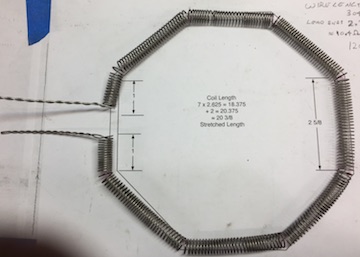
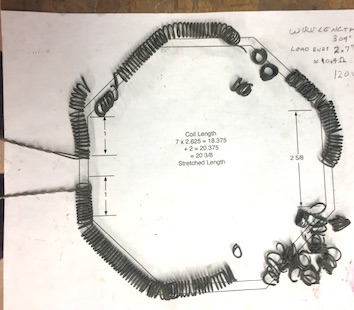
    As formed
    Heat Treatment Oven (with separate control cabinet)-formed-element.jpg

    Installed
    Heat Treatment Oven (with separate control cabinet)-element-place.jpg

    As removed
    Heat Treatment Oven (with separate control cabinet)-damaged-element.jpg

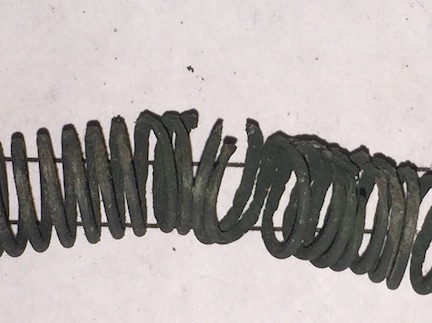
    Shorted, welded, burned out
    Heat Treatment Oven (with separate control cabinet)-welded-element.jpg

    Failure analysis shows I did not have enough space between turns. The elements expanded, shorted, burned through, welded back together, repeating until they could not take anymore. I tried to stuff too much wire into not enough space. I guess if you don't push limits, you don't know where they are.

    My intended solution is 4 elements, 5Ω each, connected in series for 20Ω, 240V, 12A 2880W on high. Low would be 120V, 5A, 720W.

    While investigating Kanthal A for the new elements, I found a site (https://shop.machinemfg.com/nichrome...he-difference/) with a nice write up comparing Nichrome to Kanthal.

    From the site, I see this comparison, "Kanthal holds its shape well, making it easier to create consistent coils, though it requires higher temperatures to become malleable. Nichrome is easier to bend and shape at room temperature, making it preferred for intricate coil designs and applications requiring precise shaping."

    I have the elements from the old kiln that donated firebrick, but they are very brittle. I had assumed that was from repeated firings over many years.

    While the gauge is much too large for my furnace, I am curious, did you have to heat your Kanthal A to form your elements?

    Thanks for your detailed build log. I have added an over temperature cut off power in case the SSR fails as you mention. I had no idea that could be an issue.
    Last edited by hemmjo; Apr 12, 2025 at 06:55 AM. Reason: image did not post

  6. #15
    Supporting Member Dr.Al's Avatar
    Join Date
    Jul 2018
    Posts
    48
    Thanks
    7
    Thanked 171 Times in 26 Posts

    Dr.Al's Tools
    Hi @hemmjo .

    I had a somewhat variable spacing between the coils but it was of the order of 5 mm at a guess. You definitely need enough to stop it sagging and closing up: the way I stretched them out was to hold them vertically and gradually move a blowtorch down the length (which heated them up enough to anneal and then they sagged under their own weight). I'd originally planned to make a chamber that could be oriented horizontally for heat treating or vertically for casting, but it quickly became clear that the element would sag if it wasn't supported along its entire length and that made a dual-orientation chamber impractical.

    I used a much thicker gauge wire than you I think (which also gives more chance of resilience and longevity). According to my look-up table, 18 gauge wire is 1 mm diameter, whereas I used 1.4 mm wire so 40% thicker.

    Regarding heating to form the elements, Kanthal A1 work hardens. That means that it starts off soft but as you form it into the coil it becomes hardened. You can get a certain amount of coiling done before it hardens and then you have to heat it up to get it to be workable again. In my case I managed to form the coils without doing any annealing, but then had to heat the coil up to be able to form the ends and also to be able to stretch the coils out.

    If I did it again, I think I'd form it at a wider spacing in the first place, although that would limit the maximum length of each individual coil section.

    I've heard that one way of spacing the coils and leaving them in an annealed state is to stretch the coil along a concrete (or other heat-resistant and non-conductive) floor and then pass current through the coil to cause it to heat up enough to anneal itself.
    Metalworking projects site: https://www.cgtk.co.uk/metalwork
    Woodworking projects site: https://www.cgtk.co.uk/woodwork

  7. #16
    Supporting Member hemmjo's Avatar
    Join Date
    Feb 2017
    Posts
    3,298
    Thanks
    410
    Thanked 2,127 Times in 1,228 Posts

    hemmjo's Tools
    Thanks, that is good information. I was limited to 18 gauge nichrome due to lack of experience and trying to get the resistance up and the current down.

    Giving a good look at Kanthal, the higher resistance will let me with 16ga, 1.3mm. I should be able to turn my new elements with very close to the proper space, to eliminate the need to stretch them much at all. Then I may have to open up the grooves in the firebrick a little.

    Found this online wire gauge chart. https://www.rapidtables.com/calc/wir...uge-chart.html

  8. #17
    Supporting Member tonyfoale's Avatar
    Join Date
    Nov 2016
    Location
    Spain
    Posts
    1,819
    Thanks
    834
    Thanked 3,235 Times in 909 Posts

    tonyfoale's Tools
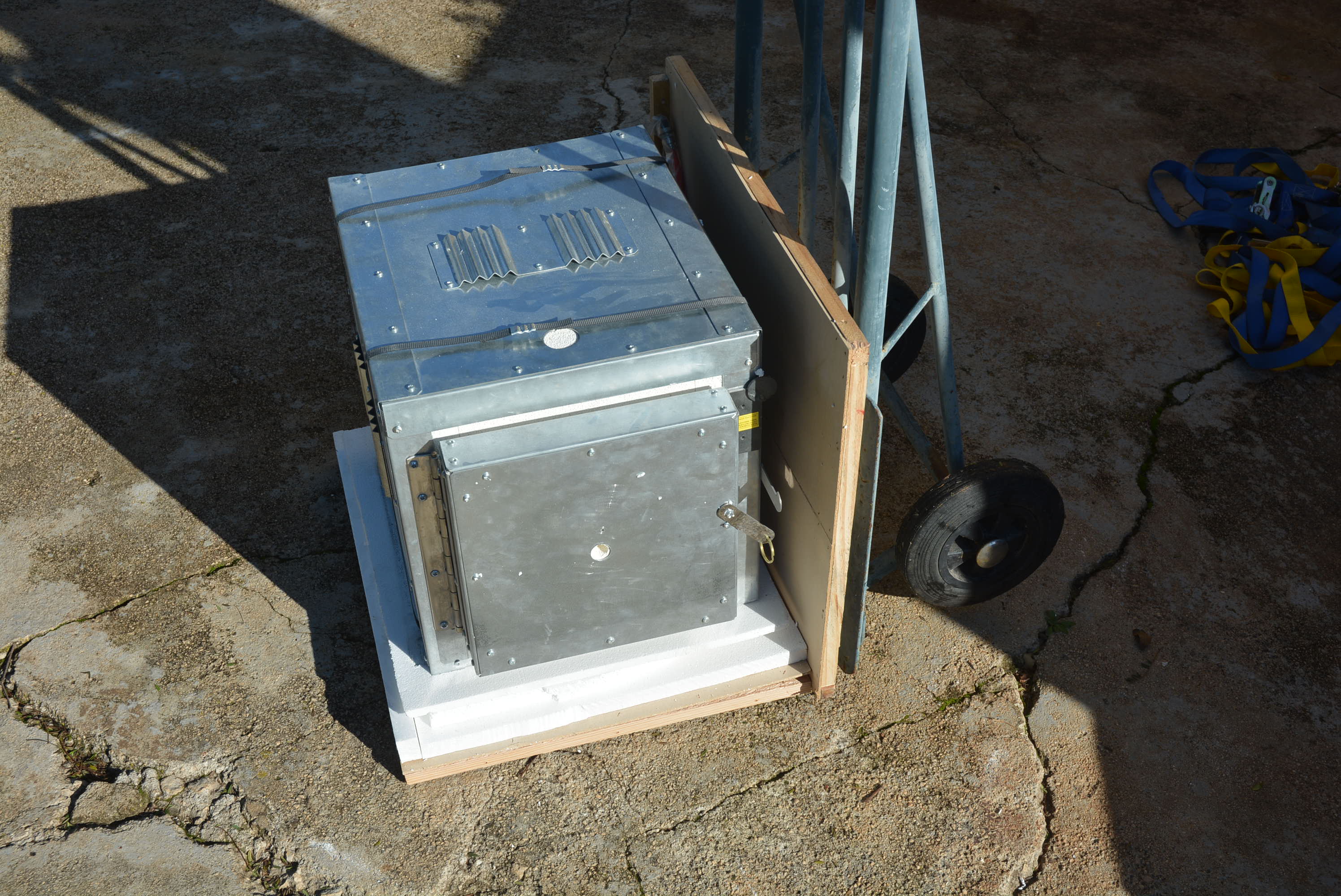
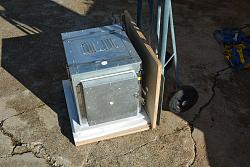
    I was saved the trouble of making an oven as planned. Santa was kind enough to send me a bought one. 200 x 200 x 300mm.
    In initial testing I set the controller to 100 C and let it stabilise for 2 hours. I then put various thermocouples that I had in through the peep hole on the door and let them stabilise. I consistently got 112/113 degregardless of the depth of insertion. 12/13 deg difference to the control sensor at 100 C is unacceptable, especially for steel tempering.
    Therefore I am thinking of adding a fan to even out the temperature. I am thinking about mounting a motor on the outside of the door with a shaft passing through the peep hole to a fan inside. Has anyone here had experience with forced circulation in benchtop size ovens?
    Heat Treatment Oven (with separate control cabinet)-dsc_6442.jpg

  9. #18
    Supporting Member
    Join Date
    Dec 2022
    Location
    Midwest US
    Posts
    389
    Thanks
    261
    Thanked 287 Times in 170 Posts

    ductape's Tools
    Quote Originally Posted by tonyfoale View Post
    I was saved the trouble of making an oven as planned. Santa was kind enough to send me a bought one. 200 x 200 x 300mm.
    In initial testing I set the controller to 100 C and let it stabilise for 2 hours. I then put various thermocouples that I had in through the peep hole on the door and let them stabilise. I consistently got 112/113 degregardless of the depth of insertion. 12/13 deg difference to the control sensor at 100 C is unacceptable, especially for steel tempering.
    Therefore I am thinking of adding a fan to even out the temperature. I am thinking about mounting a motor on the outside of the door with a shaft passing through the peep hole to a fan inside. Has anyone here had experience with forced circulation in benchtop size ovens?

    Click image for larger version. 

Name:	DSC_6442.JPG 
Views:	46 
Size:	989.1 KB 
ID:	50237

    Some of those ovens have a calibration adjustment in the controller. Not sure if that model does.


    Download plans for knife making tools.


Thread Information

Users Browsing this Thread

There are currently 1 users browsing this thread. (0 members and 1 guests)

Bookmarks

Posting Permissions

  • You may not post new threads
  • You may not post replies
  • You may not post attachments
  • You may not edit your posts
  •