Hi group. Registered to find some cool stuff and hopefully contribute something worthwhile.
-zach

Printable View
Hi group. Registered to find some cool stuff and hopefully contribute something worthwhile.
-zach
Hi zach - welcome to HomemadeTools.net :welcome:
What are your hobbies?
Hi Jon, a little bit of everything, really. Mostly automotive related things though. I'm always being kept busy with my 65 Lincoln so I'm on here to see what kind of tools and tricks I can pick up. I stumbled upon the site while looking for a DIY solution to get clean, dry air into and out of my compressor. Store bought stuff is always so expensive! I like to see reasonable solutions from regular folks!
Did you solve the compressor issue? Need a hand with anything?
No, I haven't come up with a solution yet. I am trying to get something together to get as much moisture out of the air before it goes into the tank. So, basically, an aftercooler. If you know of any good ones, post up some links!
I'm going to move this one into our Tools in Progress subforum, so you can get some member feedback.
Quote:
Originally Posted by Livyx
Check this out. https://www.youtube.com/watch?v=w8lO7FS7qTA
It's tough to get the moisture out between the pump and tank as you have to provide a place to collect and drain off the moisture, as well as significantly cool the air to condense the water vapor into a liquid, but you really don't want the air to be below the ambient temperature when it's ready for use....Quote:
Originally Posted by Livyx
I might start by trying to find a scrapped out portable pancake or submarine compressor, like a contractor would use for a nailer, and grab the 2-gallon tank to use as the collection tank, and the condensor from a car air conditioning system. Mount the condensor so your compressor cooling fan is drawing air through it first, then pipe the air from the pump into the small tank into a stand-pipe protruding about 1/3 of the way into the tank and pulling the air right out the top. Add an automatic drain to the bottom and water separator(s) to the outlet line from the main tank.
All-in-all, I don't know if I'd go to this much trouble unless I lived in the swamps somewhere.... what I'd typically do is mount some loops of baseboard radiation to a sheet of plywood on the garage wall and let gravity go to work with drains from the bottom of each loop at the bottom. Add a water separator and that's usually good for most climates.
Check out powder coating forums.Those guys come up with some pretty neat DIY set ups to keep moister out of their power guns.
Here is a post that I added to hotrodders.com.
New compressor
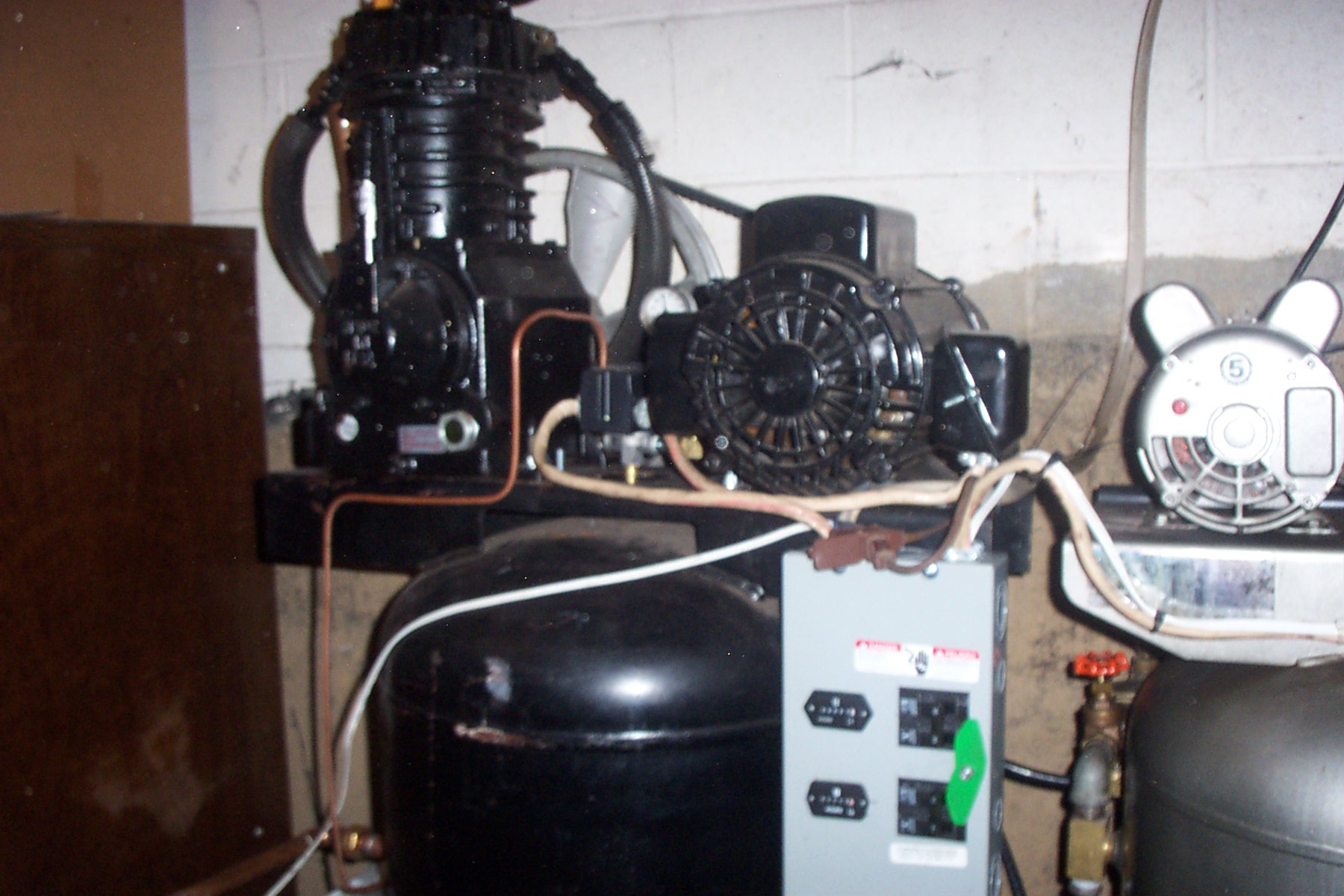
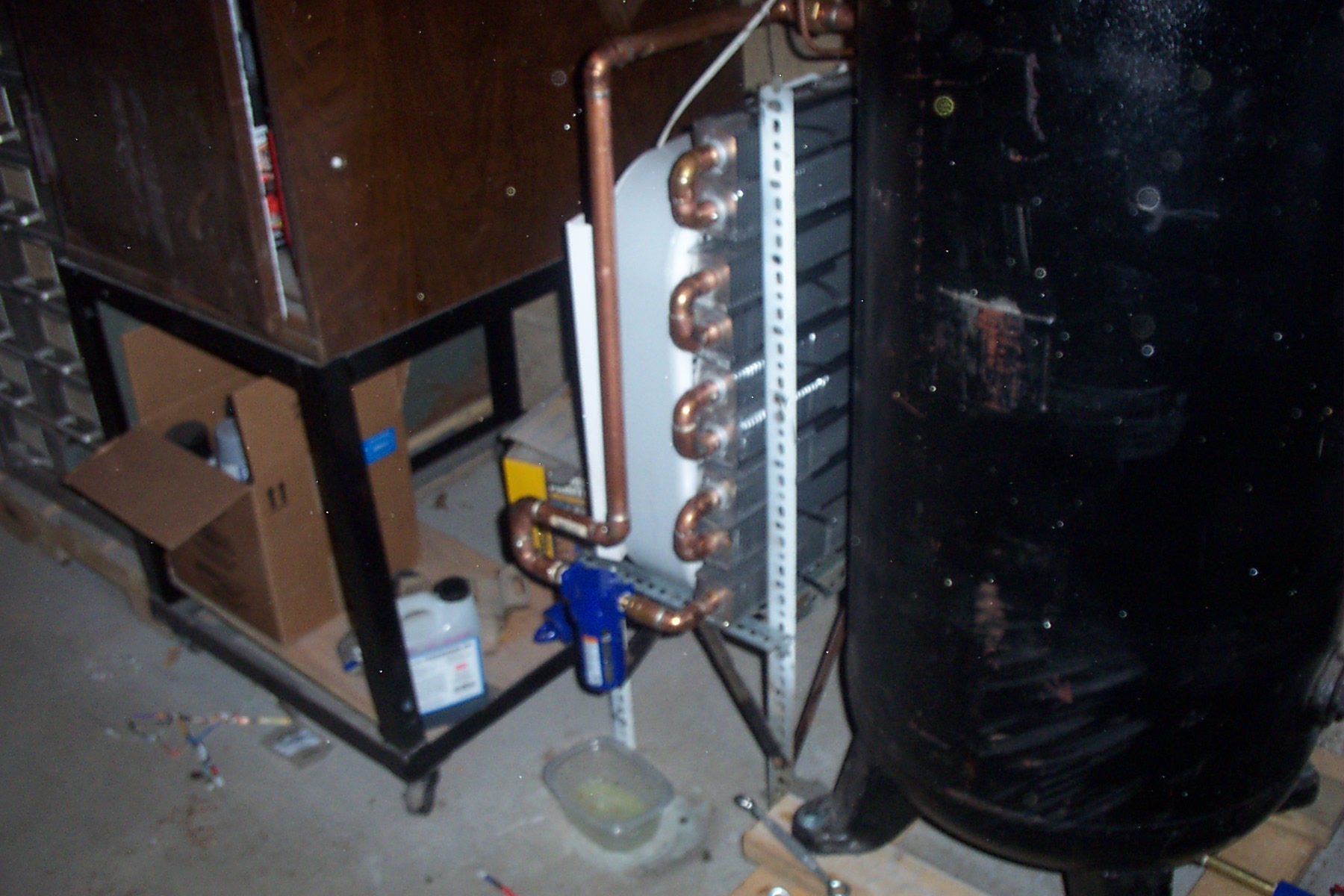
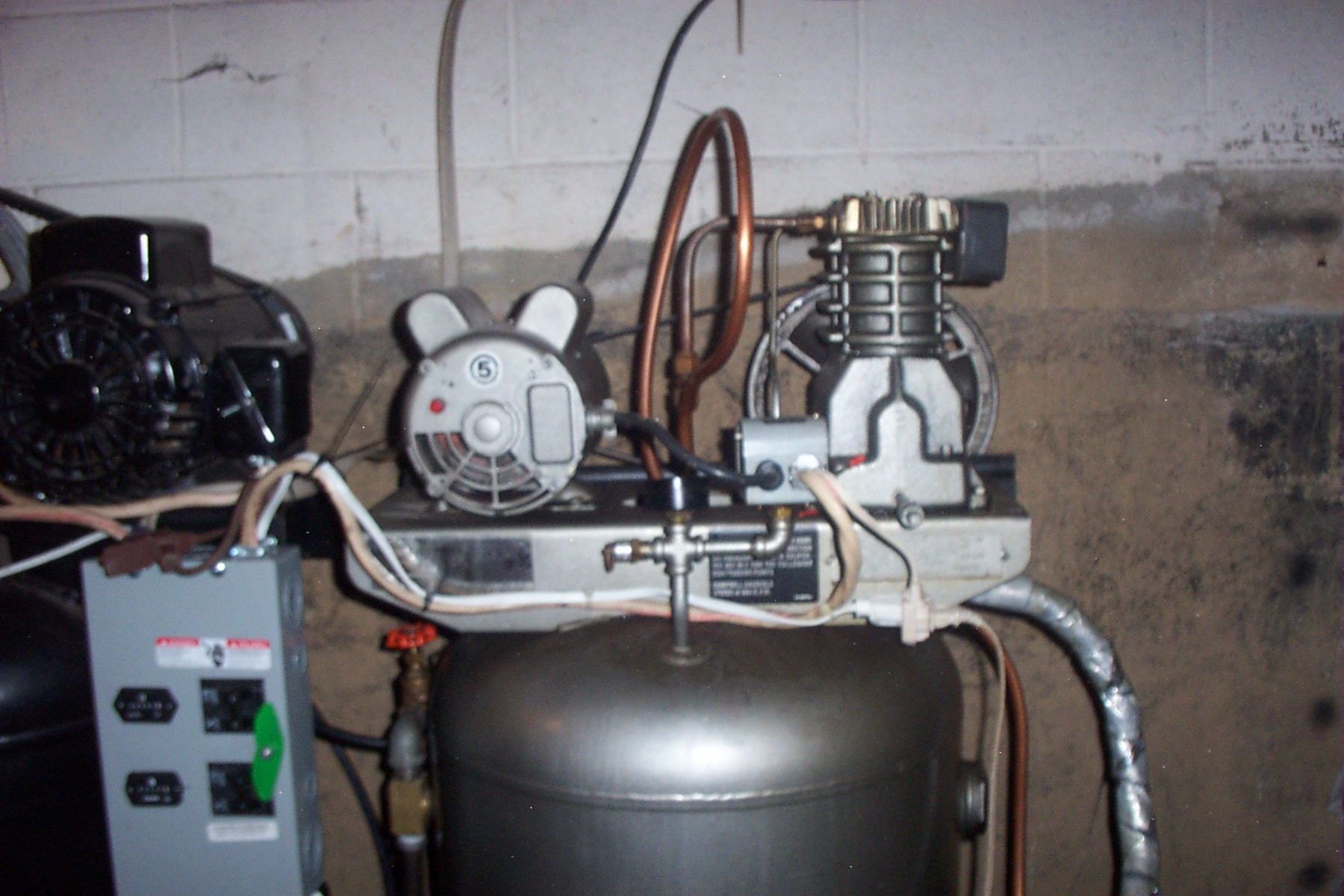
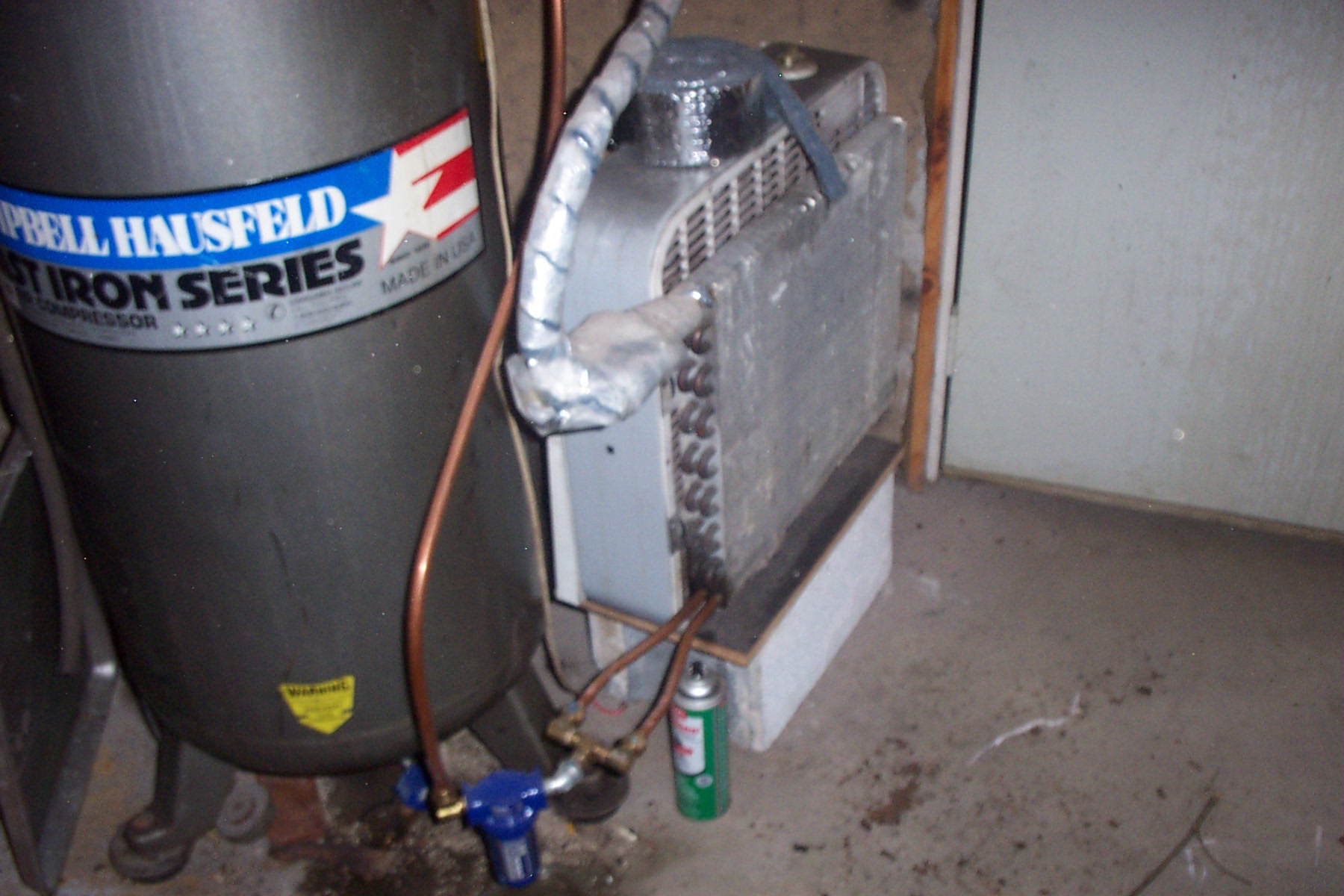
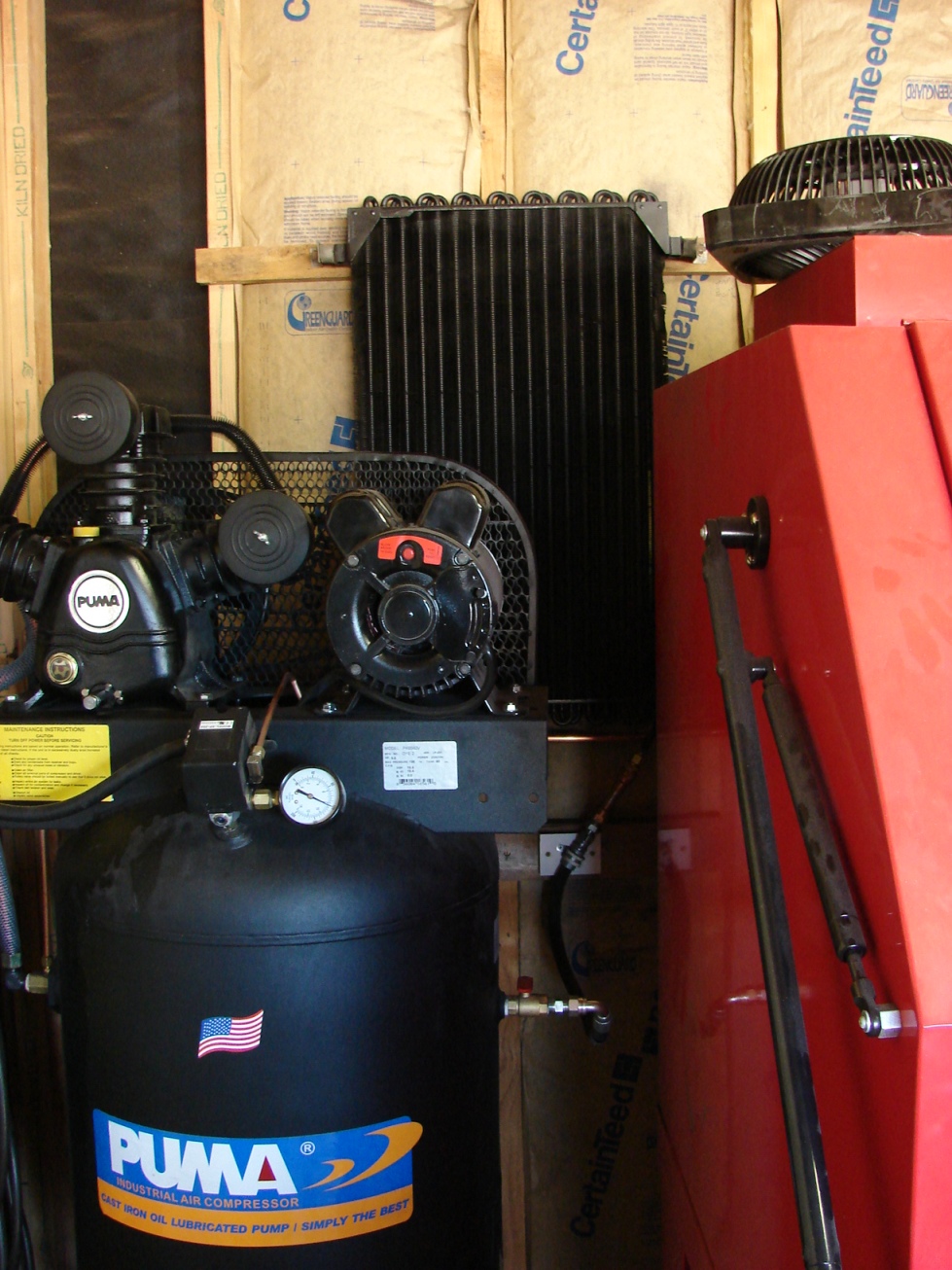
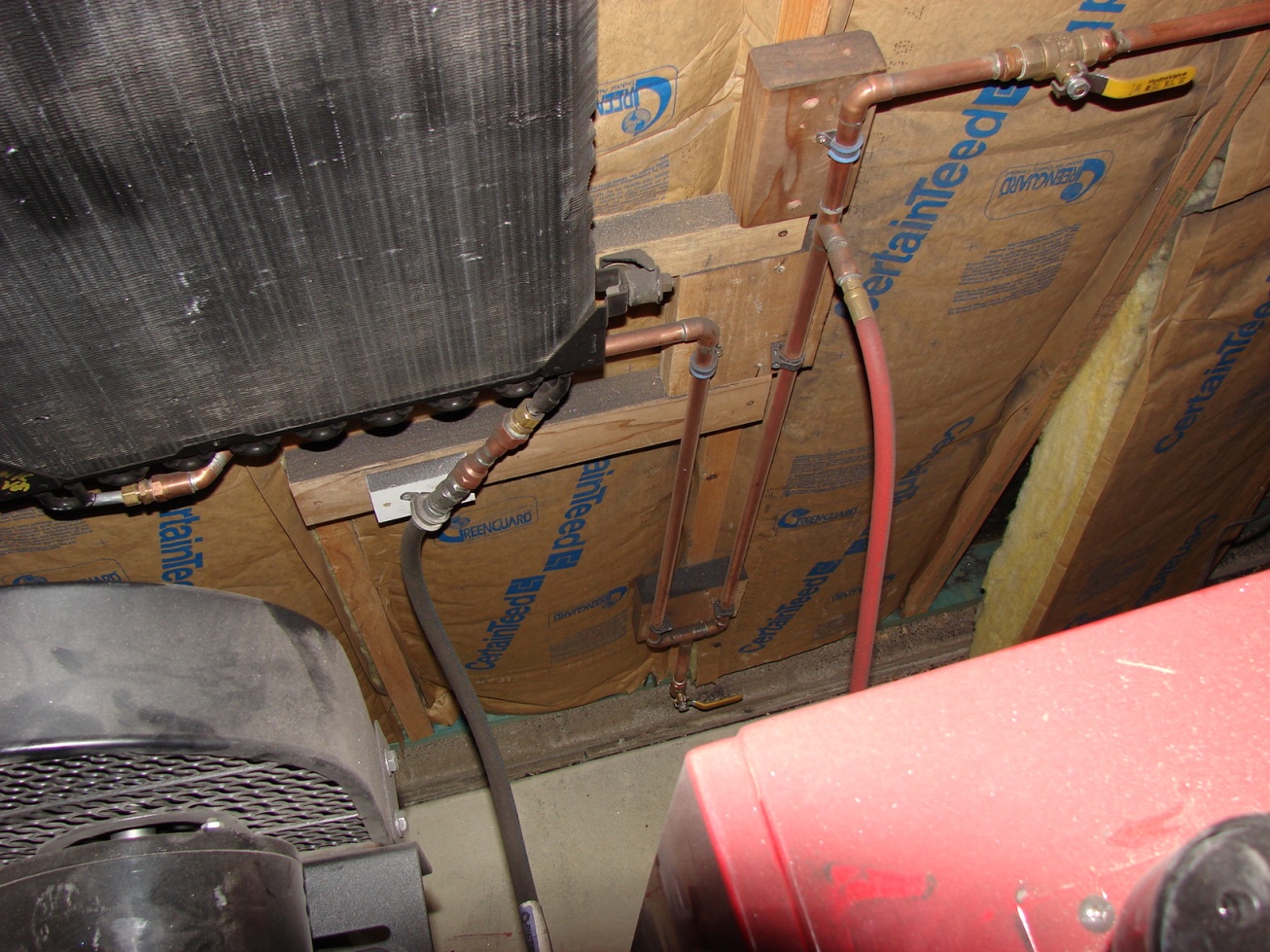
I picked up this 2 stage air compressor off e-bay. I added an automotive AC condenser to my old compressor and it worked quite well, so I added the home made condenser to the new compressor. It is simple but effective. The condenser is on the unloader side of the system, and when the condenser bleeds off air down to about 5 psi the filter opens and spits out any water in the system. Thus the little container to catch the water.
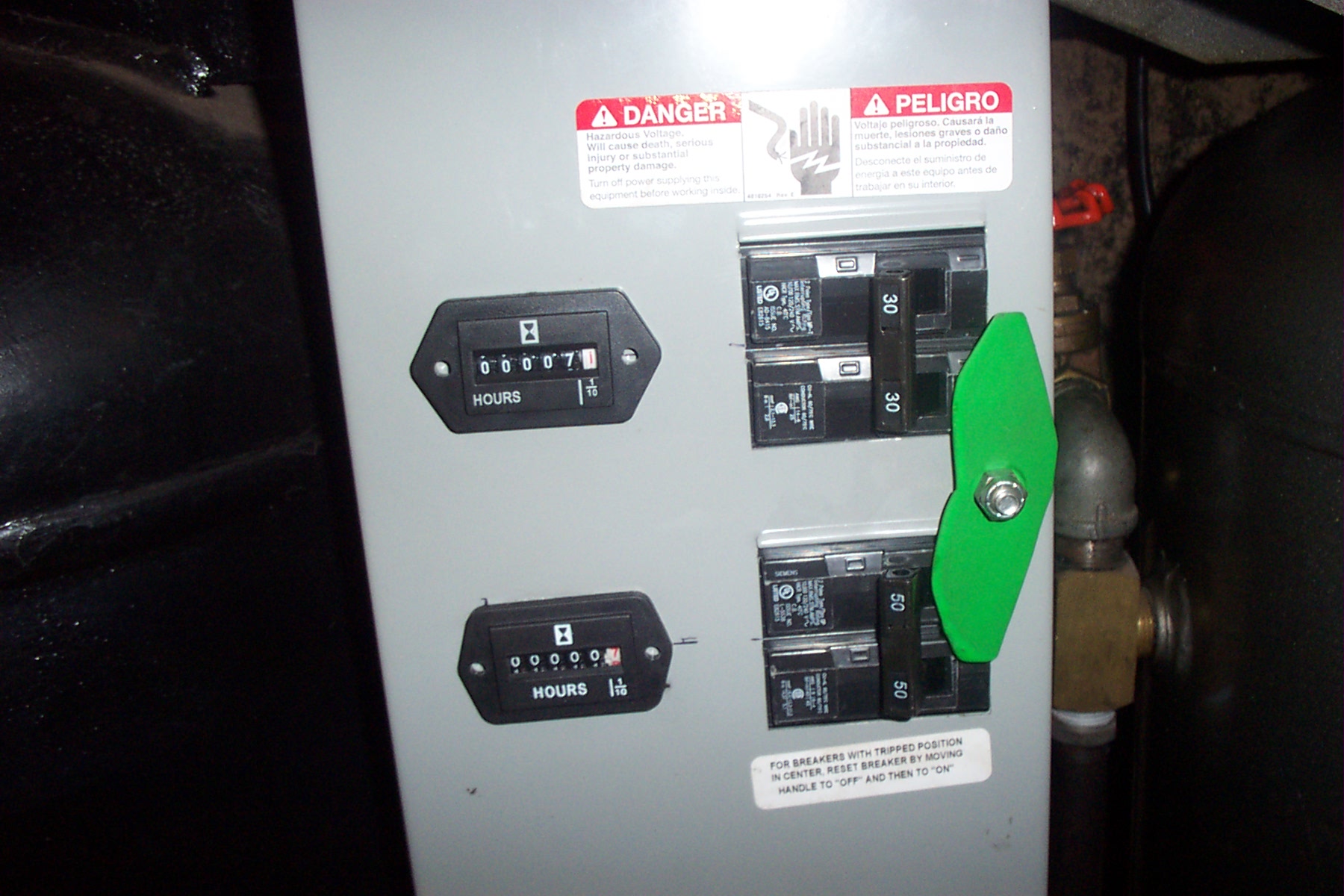
Since I kept my older compressor I installed a set of circuit breakers with a flipper between them so that only one can be turned on at a time. I also added the hour meters to keep track of service time.
What I used was an AC condenser off a car. I rerouted the compressor to tank line through the condenser and an air water separator I got at Lowe’s. I use the Lowe’s air water separator as at low pressure they will dump the water. I also added a 20” box fan to the back of the condenser and wired it into one lead of the compressor switch, so the fan would turn on whenever the compressor ran.
I later bought a 2 stage compressor and built a condenser out of ¾” baseboard radiator tube.
I can get more photos if needed.
Attachment 14231Attachment 14232Attachment 14233Attachment 14234Attachment 14235
I've been working on the same issue. From what I've read and been able to figure out on my own, the only effective way to dry the compressed air is to cool it first. That is why they build expensive air cooling machines for this purpose. I also don't want to spend a fortune to do this. My idea is to use a college size refrigerator to build one. I would run the line directly from the compressor head into a coil inside the refrigerator. I would run the coil through a water, tank inside the refrigerator, to take advantage of the liquids ability to remove heat much faster than a gas.Quote:
Originally Posted by Livyx
Next the pressure line would run from the coil, outside of the fridge, into a drying canister. I would build the canister myself, because I want it to be much larger than standard sizes are, but one could purchase one. HF sells a divilbiss knockoff that I have used with good success.
Finally the pressure line would run from the canister into my compressor tank. That way, the moisture is gone before it gets to the tank, and the air is cool in the tank, which should give the tank a slightly larger capacity.
The only problem I can think of, is that the refrigerator would have to turned on all the time, to maintain the temperature of the water. It shouldn't raise your electric bill much, but I'm sure it will be noticeable. Right now, this is all theory for me, but when I get a chance, I think I will try it. If anybody can improve on this idea or give me a reason why it wouldn't work, please let me know.
Hi,Quote:
Originally Posted by chief36chevy
I was asked by Jonathon if I could assist with this issue. I only have a very basic solution but it works.
I can't comment on your efforts above from experience however, as we know compressed air leaving the receiver is hot and dry, as the air cools it condensates and this is where we get our moisture.
The first mistake some people make here is to have their regulator too close, therefore the moisture is still trapped in the air and passes through.
The cheapest trick I know that does work is to run around 20 foot or so of air line from the receiver to the first basic cheap water trap. By the time the air has reached the trap it should have sufficiently cooled to separate the moisture from the air and therefore the moisture should remain in the trap.
From the trap run a section of air line to a second basic cheap regulator combined moisture trap. This method is as cheap as you can get, very simple and as long as your compressor is in good condition it should pretty much solve the moisture issues.
I use mine for show class auto panel and paint work. I also have a domnick hunter air dryer unit installed at the end of my setup BUT I have never seen a drop of moisture come from this unit. I have had it for several years now, I think it cost me about $500au.
It also helps to have the first trap at a lower elevation than the second regulator. It's harder for the water if any gets through the trap to travel up hill. Let me know your outcome or what you think.
In my situation regarding this type of topic another issue is airbourne Humidity. On days where the humidity is high it is very important for me to warm the area of the job to dry out any moisture that may be present. For this I use a heated booth or heat lamps for smaller jobs.
I don' know if this information has been of any use to you, but I hope it has.
johnm
Link please?Quote:
Originally Posted by Loose Ctrl
Quote:
Originally Posted by C-Bag
http://powder365.com/forum/index.php
It's been a while since I have been there.Reading around, and a search, should turn up the info.
I used an auto AC condenser and it works very well installed after the tank. Picked it up from a junk yard for 20 bucks and just needed two standard compression fittings from the hardware store to install it. I also use seperate water separators at the end of each line before any tool. The drop right after the condenser collects plenty of water but no other separator has seen even a drop so far and I've tested it over the entire summer. Some said a condenser would be too restrictive but I've had no problem with the blast cabinet or any HVLP paint gun I've used. I have an electric radiator fan that I thought would be needed but so far it doesn't seem necessary for the condenser. I mounted the condenser in line with the compressor motor so the fan could also aid in cooling it as well so I'll probably install it before next summer.
Attachment 14243 Attachment 14244