
 LinkBack URL
 About LinkBacks

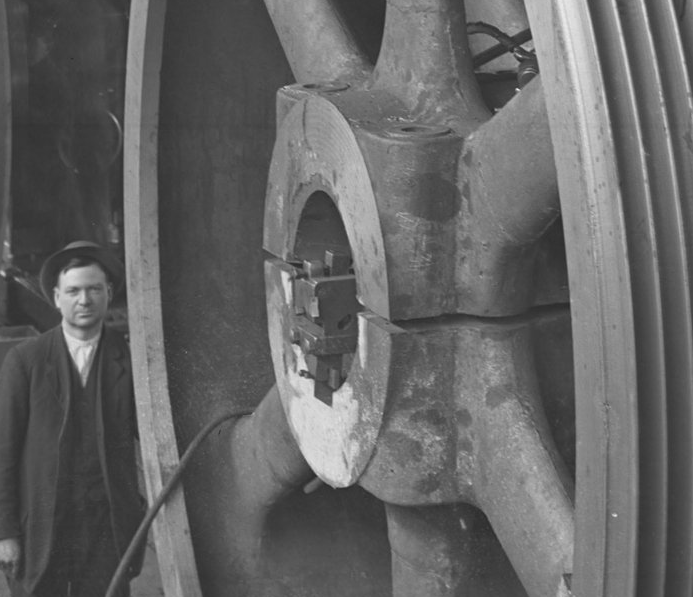
Exactly right, but only the hub, there aren't spokes across the center.Originally Posted by hemmjo

The cutter head has a tapered arrangement with set screws to control depth. Boring a split hub is common, the gap is shimmed and clamped, the same torque on fasteners secures on shaft at installation.
It looks like a boring mill, so must be using the quill Z axis as a broach, like a lathe chucked part, cutter driven by carriage. Possibly, that era had a mechanism to run the quill in and out without rotating spindle?
However, can't imagine a spindle within a square quill, I believe the machine is a shaper.
An alternative would Z the table; but this is a floor machine, not table type. Floor machines are considered 'portable', they secure the column at the part, the 'floor' actually is a giant Tee slotted plate. Dialing in a part, isn't a couple handles like a Bridgeport.
Along with all that, the bore could have been done in a vertical lathe. The casting has been turned, those grooves ain't cast, an concentricity included. Biggest I've heard of was 33'; if man in picture is 5'5'', that's an 16' to 18' sheave.
But, here's a 42' Industrial History: Big Machine Tools
https://newatlas.com/the-citroen-che...3868/?amp=true



 Reply With Quote

Bookmarks