Free 186 More Best Homemade Tools eBook:  
New: 300+ fresh build posts/day from 275 forums → BuildThreads.com

User Tag List

Page 1 of 4 1 2 3 4 LastLast
Results 1 to 10 of 37

Thread: Home built Heat Treating Oven

Hybrid View

  1. #1
    Supporting Member anthonyget's Avatar
    Join Date
    Oct 2019
    Location
    Kelmarsh, UK
    Posts
    89
    Thanks
    32
    Thanked 162 Times in 42 Posts

    anthonyget's Tools

    Home built Heat Treating Oven

    This has been a real tough one. Here is part one of my home made electric steel heat treat oven.
    I have researched loads of different designs and builds. Here is the one I believe is best suited to guys who have limited equipment and avoids the over engineered models out there. Tell me if you agree/dont agree.

  2. The Following 9 Users Say Thank You to anthonyget For This Useful Post:

    clydeman (Jun 8, 2020), DIYSwede (Jun 7, 2020), gogs26 (Jun 8, 2020), high-side (Jun 11, 2020), Inner (Jun 8, 2020), Jon (Jun 8, 2020), mwmkravchenko (Jun 8, 2020), n9dug (Jun 9, 2020), Saltfever (Jun 9, 2020)

  3. #2
    Supporting Member DIYSwede's Avatar
    Join Date
    May 2019
    Location
    Stockholm, Sweden...
    Posts
    637
    Thanks
    424
    Thanked 880 Times in 340 Posts

    DIYSwede's Tools
    -Thank you for a well made video! Nicely presented considerations and executions.
    Also, thanks for the crucial warning regarding the dust produced and the necessity for a face mask.

    Being in a "Furnace-planning mode" myself, I've just got a few tips:

    1) Blocks can be soaked in water before cutting, (temporarily) keeping the free dust down.

    2) Kanthal A-1 wire has higher temp, longer life, (higher prize) but it also assumes:

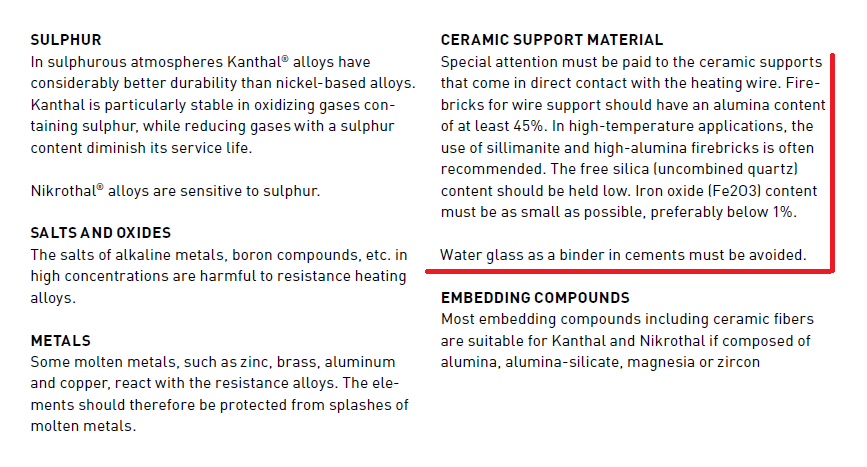
    3) Using the "26" type of blocks is absolutely recommended, as their alumina content is higher than lower grades
    (which can be seen from the Kanthal Handbook
    https://www.kanthal.com/globalassets...41-b-eng.pdf):

    Home built Heat Treating Oven-kanthal-handbook.png

    4) As they also simply say: "Water glass as a binder in cements must be avoided."

    I guess they mean avoided entirely in the oven, as the fumes seems to deteriorate the Kanthal wire over time.
    Which really is a PITA, as water glass/ sodium silicate is convenient, readily available and cheap.

    Just my 2 cents, and YMMV.
    Eagerly awaiting your next project videos!

    Johan

  4. The Following User Says Thank You to DIYSwede For This Useful Post:

    anthonyget (Jun 7, 2020)

  5. #3
    Supporting Member anthonyget's Avatar
    Join Date
    Oct 2019
    Location
    Kelmarsh, UK
    Posts
    89
    Thanks
    32
    Thanked 162 Times in 42 Posts

    anthonyget's Tools
    Hi Johan,
    That's brilliant, thanks so much. I didn't even know that what I was mixing was known as liquid glass. As soon as I read it I realised. Getting a bit slow with age.
    I wish I had known that before I did it, but I guess I will now be able to observe its effects! At least my design allows for an easy replacement of the coil. Also great tip about soaking the bricks.
    Thanks again, Nick

  6. #4
    Supporting Member DIYSwede's Avatar
    Join Date
    May 2019
    Location
    Stockholm, Sweden...
    Posts
    637
    Thanks
    424
    Thanked 880 Times in 340 Posts

    DIYSwede's Tools
    Sharing is the way to go forward - none of those tips were originally my own.
    I can merely read and have a decent memory (for my age).

    AFAIK - the need for high alumina content of the "26" bricks (as to compared with lower temp grades),
    are that the content forms a greyish Al2O3 protective oxide cover on the A-1 wire when glowing,
    thus prolonging the life span of the wire.
    This is particularly true when running the oven/ kiln up to and above 1300C,
    where the wire really begins to suffer, and where the sodium silicate would become more detrimental.

    Water glass is usually one of my go-to materials (as a cement binder, water & fire protection, glue etc),
    and it would've darned useful for (cheaply) reinforcing these "26" series fire bricks...

    When my own melting foundry/ heat treatment facility (4 kW, 400 VAC 2-phase) eventually will be built,
    I guess I'll have to live with the bricks' brittleness w/o any Na-silicate mortar,
    having a thin stainless plate as a protective bottom?

    Without intention of hi-jacking your thread:
    I haven't actually found any suggested mortar for Kanthal A-1 & "26"-grade bricks anywhere...
    -Any other readers here that have done so - please pitch in!


    Cheers
    Johan

  7. #5
    Supporting Member anthonyget's Avatar
    Join Date
    Oct 2019
    Location
    Kelmarsh, UK
    Posts
    89
    Thanks
    32
    Thanked 162 Times in 42 Posts

    anthonyget's Tools
    One good thing is that my oven will never need to go as high as 1300C, Probably 900C max.

  8. #6
    Supporting Member anthonyget's Avatar
    Join Date
    Oct 2019
    Location
    Kelmarsh, UK
    Posts
    89
    Thanks
    32
    Thanked 162 Times in 42 Posts

    anthonyget's Tools
    Johan, maybe you can help me with something. I know I bought the wrong thermocouple and I am waiting for the correct one to arrive.
    But I set my oven to 600C and put an old file in there. When the oven got to 600C, I opened the oven and the file was bright red hot, and my infrared thermometer read 800C.
    How can it be that wrong? Any thoughts?

  9. #7
    DanCom's Avatar
    Join Date
    Dec 2016
    Posts
    14
    Thanks
    1
    Thanked 18 Times in 7 Posts
    Quote Originally Posted by anthonyget View Post
    One good thing is that my oven will never need to go as high as 1300C, Probably 900C max.
    I would recommend setting your sights on about 1100°C for a top end temp. Many popular cutlery stainless steels require a soak at or around 1060°C. 13C26, Elmax, 154CM, CPMS35VN etc.

  10. The Following 2 Users Say Thank You to DanCom For This Useful Post:

    anthonyget (Jun 9, 2020), metric_taper (Jun 9, 2020)

  11. #8
    Supporting Member anthonyget's Avatar
    Join Date
    Oct 2019
    Location
    Kelmarsh, UK
    Posts
    89
    Thanks
    32
    Thanked 162 Times in 42 Posts

    anthonyget's Tools

    Fixing my mistakes

    Hi Johan,
    You were so right about a lot of things. I have had to rebuild most of my oven. I wanted to thank you for your advice.
    This is what makes these blogs so generous. Thanks again.


  12. The Following 2 Users Say Thank You to anthonyget For This Useful Post:

    DIYSwede (Jul 13, 2020), Jon (Jul 11, 2020)

  13. #9
    Supporting Member DIYSwede's Avatar
    Join Date
    May 2019
    Location
    Stockholm, Sweden...
    Posts
    637
    Thanks
    424
    Thanked 880 Times in 340 Posts

    DIYSwede's Tools
    Thanks for your confidence, hope I won't botch it!
    Short answer: Trust the thermocouple - be wary of the IR thermo until you've figured out and applied this:

    // EDIT: You wrote "the wrong thermocouple" -
    did it max out at 600 C and the oven trampled on upwards, or what's the couple's upper limit?
    I guess tool steel shouldn't be bright red at 600... Better recheck that before anything else of the text below...
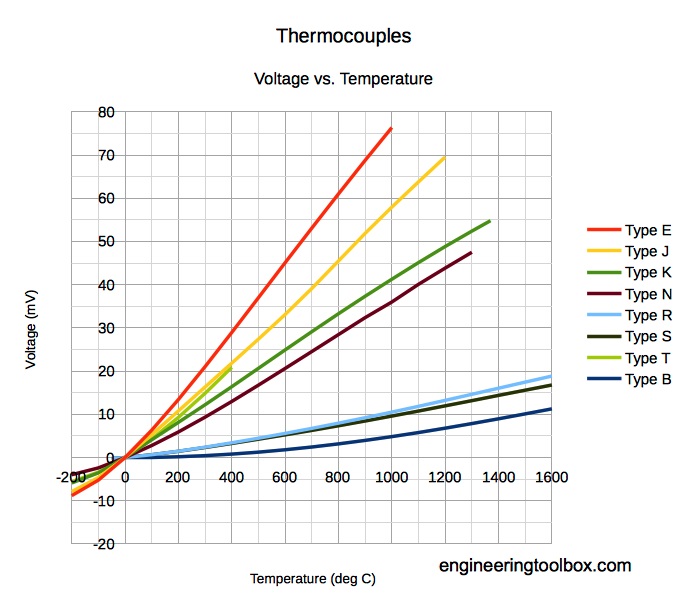
    Different types of thermocouples has different output voltages:

    Home built Heat Treating Oven-thermocouples.jpg

    So having a wrong type could fool your controller into thinking it's 600 when really at cherry red 800-ish C...
    For instance - plugging a "K" type into a controller set for a "J" type would perhaps be consistant with your result?
    (Just follow the 33 mV line from the yellow "J" line (600C) to the green "K" line and read its temp below)
    Sorry - I'm just about to hit the sack, so I wasn't really bright and fast enough.../
    /

    AFAIK: IR thermometers work by emission, and different materials have different emissivity values, kinda logical when you think of it.
    Remember the black body/ polished body relative heat experiment way back in the physics classroom?
    Emissivity is only radiated heat/ time unit - no more, no less.
    There's one reason (besides sexiness) for black-anodizing cooling fins...

    Then - a single, given material ALSO shows different emissivity att different temperatures as well - making it harder to measure correctly.
    Also logical - starting at black at room temp, then heating it to fiery red - different rate of heat radiation/ time unit from the same piece.

    For instance - I tried (in vain, of course) to use my IR thermo (1300C tops) for reading down into -80 deg C (CO2 extinguisher) a few weeks ago.

    I quick-searched. and found some hopefully decent info regarding these matters (I'm not plugging their brand - and physics dont care for shareholders):
    https://ennologic.com/ultimate-emissivity-table/
    https://ennologic.com/emissivity-inf...eter-readings/

    So for a proper readout - you need to know the emissivity of your chosen material, at the ball-park temp.

    Personally, when it comes for my own Al alloy melts - the dross kicks my 30 quid fancy-pants IR's readings all over the place -
    so I instead got a 5 quid cheapo thermocouple dipper/meter kit from China for consistent readings before the pour...

    Hope this helps - guess someone more insightful reader here will correct me - and that's how I learn too!

    Cheers
    Johan
    Last edited by DIYSwede; Jun 8, 2020 at 04:00 PM. Reason: Added Snipped text

  14. #10
    DanCom's Avatar
    Join Date
    Dec 2016
    Posts
    14
    Thanks
    1
    Thanked 18 Times in 7 Posts
    Nick,

    You can do a sanity check with a piece of carbon steel and a magnet. Once the Curie point is reached the steel will become non-magnetic. This should be around 770°C. You can also set the controller to 660° and put some aluminum in a crucible. The alum should be just starting to melt.

    A few points worth mentioning. In my experience with building ovens like this, the thin Kanthal will be susceptible to breakage. Once heated the first time it becomes very brittle. I would recommend at minimum 18 ga. 16 better, 14 better yet. Of course resistance (ohms per ft./m) drops significantly when moving to the heavier gauge. I have a Kanthal A1 spreadsheet on my blog page here. You may cover this a the another video but, make sure to double or triple back the wire on the leads exiting the kiln. This reduces the resistance and therefor reduces heat outside as well as makes for a better electrical connection. Also, the elements will sag when hot. Make sure they are stapled into the ledges. I will make a couple dozen from the Kanthal wire in a J shape and press them into the firebrick to secure the element. It would also not hurt to have a door switch that kills the power when you open the door. 220 VAC isn't fun to touch when extracting a hot blade. ;-)

    Thanks for sharing!

    Dan

  15. The Following User Says Thank You to DanCom For This Useful Post:

    Toolmaker51 (Feb 15, 2021)

Thread Information

Users Browsing this Thread

There are currently 1 users browsing this thread. (0 members and 1 guests)

Tags for this Thread

Bookmarks

Posting Permissions

  • You may not post new threads
  • You may not post replies
  • You may not post attachments
  • You may not edit your posts
  •