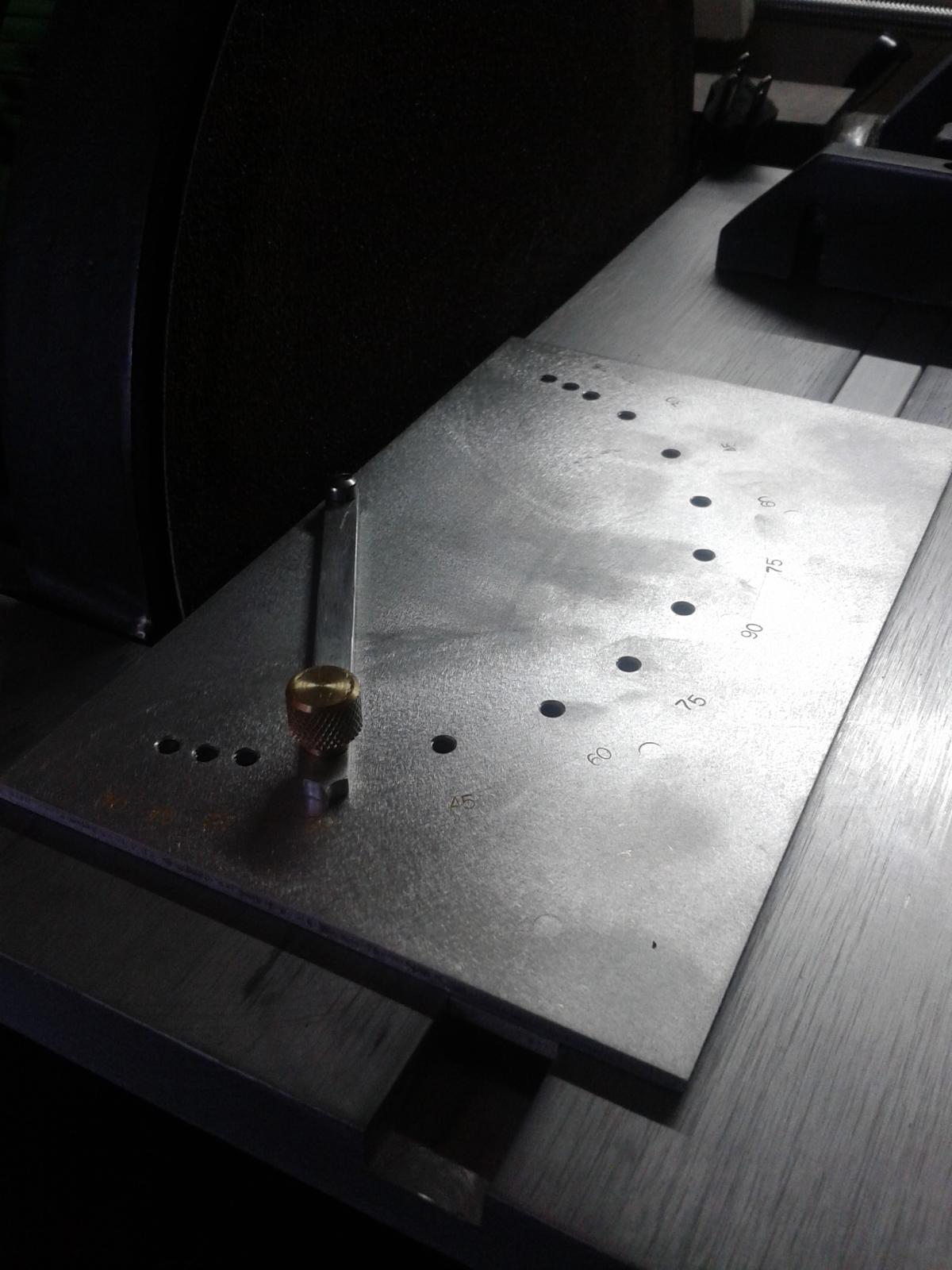
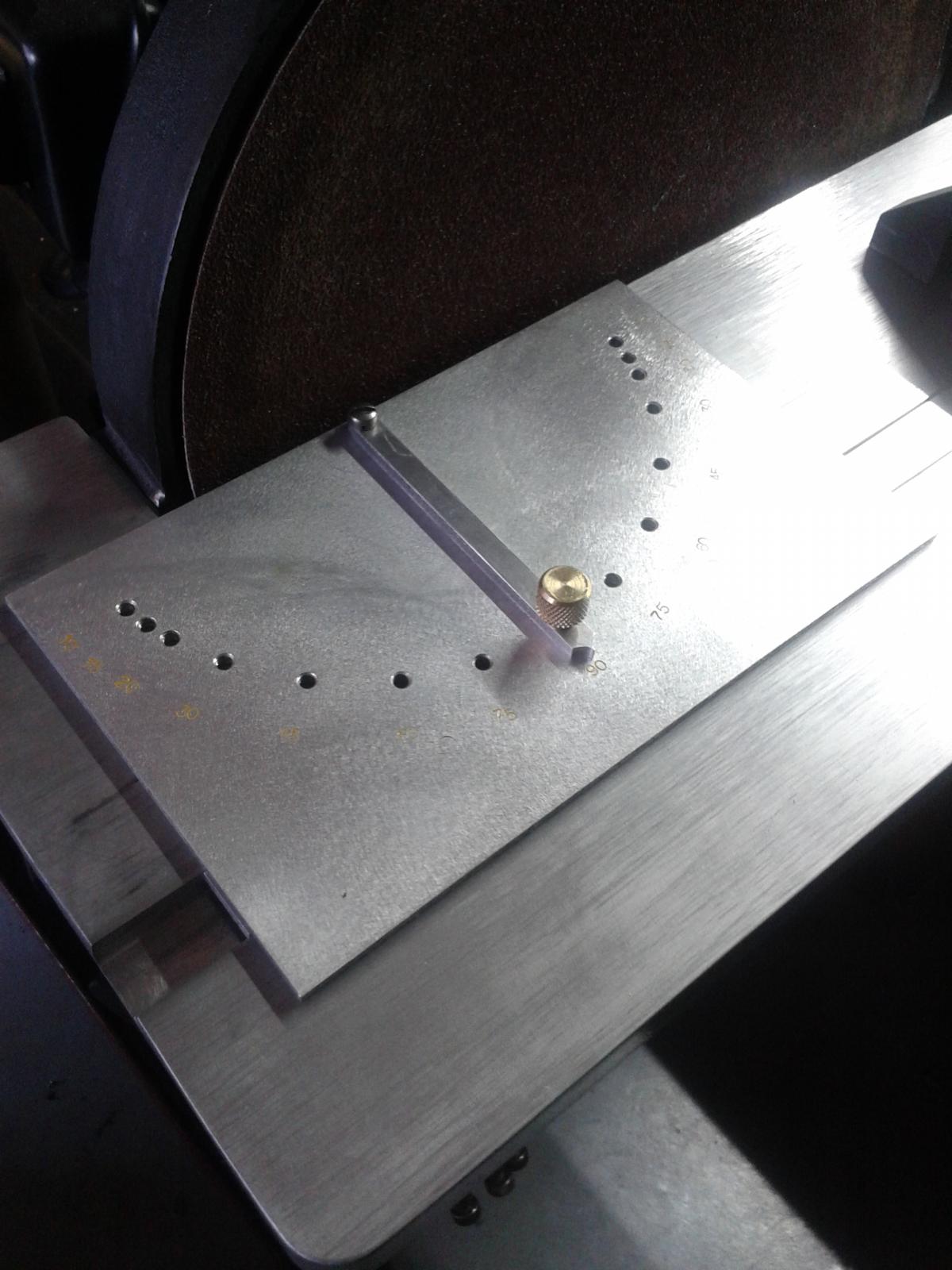
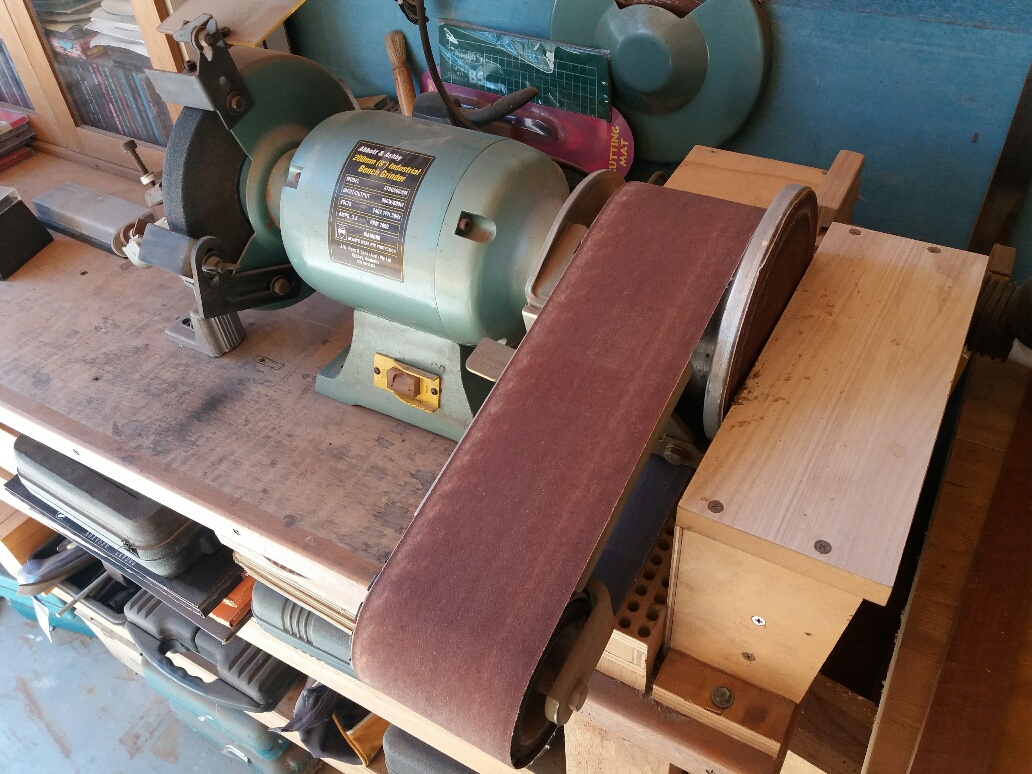
I made this angle plate for my 12in disk sander so I could grind accurate tool bits for my lathe.
https://youtu.be/t7TizM1WD-o
Attachment 30236
Attachment 30237

Printable View
I made this angle plate for my 12in disk sander so I could grind accurate tool bits for my lathe.
https://youtu.be/t7TizM1WD-o
Attachment 30236
Attachment 30237
<!-- BEGIN /var/www/html/homemadetools/protected/modules/zeus/views/tool/postUpdate.php -->
Thanks 737mechanic! We've added your Disc Sander Angle Plate to our Angle Guides and Try Squares category,
as well as to your builder page: 737mechanic's Homemade Tools. Your receipt:
<div id="blocks"> <div class="block b1 pngfix"> <div class="bimg"> <div> <a href="http://www.homemadetools.net/homemade-disc-sander-angle-plate"> <img src="/uploads/224727/homemade-disc-sander-angle-plate.jpeg"/> </a> </div> </div> <div class="head pngfix"></div> <div class="left pngfix"></div> <div class="right pngfix"></div> <div class="blockover b1 pngfix"> <div class="title"> <a href="http://www.homemadetools.net/homemade-disc-sander-angle-plate">Disc Sander Angle Plate</a> <span> by <a href="http://www.homemadetools.net/builder/737mechanic_2">737mechanic</a></span> </div> <div class="tags">tags: <a href='http://www.homemadetools.net/tag/grinding'>grinding</a>, <a href='http://www.homemadetools.net/tag/angle'>angle</a> </div> </div> </div> </div>
<!-- END /var/www/html/homemadetools/protected/modules/zeus/views/tool/postUpdate.php -->
This is a genuine question not a criticism.
Why are disc sanders popular? I have always failed to see any benefit over a belt sander. The surface speed varies over the face whereas it is constant with a belt.
I have a combined belt and disc sander but I have removed the disc because I could not find any application which the belt did not do better.
What am I missing?
Very clever jig! If I have a disk sander this will defenetly a jig I will build.
I'm with Tony and eager to be taught some new disc sander skills/uses.
Tony,
my take on answering your question...
disc sanders were popular because the sanding media is cheap - a disc is as simple as a piece of ply with a flange nut attached, and the sanding paper is a simple flat sheet glued on, and trimmed to fit, whereas for many years belts were seen as expensive (in comparison) and mounting them could involve adjusting the tracking on your machine.
when I was at school, the teachers encouraged us to use the disc more than the belt simply because the disc was cheap and easy to change, the belt could be trashed in a few seconds if a student wasn't paying attention and ripped it.
if order of "cheap-ness to feed" the least expensive is hand sanding, followed by 1/3 sheet orbital, followed by disc, followed by belt.
Nowadays you would have to figure out where highly proprietary units like oscillating tools, mouse sanders, etc fit in the mix - probably between disc and belt.
Thinking about it further, the disc sander is easy to make - simply a motor spindle, and a table - whereas a belt grinder/sander requires higher precision in frame construction, belt tension devices, tracking abilities, as well as the same key components of a disc sander...
my 2c
Des
Quote:
Originally Posted by tonyfoale
I agree that a belt sander is nicer, to be honest, the variable sfpm isn't a concern but I would rather have a belt sander but all I have is the disk sander, I also have a bench grinder but the important thing here is even with a belt sander as long as you have a table with a slot which most belt sanders do then you could make an angle plate for it the same way.Quote:
Originally Posted by tonyfoale
I didn't have a sander of any sort and I bought some stick on sanding discs to fit my calibration plate for my table saw and boom I instantly had a powerful disc sander that's proved to be useful. If you have a table saw you should already have a calibration plate for aligning the motor precisely to the table top for safety and more accurate cuts. I'll buy a belt sander too when my lotto ticket hits.
You cannot beat a nice portable belt sander if you need a nice flat or simple convex curve. A stationary is very nice also. I wish I had one, but I clamp my portable in the vise if I must have the belt stationary.Quote:
Originally Posted by tonyfoale
Disk sanders are cheaper and can be made easily from a drill if you do not have a dedicated one. Just today, I made one from a nut, bolt, sandpaper, and a piece of wood. Chucked the bolt in my lathe, got the job done even though the belt broke on my belt sander.
You can get disk sanders (portable) into places you cannot get a belt. A disk is more suited to surfaces that are more complex. Autobody work for example. Yes they have straight line flat air tools in the body shop, but mostly you see orbital disks for finish work or course disk grinders for stripping paint, etc from complex shapes.
I think it boils down to cost, disks are cheaper. On your stationary, do your roughing on the disk, save the belt for those things that need the better finish surface
Lots more examples, but I am being summoned for dinner.
Hi guys, my 2c...Disc sanders are more traditionally used in woodworking, whereas belt sanders are used for metalworking. Advantages and disadvantages of both types in both mediums. strip type belt sanders, 1-2' belts are pretty useless for the typical edge sanding you might do with wood, as the wood pieces are generally largish. The 12' disc sander with wood is easy and safe to use and easy to not oversand. I have a 12' disc I put in the table saw, which allows me to use the mitre gauge. I also have an Abbott & Ashby 8" grinder with 36" x 4" belt and 7" disc, which gets used a LOT...but in saying all that, metal=belt, wood=disc; far more often than not...and don't scrimp on abrasives! Buy the best you can; they cut cleaner and last far longer. Cheers
Jim Attachment 30254
Tony,Quote:
Originally Posted by tonyfoale
I would imagine it's an issue of time. Time on production, ease of adjustment (none - belt takes a bit longer time to replace and the guy replacing it 'should' know what he's doing), ease of replacement, and since Joe production worker used that at work... him and all his buddies knew that was what they had to buy...
Jim
For me, bladesmith and metalwork, I primarily use a belt grinder, 2x72", but would not want to be without my disk sanders. Where disk sanders excel for me is getting things flat and for precise angles. The belt grinder just doesn't get as precise as the disk. The disk is even used in some applications after using the surface grinder, which as been converted to belt. I also use sheet sandpaper and spray adhesive for the disk sander.
If I was more into wood working, a disc sander would be a nice to have, but a belt sander would be a must.
I own too many sanders to count, both belt and disc. My prize is an Oliver double end 30'' discs with precision tables. I have an old 30'' that uses regular sand paper it has a clamping ring around the perimeter. Glue is the majour disadvantage to disks. I have a couple of 16'' also, it is cheaper to buy paper for that size. Disks are superb to sand to a line after rough bandsawing the outline. If the table is set off a few degrees you can undercut the line so when you push the two pieces together you get a perfect joint. My best belt grinder is a Porter Cable G8, a waterfall sander weighing over 1000 lbs. It is over 70 years old and the platen is still perfectly flat, great to face manifolds on.
Tooler, found a YouTube video on a G8 for sale...awesome machine! ....now where could I fit that...
Jim
I am with Tony on this, I find it much quicker to change the belt on my combination unit for different grits as opposed to the adhesive disks. Also found that I only used a narrow portion of the disk due to the feed rate. I removed the disk about 30 years ago and have never missed it.
I do appreciate that it is easier for a lot of users to make a disk unit with limited tools.
I have made a few belt sanders over the years, but would not have been able to do it as easily without a lathe.
However those few parts that need turning could always be done by a small engineering firm for a relatively small cost.
Thanks to all who answered. To summarise the replies I have formed the ideas that:
1. Disc sanders are easier to manufacture, both DIY and commercial.
2. Discs are cheaper than belts, but in my experience that is offset by the need for more frequent replacements.
3. It is claimed that discs are better and more accurate for fine work, but I suspect that a lot of that is because disc sanders tend to be fitted with better work piece rests than belt sanders. I made a good rest for my belt sander and since then I have never come across a job that the disc would do better. If I want accuracy I use a milling machine but I understand that not everybody has a mill.
4. Disc sanders seem to be preferred more by wood workers than metal workers, although I am not sure why. I work with both but predominately metal.
5. It is claimed that discs are quicker and easier to change than belts. i am not convinced. This will depend a lot on the design of the machines. It only takes seconds to change a belt on mine but when I had the disc fitted it took minutes to change because of the adhesive fixing. I often change belts between different grits because it is so quick, I would never have done that with a disc.
My overwhelming conclusion is that discs have a real or perceived economic advantage and belts are largely the preferred option. So if you have a belt sander with a good work rest there is little reason to change it for a disc.
Now I have another but related question. I am not a knife maker. I notice that belt sanders seem to be essential for knife makers for sharpening.
WHY are belts preferred to a solid grinding wheel?
You cannot appreciate a disc until you have worked with a big heavy machine, the disc alone is about 100 lbs each side. You can push much harder on a disk because a belt would stall due to the drive. Belts certainly have the advantage of changing grits in a few seconds, that is why I have multiple disc sanders. Most shops only change the bigger discs once or twice a year, they last many hours with skilled use.
Something that may be of use to this thread and many will know already is get yourself a rubber belt cleaning block, most abrasive belts or discs will clog long before wearing out and these will clean them up like new without blunting them saving a lot of money.
My concern here would be introducing a dust much finer than sawdust, as well as abrasive sanding medium, into the table saw motor and bearings. I loves me a hack as much as the next guy, but you can run these things out into “penny wise, pound foolish” territory, say when you compare the price of a HF sander, belt or disc, against a replacement table saw.Quote:
Originally Posted by Crusty
How long you been running that set up on your table saw, and how often? Observe anything wonky?
I never knew about this until I saw a video of a guy cleaning his sanding belt with the sole of an old tennis shoe.Quote:
Originally Posted by olderdan
Hi Tony,
I think that belt sanders for knife makers are more popular for a few reasons (I would not classify myself as a knife make, but do make my own):
1) Easier to keep long surfaces flat and evenly reduced.
2) Better heat dissipation from the long belt (the more popular sanders seem to 2" x 72"although mine is metric at 50mm by 1830mm)
3 Multiple sized wheels to get easy radii for hollow grinding, concaves etc
4) Quick and easy to change grits between course removal and fine finish
5) Metal tends to clear from the belt easily as opposed to build up that you get on a grinding wheel
6) Easy to grind even convexes using the slack part of the belt
7) Ease of access on both sides of the belt without obstruction from the motor for instance
8) Grinding wheels wear down and change diameter whereas the wheel on the sander remains constant
9) Belts are cheap compared to grinding stone, easier to change and have more grit choices
I am sure that a good knife maker could come up with a few (maybe a lot) more
I tend to use mine for sharpening all sorts of other tool, even my drill bits with an attachment that fits to the platten section.
Alan,Quote:
Originally Posted by olderdan
I have never tried that but I find that a strong vacuum cleans them up like new but that may be a function of what materials I sand/grind. On any form of grinding operation I never work on materials that might clog the wheels/belts. I find other methods to remove material from gummy stuff, have done that since boyhood.
Of course we all have different needs and methods of working. I am sure that mine are kindergarden stuff compared to yours if you are using 100 lb discs. I never use any form of grinding/sanding to remove large amounts of material and I never push on my small linisher hard enough to stall it. I find other methods and tools when I have lots of material to remove - saws, mill or lathe are common for metal - saws and planes for wood.Quote:
Originally Posted by Tooler2
My perception has always been that belts are more expensive.Quote:
Originally Posted by Tonyg
Since I made a T&C grinder I use that for all tool sharpening but before that I use normal bench grinders. I will give the linisher a try for that out of interest.Quote:
Originally Posted by Tonyg
The one thing that I use a disk over a belt for is getting things flat. A belt will bunch up at the beginning of the cut, while a disk will get it about as flat as is possible. I use pyroceramic platens and they will still not get materials as flat as a disk. When I say a belt will bunch up and create a less than flat surface, I'm talking less than a thousandth, something that is hard to see with the naked eye. For most operations a belt will be more than accurate enough.
I would not want to be without a disk when doing folders and guard work for fixed blades. The trick is to hold the material to the disk while it's stopped and then turn the machine on and off while maintaining contact, a foot switch helps there. That said, I use the belt grinders far more often, so for me, a disk sander is more of a specialty tool just used for certain operations.
you use sanding/grinding for dirty material that cannot be machined with tooling. I also have a Volpato horizontal belt sander that has a ''jointer'' on the back side. This allows one to joint particle board that one would never use a regular jointer on.Quote:
Originally Posted by tonyfoale
This is a good example of a small tweak or add on to make a tool more use-full
Good job
did you stamp the numbers or CNC
Ray
I stamped them, I used a protractor to get the arc right and used that as a guide and eyeballed the rest.Quote:
Originally Posted by shopandmath
So simple, I really think this is a great idea. Thanks
Alan,Quote:
Originally Posted by olderdan
I followed your advice and I have benefitted according.