Does anyone have some info on building a quality propane burner for a small to medium size Forge?

Printable View
Does anyone have some info on building a quality propane burner for a small to medium size Forge?
kmc5twenty5, here is contact details of a person, Ian Mills who really is a knowledgeable person in this regards. He already build a lot of different propane burners..
Ian Mills, South Africa , Gauteng: ian214@live.com
Regards
Gert Odendaal
A great place to start would be the ABANA web site. Or just look for gas forge plans on line. There are many different plans depending on what you want to do & the style & size of forge you want to build. A big thing is if you want to forge weld you will need more heat. I built a gas forge from a refrigerant cylinder That worked great. I had two burners for it one had a fan & got hotter & one that didn't. That was a long time ago & I don't have any plans for it.I prefer round forges compared to square or rectangular ones but they are many different ones out there. Hope I helped & didn't confuse.
Dave "Slawman" Huffman
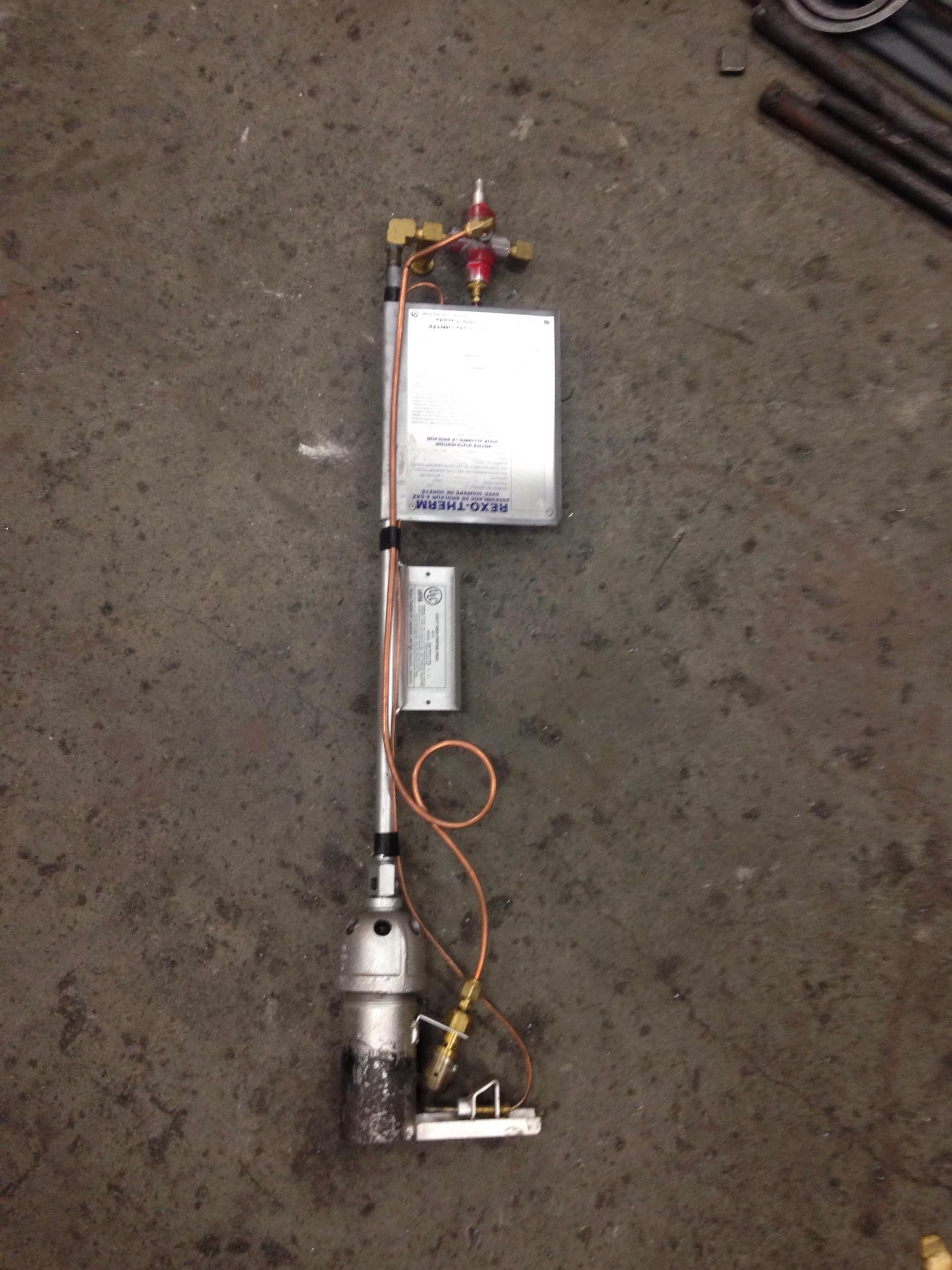
There are many burner designs online. Personally I have been use a gas forge for almost 20 years and I cannot stress the importance of safety when dealing with propane. Be sure to familiarize yourself with propane gas and its dangers. I strongly suggest using a thermocouple valve/switch with a pilot light. Rexo-therm is a company in Toronto (416)253-9778 that makes 60,000 to 500,000 BTU burners with all the safety requirements attached (ULC listed). I have no financial interest in this company. Attachment 17574Attachment 17574Attachment 17574Quote:
Originally Posted by kmc5twenty5
I would also suggest avoiding Kaowool or other ceramic board walls as they create airborne silica particles. My suggestion is to pour refractory cement (2000 plus degree rated) as your walls.
Good luck and be safe.
You could look at myfordboy blog and online resources he has plans and much more info.Quote:
Originally Posted by kmc5twenty5
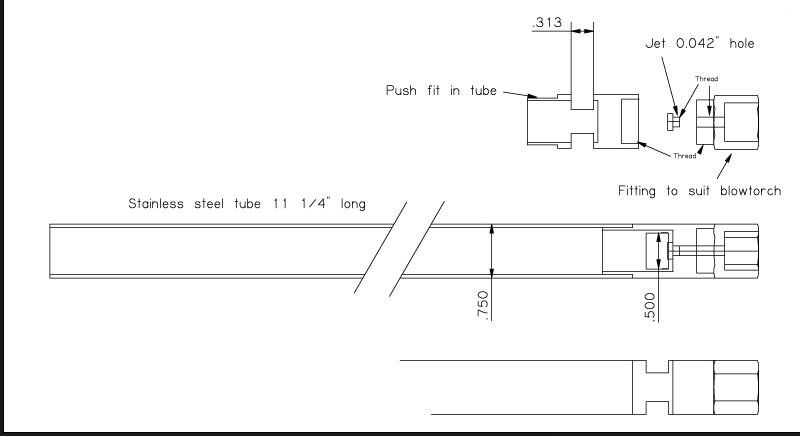
Attachment 17575
Good luck
Olderdan
Sir,
I have been a custom knifemaker and blacksmith since the middle '80's. I have build close to 100 forges and burners. I wrote this thread https://www.bladesmithsforum.com/ind...e-and-feeding/
about the burner that I use, which is a simple, easy to build, blown burner (which means that it uses a fan to drive air through the system). All of the other suggestions above have been for venturi burners, which work like a carburetor. Both work, venturi are just a bit fussier to build and get tuned.
One other thing I saw go by, the suggestion that you not use Kaowool or one of the other spun ceramic fiber blankets for the forge. Two things to know. It's true that you don't want to breath the airborne fibers, however, a simple refractory topcoat will capture the fibers and increase the efficiency of the forge. A hard castable forge doesn't have the fiber problem, but it's much less efficient. The reason is simple, hard refractories are not insulators, you have to heat the whole mass of the forge liner before you can get any heat to work with. I had a welding forge with a Kaowool top and a hard brick floor. The convention wisdom is that you need this because flux (borax, often) will eat through Kaowool at temperature. Which is true. The problem was, the welding forge needed a good 15-20 minutes to come up to a solid welding heat, whereas my "everyday" forge (top coated Kaowool) is ready to work 90 seconds after being lit. Unless you plan to forge 8-16 hours a day, 7 days a week, a hard refractory forge is just burning gas for no reason, every time you light it.
Just my .02
Geoff
I've never posted before hope I'm doing it right. Check out Dave Hammer on utube I met him at a blacksmithing meeting real nice guy. He makes great videos clear and concise. Look up forging a gun barrel you will find a link to his other videos.Quote:
Originally Posted by Geoff Keyes
Geoff;Thanks for the very informative link. I haven't done any bladesmithing since I was a teenager working in a Blacksmith shop back in the 60s. Back then we had 2 30" diameter coal forges that had huge hand cranked blowers on them. Now I am finding that I want to build a forge but not so much for making knives. I need to be able to heat a 20 Inch diameter 2" cast steel Kubota final drive sprocket hot enough to straighten it Due to the size the only economical way I can see to do this will be a large coal fired forge but possibly a propane fire ring like those used under 40 gallon cooking pots might be possible providing I can get enough propane volume and fan forced air I have a 500 gallon propane tank that feeds my house via a 3/4 inch gas line
OK, that's pretty specific :D. Whatever you do is going to use a ton of fuel. Is this going to be a one off thing, or do you have a pile of these to do? I would put a bit more engineering into a forge intended for longer term use. Here is how I would go about it. There is a thing called a ribbon burner. Wayne Coe is the ribbon burner guy (WayneCoeArtistBlacksmith). You should contact him about the basics of the burner, but what I would is build a cross shaped ribbon burner about 12-15 inches across the arms. Pipe the propane in at high volume and pressure. I have a 120 gallon tank that feeds my forges (I have 3 hooked up) through a high pressure regulator. I never need more than about 8-10 psi though 1 inch black iron pipe. To feed this monster you might need 2 or 3 times that. This is one time when I would use a bounce house inflator or a shop vac. You are going to really need some volume to run this.
Next I would build a shallow pit, lined with fire brick, or a mix of sand and clay (search for Tim Lively clay forge https://washtubforge.wordpress.com/2...rge-and-anvil/). The burner goes in the bottom of that. Next I would build a hood, basically an inverted shallow bowl, lined with Kaowool and designed to swing away. You'll want to have space between the top and bottom for the forge to breath. This is a very large sheet metal forge, much smaller ones get used for armor making.
How are you planning to move this thing once it's hot? You might consider some kind of crane. How are you going to push/beat/forge it back into shape? Friends with long handled sledges? You might want to think about a drop hammer. 100 lbs falling 5 feet packs a huge wallop.
Be sure to take video, I want to see it.
Geoff
Basically a 1 off Part of my thinking about coal fired in a pit with ducked air from underneath.
the weight of the casting is not as much as you might think since the rim with the teeth is about 2 inches thick the hub is 5 inches in diameter with a 3 inch diameter center bore and 4 inches thick the web between the hub and teeth is 1 inch thick so overall the total weight is around 75 lbs. Easily lifted by 1 hand but since it would be red hot I was thinking along the lines of a 2 man crucible tong
for an anvil as such I have a weldement that has a 5 inch thick plate about the same out side dimensions as the sprocket with a 7 inch center bore and a 26 inch diameter 6 inch tall base under it it also has a vertical column about 3 ft tall off to 1 side I was planning on welding a second column to the opposite side then a section of 10" 100 lb per ft wide flange beam to the top of the columns Additionally I have a 12 inch diameter 1 inch wall pipe that has a 2 inch thick cap welded to it this would allow me to make a press which would press on the web using my 50 ton bottle jack then it would be a matter of sledge hammering the rim straight I may have to have one person keep waving my 10 rose bud oxy act torch around the sprocket while I have it pressed and beating it into submission But I believe it to be do able as I have done larger things in the past using as many as 4 torches but they sucked large bottles of oxygen and acetylene dry
After I have it straight I will have to re heat the rim and teeth at least to a dull cherry then spin quench to re harden the teeth
I had a long handled propane roofers torch from Machine Mart. An old gas tank ( very careful cutting it ) and some" You Tube " clips, watch as many as you can and use a lot of common sense. We are in the middle of moving home so its packed away but will post some pics when mine is set up again.
Good Luck.
The vicar.
See slawman's post below.Quote:
Originally Posted by kmc5twenty5
You may find these pages by Ron Reil useful which includes info on the burners mentioned above and more. It is on the ABANA site but more specifically
Ron's Forge Page My son and I are in the process of putting together the Mongo burner. Stay safe and good forging, Jeff
Hi , I'm the guy Gert tried to direct you to! if you give a bit mor e info I'm sure I can help! do you want to go blown or naturally aspirated? size and type of forge?
the ribbon burner that Wayne coe has the info on was shown/given to him by a good friend of mine( John Emmerling) who had picked up the idea from his neighbour the glass blower. Jerry Frost in Alaska has recently developed a naturally aspirated one.
regards Ian
Facebook...homemade forges....anything and everything....gas, coal and things I don't wanna know...