
 LinkBack URL
 About LinkBacks



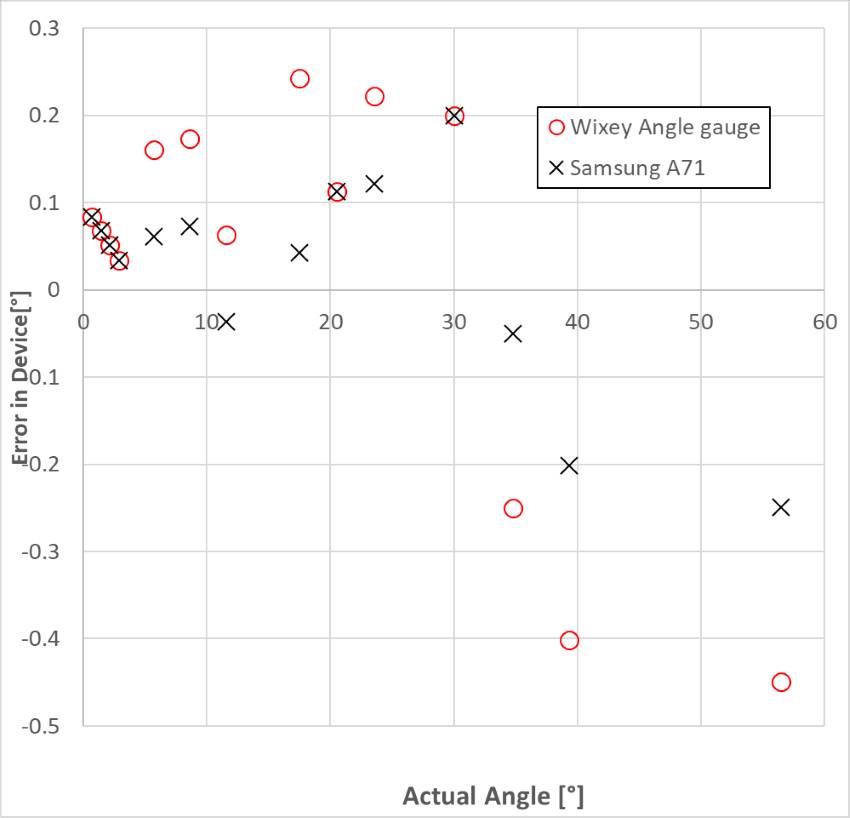
Yes, that plot of the errors is interesting and more informative. It shows that with the phone and the Wixey angle gauge
https://www.rockler.com/wixey-digita...13bcbf835ec14f
the first thing that jumps out to me is the fact that they both have errors on the positive side for angles less than or equal to 30° and both have negative errors for angles that are greater than that. This suggests two things to me to me. Please notice I said "suggests". First, there may be a common element in this. Two devices would definitely have different circuit boards and different outer cases but perhaps those elements are not in the mix. The other thing that it suggests is that there may be two different processes at work here: one being more predominant at lower angles and the other at higher angles.
It could be the sensor itself that is at work here and the same sensor may be used in both of them. Another possibility is that most electronic parts will have manufacturer's recommended or suggested circuits. It could be that the two devices both use the manufacture's suggested circuit and that circuit is responsible for one component of the errors.
A third interesting point is the exact matching of the first four readings from the zero point. And in this small range, the error seems to be going in a decreasing direction. But then the other readings under 30°, with only one seem to increase from the low value of the fourth of these four angles. Could this be another point of interest at about 3° or 4°?
All in all, the errors seem to be within a range of +0.25° to - 0.35° and that is good for many purposes. We just need to keep in mind what they may be and use better methods when more accuracy is needed.
Paul A.
Originally Posted by editor@glue-it.com



 Reply With Quote


Bookmarks