
 LinkBack URL
 About LinkBacks
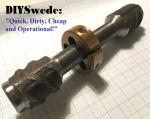

Thanks Claudio, for yet another creative approach, nicely looking and well executed tool (and video)!
I've been walking this tedious road myself for quite a while now,
as the tiny nib of the vial of my cheapo Machinist's Level broke when overhauling it, described in this dismal read:
35 buck Chinese Machinist's Level overhaul and cralibation (!)
I've still some work to do on that project:
1) Refill the vial with the appropriate amount of the proper fluid.
2) Permanently seal the vial (easier said than done).
3) Reliably and sustainably fix it in the housing tube.
4) Remount in and calibrate the level.
A few findings of mine so far (FWIW):
The original fluid in these high precision vials is "Ether" (Diethyl Ether or Ethoxyethane) and that for a darned good reason:
Low kinematic viscosity, i. e. it flows really easy in the vial of such a low curvature,
as to get a 2 hundreds of a mm (per div) in 1 meter.
Even with this very low viscosity fluid, the bubble still would take some 20 secs to set...
But depending what kind of resolution you aim for, other fluids (like acetaldehyde, ammonia or acetone) might be good enuff...
Snag with Ether is the volatility and vapor pressure at room temp, making it hard to handle (aside of even getting hold of it).
Next assignment is to get the fluid into and keeping it permanently within the vial, as in the above steps 1 & 2...
My experience is that ether really effectively prevents epoxi (and everything else I've tried so far) from curing.
Next try will be adding a droplet of waterglass (Sodium Silicate) to the nib, instanty cured by a shot of CO2 gas.
If that is good enuff is to be determined - other suggestions welcome...
But that's to come in another post in the thread above.
Cheers
Johan
Links:
https://en.wikipedia.org/wiki/Diethyl_ether
https://www.engineeringtoolbox.com/k...ity-d_397.html


 Reply With Quote


Bookmarks