
 LinkBack URL
 About LinkBacks

 with a longitudinal flat on it. (See first picture below.) The actual "stop=" consisted of two nuts; one acted as the stop and the other as a lock nut to hold the stop in place.
Calling it a poor design would be a compliment. The nuts had too little inertia to spin freely so one had to tediously turn them by hand, then repeat the same operation with the= "Pin It")
Like many mill-drills, mine came with a depth stop that consists of a threaded rod (1/2-20) with a longitudinal flat on it. (See first picture below.) The actual "stop" consisted of two nuts; one acted as the stop and the other as a lock nut to hold the stop in place.
Calling it a poor design would be a compliment. The nuts had too little inertia to spin freely so one had to tediously turn them by hand, then repeat the same operation with the so-called lock nut. Precise adjustment was nearly impossible and the lock nut seldom stayed tight so the setting would drift.
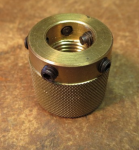
I solved part of the problem by turning a heavy, elongated brass nut (see second picture) that had enough inertia to spin rapidly up and down the thread if given a healthy twist. Rather than fuss with a lock nut, I threaded the stop for five 8-32 setscrews. Tightening one of these against the flat holds the stop in place with no chance of drift. I used five screws because that makes for a convenient setting interval. (1/5) * (1/20) = 0.01" so each setscrew position represents a 0.01 inch change in depth relative to its neighbors.
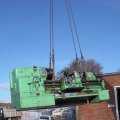
I only use this stop when I need very fine control over the depth setting. For less demanding work, a clip-on commercial stop of the type shown in the third picture is quicker to use. It consists of a spring-loaded "clothespin" with a split hole threaded to match the depth rod. Repositioning it is done very easily and it doesn't slip but it does lack the fine position control of my design.





 Reply With Quote


 Originally Posted by paxx




Bookmarks