 LinkBack URL
 About LinkBacks
Why buy when you can make one?
Here's the website for pattern (Light Burn and SVG included) and step by step: https://makethingswithrob.com/nut-bolt-identifier/





Why buy when you can make one?
Here's the website for pattern (Light Burn and SVG included) and step by step: https://makethingswithrob.com/nut-bolt-identifier/
carloski (Aug 12, 2022), DIYer (Aug 12, 2022), Duke_of_URL (Aug 15, 2022), gene55 (Aug 23, 2022), RetiredFAE (Aug 13, 2022)


To save a bit of fabrication effort I just used a commercial thread gauge. Thread a bolt and its matching nut in each hole...
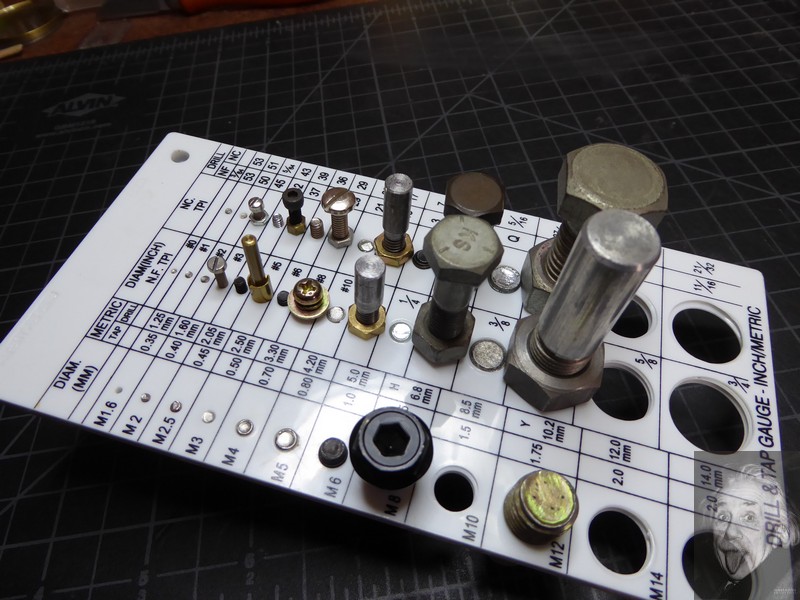
If things get too crowded, use the reverse side of the gauge to stagger the bolt placements...
This scheme provides space for fastener sizes you may not yet have in your collection. Also, it accommodates metric as well as inferial fasteners.
Also, having the nuts removable from the board allows checking threads on devices where the stud cannot be removed.
---
Regards, Marv
Smart phones are to people what laser pointers are to cats
Homo sapiens is a goal, not a definition
Frank S (Aug 12, 2022), Make Things (Aug 13, 2022), WmRMeyers (Aug 12, 2022)
Thanks...I haven't ever seen one of those. I like the idea of removing the nuts!
Mine was a promotional gift from a company with which I do business but they can be had from Amazon...Originally Posted by Make Things

https://www.amazon.com/Screw-Thread-...s%2C136&sr=8-6
---
Regards, Marv
Smart phones are to people what laser pointers are to cats
Homo sapiens is a goal, not a definition
Thanks! Next cheapest one of those I've seen was over $20, and I'm too cheap but spend that!And I will make the modifications/additions you suggested!
Bill
It's plastic so you'll want to be a bit gentle with it. I don't use the plastic threads to identify an unknown screw. Instead I find the one with the nearest diameter to the unknown, remove it from the board and use its nut to test the unknown. That way only the screws that actually fit the threads in the board are screwed into it and the chance of damaging the plastic threads is minimized.
I look at it as just a very compact way of organizing a test screw collection. I have these...
https://www.amazon.com/Bolt-Thread-C...s%2C152&sr=8-4
as well, purchased earlier, but they must be taken off that infernal cable and mounted to a board to make them useful and, when that is done, the result is way bigger and heavier than the little plastic thread gauge.
---
Regards, Marv
Smart phones are to people what laser pointers are to cats
Homo sapiens is a goal, not a definition
...More on screw identification...
If it's a numbered screw (in inferial land most smaller than 1/4" are), it helps to know the number. I made a gauge for this purpose...
DIY Screw size gage
but if you don't do it often it may be easier to just work it out mathematically. For numbered screws the diameter is computed from...
D = 0.060 + 0.013 * N
where N is the screw number. Solving for N, we have...
N = (D - 0.060) / 0.013
so measure the diameter of your unknown, plug it into the above and solve for N.
If you don't already own thread pitch gauges (inferial and metric), remember that any screw of known pitch can be used as a pitch gauge.

---
Regards, Marv
Smart phones are to people what laser pointers are to cats
Homo sapiens is a goal, not a definition
There are currently 1 users browsing this thread. (0 members and 1 guests)
 Posting Permissions



 Reply With Quote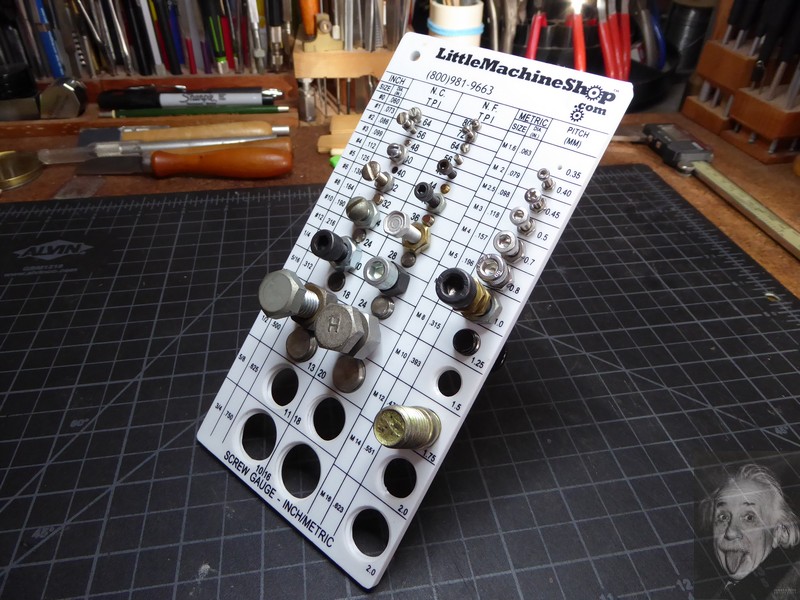

Bookmarks