I need to be able to reverse a 120v motor. I'm thinking about building a DPDT switched receptacle. Will any knowledgable members care to advise, please?

Printable View
I need to be able to reverse a 120v motor. I'm thinking about building a DPDT switched receptacle. Will any knowledgable members care to advise, please?
So - you have missing information to answer your question:
1 - is the motor DC or AC?
1dc2 - if the motor is DC and is only 2 wires (not counting the case ground), then look up DPDT reversing switch and you will find many schematics
1dc4 - more complicated, but possible - find the datasheet on the motor (sometimes this information is printed on the motor)
1ac - see #2
2 - if the motor is AC, do you know the motor can be reversed by changing what is on the various wires?
2? - I don't know - you need to find a datasheet on the motor to find this out (sometimes this information is printed on the motor)
2n - some AC motors can't be reversed because there is no way to access the needed connections
2y - now you need to figure out which wires need to be energized in the CW and CCW rotations and design a switch that will do that
hope that helps...
Some motors can be reversed by turning the housing with the field winding around and having the drive come out the other side of the motor. This all depend on the location of the connections and the compatibility of the covers to the housing.
What kind of tool, machine, etc., is it? Or if it is just the motor, what did it come out of?Quote:
Originally Posted by neilbourjaily
It's a treadmill (s) I intend to modify. It'll probably be either a Matrix 7xi or a Life Fitness CLST. They are both 120v AC. I don't know how accessible the electric guts are, though I may not care about breaking the onboard electronics.. My thought was to build a corded gang box with a reversing switch as well as adjustable speed as I'd be plugging several into the same box. I'd leave them all at a single speed and control the speed with a variable resistor assembly in the gang box is what I'm thinking.Quote:
Originally Posted by Floradawg
I am grateful for all input.
Hmmmm... Speed control of an AC motor with a resistor - probably not going to work. An AC motor tries to stay synced with the frequency which is why AC motors generally use a VFD (variable frequency drive). A resistor would drop power but not how you would want it to.Quote:
Originally Posted by neilbourjaily
Thank you, BuffaloJohn. I will apply myself to the AC motor controllers that can be seen in the electrics sxn.Quote:
Originally Posted by BuffaloJohn
Treadmill motors are usually DC for easy electronic speed control.Quote:
Originally Posted by neilbourjaily
I suggest you seek advice from an electrician before attempting to reverse the motor. In my view it will be money well spent, and save you burning the motor out, getting a huge shock or blowing a fuse, or at worse save you from all 3 failures.
They are also usually permanent magnet types in which case direction reversal is easy. Just reverse the two wires. That is all. However, unless you feed it from a controller or other variable voltage source you will only have a single speed available.Quote:
Originally Posted by Bony
I'll see the motors on Tuesday when I arrange to get the treadmills. They are also on the second story and may require some degree of disassembly to get them to the ground floor and out the door. I'm getting them from a commercial gym that is rotating out their old treadmills and getting new ones. In my inspection of them, I'll look at the plate on the motor. My intention is to gang them together, charge them through a single gang box, and control them from the box. I want to be able to reverse them and to control their rate of speed.
I thank you each and all again for your insights here. What a fine group to be part of.
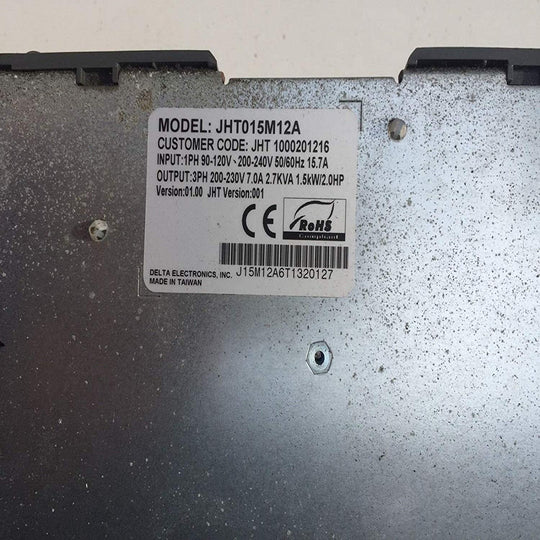
I thought I would look for the motor (a replacement part) online, not much to see, but I did find a controller for a Matrix T7xi and here is the label on it:
Attachment 49642
So - that motor controller output is for a three phase AC motor and likely is a VFD. Check the controller of the treadmill you are getting and you may find the info you need...
The Life Fitness CLST motor or motor controller is hard to get an image of, but there are a number of listings of that company's motors and they list as DC motors. The motor has a nameplate, but the images are just too small to read anything online.
I found AC and DC motors. I'll wait until I have them in hand. The current may influence my choice. I am restricted to a 120v receptacle for my experiment.
The motor model # is JM11-007. It is for a Matrix brand treadmill. It's AC 60Hz 3ph and 1500w (230v X 6.5A) thus 2hp. I'll have 2 motors and 3 treadmill decks. I intend to power the 2 outer decks and to cover all 3 with a single conveyor belt to assure a smooth surface for lateral transition/footwork and to make sure the decks turn synchronously.
I have the controls from one of the treadmills, which includes speed control. My thought is to gang the 2 motors through a single gang receptacle (connect with a 2 receptacle pigtail?) with the one speed control wired upstream from the receptacle and still within the gang box. I also want to reverse the motor direction, which I'd like to do within the gang box.
I am grateful for all replies.
[QUOTE=neilbourjaily;254678]The motor model # is JM11-007. It is for a Matrix brand treadmill. It's AC 60Hz 3ph and 1500w (230v X 6.5A) thus 2hp. I'll have 2 motors and 3 treadmill decks. I intend to power the 2 outer decks and to cover all 3 with a single conveyor belt to assure a smooth surface for lateral transition/footwork and to make sure the decks turn synchronously.
I have the controls from one of the treadmills, which includes speed control. My thought is to gang the 2 motors through a single gang receptacle (connect with a 2 receptacle pigtail?) with the one speed control wired upstream from the receptacle and still within the gang box. I also want to reverse the motor direction, which I'd like to do within the gang box.
I am grateful for all replies.[/Q
The tread mill(s) would have a variable frequency drive built in I would think. That would be a nice setup for a powerful wood lathe or a swap out for a metal lathe. I know that's not what you want.
[QUOTE=Floradawg;254707]No, but I kinda like the idea.Quote:
Originally Posted by neilbourjaily
Non-relevant reply deleted.
He has three phase motors from the treadmills - thus they are controlled by frequency using a VFD - variable frequency drive.Quote:
Originally Posted by tonyfoale
Three phase motors are induction motors. While there is a voltage component of the VFD, the primary control of speed is the frequency of the AC 3 phase waveform (there is a voltage component in VFDs which is used to keep the motor from overheating by keeping the magnetic flux within the design parameters).
Yes there are many treadmills that as DC motors, but not these...
I stand corrected. Thank you.Quote:
Originally Posted by BuffaloJohn