
 LinkBack URL
 About LinkBacks


In a recent thread on another forum, someone wanted to make a 14 tooth ratchet and asked for methods for dividing a circle into 14 segments. Since he lacked a rotary table and dividing head, it was suggested that he use dividers to step off chords around the circle. After all, this was good enough for the ancients who made the Antikythera mechanism so it ought to work here.
It was suggested that he guess the initial divider setting and step off around the circle. If he didn't get 14 divisions, adjust the dividers and try again. Continue this iterative process until he obtains exactly 14 divisions.
Now, anyone who knows anything about trigonometry will realize that iteration is about the dumbest way to approach this problem. So how do we calculate the initial spacing of the dividers?
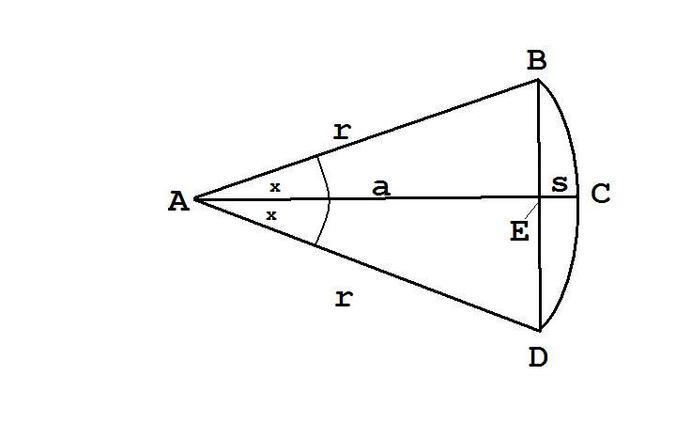
Refer to my canonical diagram of a circular arc below...
A regular (i.e., all sides equal length) polygon of N sides has been inscribed in a circle. The chord BD represents one of these sides. At the center of the circle it subtends an angle of 2x. We'll use the label T for 2x, i.e., T = 2x. Since all the sides are equal we know that T = 360/N.
We now have an isosceles triangle, ABD, where we know an angle, T, and the two equal sides, r, and wish to know the remaining side, BD. Fortunately, trigonometry provides us with a formula, called the "law of cosines", to compute this side. If 'c' is the unknown side opposite the angle 'theta' and 'a' and 'b' are the other two (not necessarily equal) sides, then the law of cosines says...
c^2 = a^2 + b^2 - 2 * a *b * cos(theta)
Applying this to our problem, we have...
(BD)^2 = r^2 + r^2 - 2 * r * r * cos(360/N) = 2 * r^2 * (1 - cos(360/N)
And, solving for BD, the required divider setting, yields...
BD = r * sqrt (2 * (1 - cos(360/N))
Now, as a check, every schoolboy knows that if you step off the circle with the radius used to draw the circle, you'll get a perfect regular hexagon. So, with N = 6 the formula should show us that BD = r. Substituting, we have...
BD = r * sqrt (2 * (1 - cos(360/6)) = r * sqrt (2 * (1 - cos(60)) = r * sqrt (2 * (1 - 0.5)) = r * sqrt (1) = r Q.E.D.
So, armed with this formula, you can compute the required divider setting for stepping off a regular polygon of any number of sides.
--
A little math aside here. Note that if c is the hypotenuse of a right triangle opposite the right angle, theta = 90, the law of cosines reduces to the Pythagorean theorem, c^2 = a^2 + b^2



 Reply With Quote

Bookmarks