


New: BuildThreads.com - 300+ build posts/day (with photos)
clydeman (May 27, 2025), nova_robotics (May 27, 2025)



That is really not good for the spider gears. But I guess some do what they got to do.

Don't know why they are not rather using the tractors rear power take off shaft?
Output speed. They can change output speeds by shifting gears and using the throttle.
PTO runs much higher RPM and is only controlled by the throttle. Probably can’t make it go slow enough.

I've heard that a number of times but I can't wrap my head why it would be bad for them. The spiders are just as loaded if the rear wheels are spinning at the same speed or if there's a speed difference. On paper there's a slight advantage when they're spinning at different speeds because then you gain hydrodynamic lubrication of the shaft and bearings. No spinning gets you metal on metal. But the absolute load should be about the same.Originally Posted by hemmjo

If you had an LSD or something I can understand how a speed difference would do a tremendous amount of damage, but an open diff?
The teeth are always loaded, but the bearing surfaces are not always moving relative to each other. In normal operation, the spider gears in a differential application do not constantly rotate. While they always carry a load, they do not rotate unless the axles rotate at different speeds. The speed difference can be from turning, tires inflated differently or being different sizes, or getting the vehicle stuck and spinning one wheel. Doing a “burnout” with a open style differential is also bad.
You could drive hundreds of miles (or kilometers) and not have the gears rotate more that a few times.
All of the spiders gears I have seen have no “bearings”. They have smooth steel bores that run on a smooth steel shaft. The thrust is absorbed by the smooth back of the gear pressing against the smooth face of the differential carrier. Not ideal for constant motion.
That said. The last differential I had apart was a late 60’s Chevy. Maybe designs have changed. BUT, the ones I have seen are just not designed for constant relative motion.
 and not have the gears rotate more that a few times.
I'm not sure about that part. I'm pretty sure those spiders are almost always spinning back and forth a little bit unless you're driving perfectly straight. I'd bet if you added up all the half rotations and small movements you'd get to about 10 revolutions by the time I got to th "Pin It")
I'm not sure about that part. I'm pretty sure those spiders are almost always spinning back and forth a little bit unless you're driving perfectly straight. I'd bet if you added up all the half rotations and small movements you'd get to about 10 revolutions by the time I got to the end of my 1000 ft long driveway and pulled onto the asphalt. Even just backing out of a parking space is going to score another rotation of the spider gears.
Spinning back and forth a little bit is totally different than, getting stuck and spinning one wheel trying to get out, OR by seeing how long a black strip you can lay down on some road, OR, jacking up one wheel and driving some load with that while the other is held stationary. The bearing surfaces on Spider gears are not designed for constant motion. I know for a fact that one wheel spinning with a open type differential will ruin a differential. I know this from personal experience in regard to "The last differential I had apart was a 1960 Chevy"
This is a custom seat cutter my dad had made in 1966 to reface the spider gear thrust surfaces in my Chevy. My dad was a machinist. He taught me how to measure the radius required and had this tool ground from an old milling cutter where he worked. I will probably never use it again, but it has a special place on my tooling shelf. That cutter taught me many important lessons. I am reminded of them every time I see it.
The differential case was scored from the spider gears spinning too much. We got new spider gears shaft and shims. My dad taught me how to set the backlash for gears. We used the reamer to set that lash.
The danger is real. You can find information about the issue. I found this for your perusal. https://www.subaruoutback.org/thread...e-gears.46819/
Spider gears will last longer than you car, or tractor, unless you abuse them. Locking one wheel and turning the other under some load, like that clay extruder, is not how they were designed to be used.

KustomsbyKent (Jun 2, 2025), nova_robotics (May 28, 2025), Philip Davies (Jun 1, 2025)
There are currently 1 users browsing this thread. (0 members and 1 guests)
 Posting Permissions

 LinkBack URL
 About LinkBacks

 Reply With Quote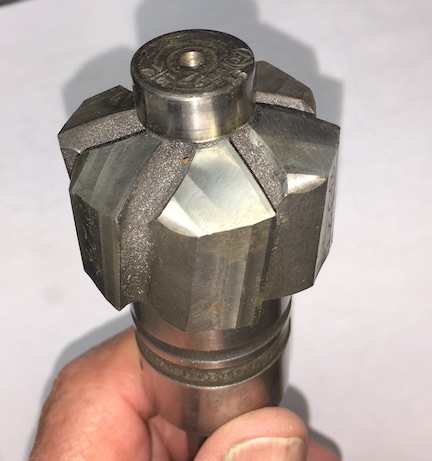
Bookmarks