 LinkBack URL
 About LinkBacks
Trenchless pipe installation.
Previously:



Trenchless pipe installation.
Previously:
New: BuildThreads.com - 300+ build posts/day (with photos)
emu roo (Yesterday), nova_robotics (Yesterday)



How is that pipe installation?
emu roo (Yesterday)
If you question was rhetorical - stop here, but note that the pipe being split was installed trenchless since it is laying above th ground.Originally Posted by hemmjo

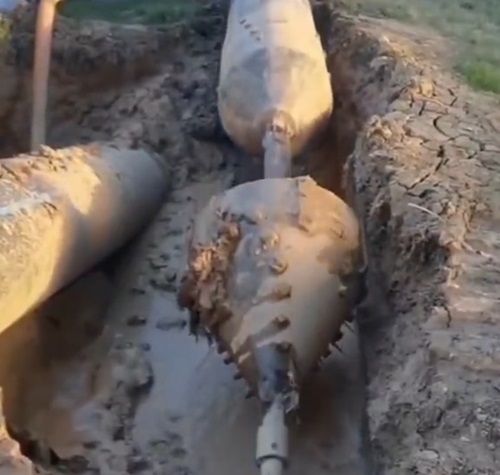
If you were asking a real question - a stiff but bendable pipe is fitted into the female end of the splitter and is pulled through the void created by splitting the old pipe.
Last edited by Karl_H; Yesterday at 04:26 PM. Reason: Correcting autocorrect.
emu roo (Yesterday)


be nice to have the split at the bottom so the remains of the old pipe could double as armour for the new pipe. it would probably cause "lift" though
emu roo (Yesterday)
I do notice that the pulling hear is designed for a pipe to follow it through the ground. A lot of pipe was replaced around here using a similar concept, but the new pipe was size ti fit into the old. I see two situations in the video..
#1 the pipe is buried less than 1 pipe diameter under sand which totally collapses as the cutting head is pulled through. We have no idea how long that pipe runs under the sand. The set up appears to be staged as the pipe daylights into a wood box set into soft sand. That is a big pulling head. The bend radius for a pipe that size to large fot the pipe to follow i into that box.
#2 we see a section pf pipe resting on pallets and connected what I assume is the pulling machine. If that pipe was in fact buried in any number common of substrates, those jagged edges created by the cutter would not be able to flay away like that and would possibly even be pressed back onto place with the jagged edges slicing into the new plastic pipe.
Interesting concept, I just have questions about real world use.

As you have mentioned there are a few questions about the operation.
To me this appears to be a demonstration or a test to prove or disprove the possibility to replace a section of an old pipeline which probably runs under an existing structure such as a building or a road most likely a road. In which case would be buried several feet below the surface and yes, the substrate the pipeline would be buried in would be restrictive. I doubt that it could be substantial enough to cause the split pipe to collapse back in on the new pipe being pulled through with enough force to damage it however you are correct in that the severed edges would probably not flyaway as freely as the demonstration suggests.
My question is what tonnage of force would be required to split spread and pull a new pipeline through the old pipe given that it would be as we believe would be buried several feet below the surface.
I do a lot of work for a contractor who regularly pulls pipe under roads after boring. He has tried to pull 6" pipes through a bore that was not several inches larger than the pipe A 6" pipe cannot easily be pulled through even a 7" bore. He has tried to use expanders that I have made for him his machines have 100 tons of pulling power but trying to pull an expander of 8" in diameter through a 7" bore hole or 60 feet in length while dragging a 6" pipe which is close to 7" OD requires nearly all of the machine's capacity. Having to start and stop to remove the drill pipe sections is where the problems arrize

Last edited by Frank S; Today at 07:12 AM.
Never try to tell me it can't be done
When I have to paint I use KBS products
 Posting Permissions



 Reply With Quote
Bookmarks