 LinkBack URL
 About LinkBacks
Didn't watch the video due to very bad internet connection, but have seen this picture of final result. Impressive. It's on my to do list.
LMMasterMariner



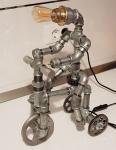

Didn't watch the video due to very bad internet connection, but have seen this picture of final result. Impressive. It's on my to do list.
LMMasterMariner
Ralph - imagine for example, using a boring bar and wanting to control accurately the hole depth so that with each cut pass the carriage is stopped at the same place every time. Same could apply in essence if turning outer diameter to a critical stop point. I now have problems that prevent me managing shop work and not sure I can find an example video very easily I'm afraid, though try the following link --.Originally Posted by Ralphxyz

The original part 1 build video can be found on my simple web site - https://www.oldmansshop.com/vid-page...e-stop-pt1.php
Chris

I'm not much of a safety Nazi but permit me to interject one observation...
If the carriage is being driven by the leadscrew or a separate feed rod, running the carriage into a locked down carriage stop can cause a lot of damage. When not in use loosen the screws on the stop so the carriage can push it along if accidentally fed into it under power.
If you have cause to fear such a collision you may even want to fit the stop with a buzzer activated by a microswitch whenever the carriage contacts the stop. Though, as with many safety devices, training yourself to be aware and careful may be a better solution.
Last edited by mklotz; Jul 17, 2024 at 11:34 AM.
---
Regards, Marv
Smart phones are to people what laser pointers are to cats
Homo sapiens is a goal, not a definition
Marv - you are right of course but I never use the stop unless using manual feed! If desired to use it with leadscrew operation then a micro switch type of set up could well be useful, though I expect not infallible. Over the years I have done the bulk of my finer work manually feeding. Your other point - my block is secured firmly in use but not strongly enough to resist an accidental 'crash' if under power. It has served me well safely. Best, Chris
Chris, the remark wasn't aimed at you. It was intended as a reminder for the less experienced folks who may see this thread.
FWIW, I keep my carriage stop locked up against the headstock and have yet to run into it accidentally. OTOH, I ran my swarf tray into the headstock often enough that I did build an alarm to warn me about that...
Lathe alarm
Fortunately the tray is thin sheet aluminum so the headstock was undamaged. I can't say the same for the tray.
---
Regards, Marv
Smart phones are to people what laser pointers are to cats
Homo sapiens is a goal, not a definition
Good construct Chris, and a very useful addition for a lathe.
One nit; the Vernier descriptor is not an accurate one as by definition a Vernier uses 2 scales to interpolate a reading.
https://en.wikipedia.org/wiki/Vernier_acuity
Perhaps a better name would be "graduated dial"
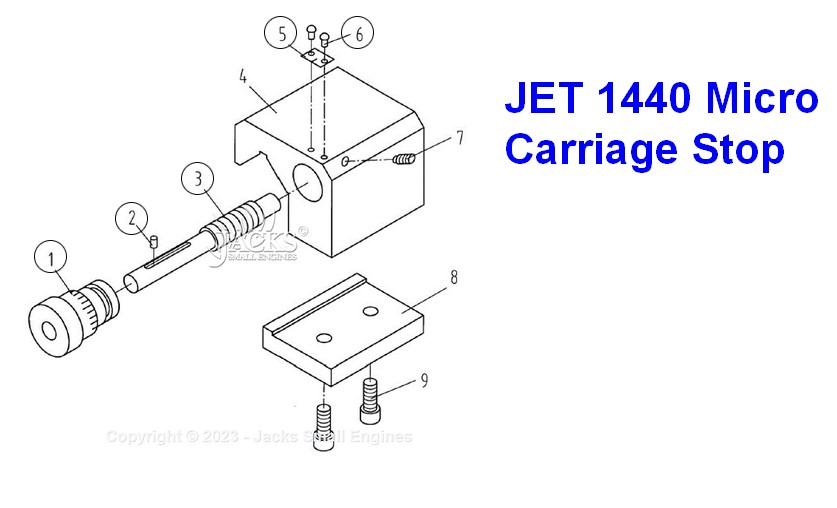
The JET 1440 lathe I acquired many years ago had an adjustable stop which is very similar in principle to the one you made.
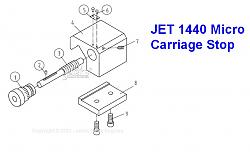

Last edited by gatz; Jan 31, 2026 at 12:02 PM.
There are currently 1 users browsing this thread. (0 members and 1 guests)
 Posting Permissions



 Reply With Quote

Bookmarks