I still enjoy using a broom.

Printable View
I still enjoy using a broom.
I sure a fair amount of what they picked up was from the horse...
A narrow street!
Or all the other horses. That was WHY they had street sweepers in the first place...
That overflowing trash barrel in the back seems to indicate they either didn't empty them very often or everyone walked around wadding up paper and throwing it away.
Sailors turning capstan to weigh anchor. 1932.
Fullsize image: https://diqn32j8nouaz.cloudfront.net...r_fullsize.jpg
https://diqn32j8nouaz.cloudfront.net...igh_anchor.jpg
"What shall we do with the drunken sailor?"...
I'm thinking this is from the USNA. We weren't using wooden sailing vessels in the 1930s, however midshipmen still had to learn how to sail.
Cocklepickers. Lancashire, England. 1916.
Fullsize image: https://diqn32j8nouaz.cloudfront.net...s_fullsize.jpg
https://diqn32j8nouaz.cloudfront.net...klepickers.jpg
Fullsize image: https://diqn32j8nouaz.cloudfront.net...p_fullsize.jpgQuote:
Machine shop inside Wilson Dam on the Tennessee River, 1947.
https://diqn32j8nouaz.cloudfront.net...chine_shop.jpg
Minnesota bank workers. 1974.
Fullsize image: https://diqn32j8nouaz.cloudfront.net...s_fullsize.jpg
https://diqn32j8nouaz.cloudfront.net...nk_workers.jpg
Clearly dressed for the 2 days of summer in MN :-) Open late, too, I remember when 'bankers hours' were a real thing...
Groovy baby!
Long Island Railroad workers. 1942.
Fullsize image: https://diqn32j8nouaz.cloudfront.net...s_fullsize.jpg
https://diqn32j8nouaz.cloudfront.net...ad_workers.jpg
'Long Island Railroad workers. 1942.'
Steam trains and girls. What more could a guy ask for?
Washing carpets by the sea. Helsinki, Finland. 1907.
Fullsize image: https://diqn32j8nouaz.cloudfront.net...s_fullsize.jpg
https://diqn32j8nouaz.cloudfront.net...ng_workers.jpg
Definitely some tough women there! I see lots of snow in the background by the giant mansions...
'Washing carpets by the sea. Helsinki, Finland.'
I found this article on the subject interesting.
https://www.atlasobscura.com/article...cleaning-piers
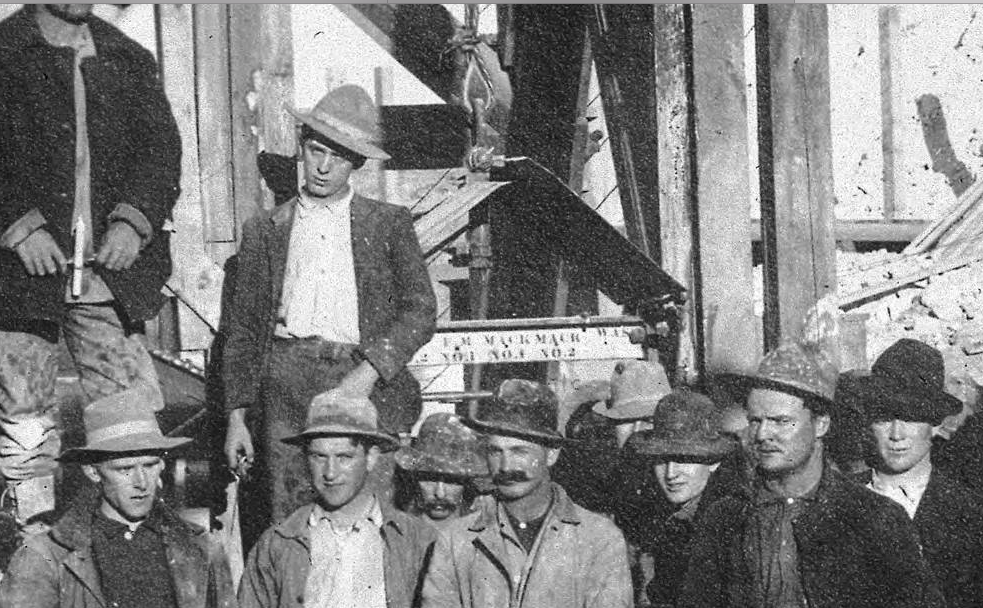
Gold miners. Nevada, 1905.
Fullsize image: https://diqn32j8nouaz.cloudfront.net...s_fullsize.jpg
https://diqn32j8nouaz.cloudfront.net...old_miners.jpg
What’s that structure, the head gear? Pounders?
The structure appears to be an elevator system.
Attachment 34819
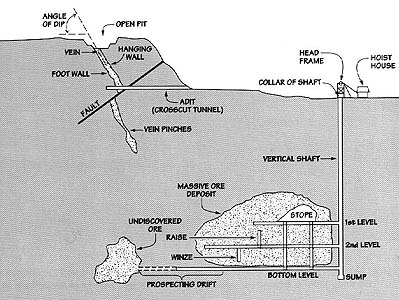
The mine is probably like this...
Attachment 34820
This is from Google.
The most visible feature of a mine shaft is the headframe (or winding tower, poppet head or pit head) which stands above the shaft. Depending on the type of hoist used, the top of the headframe will either house a hoist motor or a sheave wheel (with the hoist motor mounted on the ground). The headframe will also contain bins for storing ore being transferred to the processing facility.
U.S. Army nurses in France. 1944.
Fullsize image: https://diqn32j8nouaz.cloudfront.net...e_fullsize.jpg
https://diqn32j8nouaz.cloudfront.net...ses_france.jpg
It appears to be the shaft elevator judging by the large wheels and cables at the top of the structureQuote:
Originally Posted by Philip Davies
re post #1584
"Your Mom wears combat boots!"Quote:
Originally Posted by Jon
Yes, she does! With US Army canvas boot leggings as well.
And saved your dad, and your dad, and your dad, and yours too!
However, seeing how YOU turned out, she almost regrets that last one....
The year of my birth. My father had already died in the Marine Corp. Truly the greatest generation, men and women, military and civilian. All the greatest.
Quote:
Originally Posted by Jon
Finnish bakery workers. 1890s.
Fullsize image: https://diqn32j8nouaz.cloudfront.net...s_fullsize.jpg
https://diqn32j8nouaz.cloudfront.net...ry_workers.jpg
Circa 1890.
Fullsize image: https://diqn32j8nouaz.cloudfront.net...s_fullsize.jpgQuote:
The Harvard Computers, the group of women computers at the Harvard College Observatory, who worked for the astronomer Edward Charles Pickering. The group included Harvard computer and astronomer Henrietta Swan Leavitt, Annie Jump Cannon, Williamina Fleming, and Antonia Maury.
https://diqn32j8nouaz.cloudfront.net..._computers.jpg
No question a greater quantity and higher percentage of females work today in high level positions than 1890, withdrawn from stereotypical roles. The availability and means to distribute such historical information certainly expanded at least the same rate, if not more. WWII may have opened labor to them, yet the majority who excelled, appear to have mathematics in their favor.Quote:
Originally Posted by Jon
So why is it; if asked, few women can name one positive role model in something other than entertainment, fashion, or politics? That last one is gratuitous, since many politicians do so, simply because they lack marketable skills.
Fullsize image: https://diqn32j8nouaz.cloudfront.net...s_fullsize.jpgQuote:
Mill workers in the spinning room, Magnolia, Mississippi, 1911.
https://diqn32j8nouaz.cloudfront.net...ll_workers.jpg
Mostly children...
There are a lot of children, why are two women wearing wide brim hats?
'Mill workers in the spinning room, Magnolia, Mississippi, 1911.'
Those fire buckets may contain sand.
But I found this interesting. The rounded-bottom bucket is far more efficient in launching the water at the fire than a flat bottom bucket.
Looks like a nice, bright cheery place... Until you notice that it's lit (on darker days or nights, by a handful of bare, incandescent bulbs that look to be about 10' - 12' apart. In my shop I have 4' LED lights every 8' or so that give of 10X the light of those bulbs. Now ask women and children to work around a bunch open spindles and other pinch points and moving parts... YIKES!
Lighting options has greatly improved over the yearsQuote:
Originally Posted by Hoosiersmoker
While hazards in the work place have been reduced immensely throughout the years so has training and awareness of the hazards which still exist, and are more difficult and in some cases nearly impossible to completely eliminate.
I worked around some flat belt equipment as a teenager most all of it had been converted to individual motor drives and could be stopped independently of everything else it was still next to impossible to change speeds unless the belts were turning maybe not actually under power at the time usually we changed the speeds as the motors were winding down. Slowing the speed of the machine was easy as gravity helped you. You simply used a push stick to slip the belt down to a smaller diameter pulley then used it to force the belt over the larger one on the bottom, but when changing in the other direction you had to do this in reverse meaning the belt had to be lifted and forced to climb over the larger pulley. Do this while the motor was still turning fast and if you weren't careful it would grab the stick before you could get it fully out of the way and smack you right in the face or send it flying through the shop or break it. Do the change when the RPMs had fallen off to the point that momentum was lost and the 4 or 6 inch wide belt might not rout itself in place. if it was mostly seated then you simply started the motor if it was only partially on then you had to roll it by hand but if it failed to make the climb and the motor stopped then you had to start the motor and try again.
Trust me when you are 12 or 13 years old you learn very quickly how to time things just right very quickly
My father was working for 'Briggs Motor Bodies' after WW2 at the Southern end of Eastleigh airport, where the first flight of the Spitfire took place and many aircraft were built in the that building, there the lighting was an incandesent bulb every 4 yards, Ford Motor Company bought Briggs for the site and to bring a major part supplier 'in-house'. Fords first action was to install continuos strip lighting 4 tubes wide 10 feet apart throughout the building, eliminating all the dark corners and hidey-holes at a stroke. https://www.fordtransition.org.uk/im...embly-Line.jpg
The Cunliffe-Owen buildings that became the Ford site https://supermariners.files.wordpres...en-factory.jpg Note the lack of 'North-light' roof layout and roof glazing, something Ford also added to their plant extensions.
Fullsize image: https://diqn32j8nouaz.cloudfront.net...w_fullsize.jpgQuote:
Salmon fishery, Celilo Falls, Oregon, 1941.
https://diqn32j8nouaz.cloudfront.net..._work_crew.jpg
I wonder how many people fell in and got swept away before securing themselves with rope...
'Salmon fishery, Celilo Falls, Oregon, 1941.'
I never heard of it but I found this interesting.
On March 10, 1957, the massive steel and concrete floodgates of newly completed The Dalles Dam on the Columbia River are closed, and within hours Celilo Falls, approximately 13 miles upstream, disappears beneath the rising waters. The falls formed a rough horseshoe shape across the river, and nearby are two ancient Indian villages -- Wyam, on the Oregon side of the river, and S'kin on the other shore -- which also disappear into the reservoir behind the dam. Tribes from near and far have for thousands of years come here to fish, trade, and socialize, and the loss of the falls and downstream waters is a heavy blow to traditional Native culture. Tribal members are among the 10,000 people who gather to witness the opening of the dam and the submergence of Celilo Falls, celebrated by some and considered by others a heartbreaking turning point.