I'm betting all four of them are as hard as nails and I certainly wouldn't want to mess with any of them.Quote:
Originally Posted by hemmjo

Printable View
I'm betting all four of them are as hard as nails and I certainly wouldn't want to mess with any of them.Quote:
Originally Posted by hemmjo
black smith,not much different that carpenter, just diferent tools, you still have to make things fit. my grandad was a back smith and carpenter.(on my dads side) he built a many churches & the pews inside in northern LA ( lousiana/arkansas border in the fork of delauter.. )many old maps show the town there being named either after us or we were named atfer the town,nobody knows, and most or all I have found including my dad & his brother who died last year at 87 years old never knew that area was named after the family, but somehow google shows it to be the name of the area "tucker town") I do not know when the name was stoped being used but it must of been in the 1800's or earlier. my other grandad was just a carpenter. He built many/most of the homes in/around Gustine & another smaller town I ferget the name of cali including the one m 87 year old mom was born in and grew up in. that side of my family also owned one of the 2 or 3 major water wells that survived the big SanFran earth quake/fire in sanfran sysco.:headscratch: I know thats not how it is spelled..., that was one bussy well. as for me...I personaly thing any body can be acarpenter if they give a ****. me a machinest, racer,dad ,fabricator.and also carpenter wen needed. I built my 24x34 shop by my self, finished like a home on the inside with central ac&heat&bathroom&kitchen,all drywalled.all painted nicley( wife did help with shingles and helped picking up the ridge board.) my small toy shop 12x12' ,my 2 story barn( also finished on the inside with ac & heat, I did all my self execpt for the concreate slab's, I did do all forming for everything. it's possiably the simplest stuff Ive ever done. it can be quite relaxing.and fustrating to do when your a machinest and work down the to .0001" on most stuff. for some reason wood just dont like cutting exzactly. so if you need a break go out and build a few sheds or a shop, it's quite eazy. as for door frames...I dont really use them,I buy door slabs and build the building to fit. no shiming required.( it's good to use pressure treeted on those of they are exterrior doors.) plumbing is eazy as is the electrickel & AC.I did have my brother come over to charge the AC unit for me. it's nice to have blue prints or just do them your self and work it all out before hand. and since Im in Florida my stuff has to pass some pretty ridged standards.( hurricane)and passed with no issues. inspector said it was over kill.
Workers at the Aircraft Engine Research Laboratory in Cleveland, Ohio. 1944.
Fullsize image: https://diqn32j8nouaz.cloudfront.net...s_fullsize.jpg
https://diqn32j8nouaz.cloudfront.net...io_workers.jpg
Charlies Angels couldn't hold a candle to these girls.
Although I am not sure where the town is to which you referred, but NW Louisiana is where I am originally from as well.Quote:
Originally Posted by marksbug
wow thats 2 people in the last year Ive met from up there. well 4 including her kids. we were waiting for a flight ,I was going to mem tenn she was at the rong gate. she asked me why I was going to spearsville...I didnt look like airforce....she almost blew my mind, then I looked at the next gate and it said spearsville on it. now that blew my mind. a flight from florida to sperasville. I may have to do that some day. to see some old people before there all gone. or Im gone. I also have a local friend at the afb up there for another year or so.
farmville /bernice area, rural route 2 I think,but back in the woods was "tucker town"long long ago, but nobody remembers tucker town road gos around the town up to the arkensaw border or very close to it. I still have some ken folk up there is that area. heck you may be one of them:idea:Quote:
Originally Posted by mlochala
Typesetters at Milwaukee Journal. 1930s.
Fullsize image: https://diqn32j8nouaz.cloudfront.net...s_fullsize.jpg
https://diqn32j8nouaz.cloudfront.net...ypesetters.jpg
I knew people did that job back in the day.
But I never met any of them.
I have set type, by hand, for a small letter press in college, late 60's. As I recall it had about a 12" x 14" chase.
So frustrating when someone before you replaced the type in the wrong spot in the type case.
just using this dam keybord chalanges me...spellen too:embarrassed:
At Camp Creek Threshers (Waverly NE) this Linotype was set up for demonstrations. I think it still is.
Attachment 42126
My MIL had spent time at one of those machines back in the day.
While there, I had them make a slug with her name on it. She was as happy as a kid with a new toy.
I got to use an old Linotype machine once back in high school; our print shop class had gotten two when the local newspapers switched to phototypesetting; they gave all their old Linotypes to the high schools.
Unfortunately while I was enrolled in print shop I broke my thumb and spent most of the 9 week class with a cast on my left hand and arm.
Have we discovered why mainstreammedia is less trusted than perhaps in this era?Quote:
Originally Posted by Jon
Yes, ran (rammed?) that term together intentionally.
I have one Model 31 Linotype up and running each year at the print shop at the Tri-State Engine and Threshers Assn. in Bird City, KS. That show always begins on the last Thursday of July and the following Friday and Saturday. You can see many steam tractors as well as a lot of older machinery there, a blacksmith shop, etc. The print shop is just a small part of that show. Come see that show if you can and you can see a Linotype in operation.
For some 25+ years after my stint as Plant Engineer for a heavy equipment builder which went out of business in 1982 I operated a commercial letterpress and hot lead typesetting shop I had previously run as a part time "hobby" shop and, as Linotype and other linecasting machinery quickly became obsolescent when "cold type" became the norm, these machines were had for little or no cost just to get rid of them. I believe I owned 19 of them, many I scrapped and parted out. I currently have the one in Bird City and one at my home shop, a Model 32. When I got over 60 I had to get another PE job for health insurance and the letterpress shop was nearly shut down. When Medicare became available to me I retired from the Coil Coater plant previously mentioned and since then I've pretty much do what I wish at my "little tin shed" (5000 square feet) on my small farm East of Denver. In it I have quite a few older machine tools, welding equipment, etc. I just acquired a 19 inch LeBlond lathe (20-1'2 swing over the bed), 8 feet Centers, and have been trying to rearrange things to get it in to replace an old Cone Head lathe 15 inch swing by 8 foot centers dating to the late 19th Century.
I still don't know what I want to be when I grow up!
I believe it is because every letter those guys set was written by a real reporter. Today, it seems like all of our news is cut and pasted from one source to another. When I was in school what was called plagiarism. Also, the news outlets totally control the content. The content is now as much click bait as it is that real news.Quote:
Originally Posted by Toolmaker51
DON'T grow up.... A " kid " has to be allowed his toys to play with,...I would love to have your toys and " playroom " .....5000 square foot tin shed. You, sir; are very lucky to have the room and knowledge to pursue activities which make your life fulfilling. I wish you many happy days in the future. LarryQuote:
Originally Posted by the harmonious blacksmith
This was a job often done by the deaf. Rooms full of inotypes are stupifyingly loud. See the bubble at 2:41.
https://www.youtube.com/watch?v=MI2sYvUb4_0
Solution; save growing up for later! W-aaaay later.Quote:
Originally Posted by the harmonious blacksmith
Practically neighbors, ignoring that desolate Sahara-like transit known as Kansas, any farther it'd be Colorado, (sometimes a desolate Himalayan-like transit, free nose bleed and popped ears included).
Ahhh, so many things travel posters omit.
But haven't hit any antique power shows in a long time. That might be a good long weekend, with lead time known. Road trips shorten with streamed internet.
Thanks!
https://www.google.com/search?client...ird+City%2C+KS.
My wife is from Slidell. I love Louisiana.Quote:
Originally Posted by mlochala
I have heard several ideas where the phrase "mind your p's and q's" comes from but I think it has to be from setting type.
We hot metal compositors avoid using the "LEAD" word.
Everyone goes "we're all gonna die" because there is so much misinformation about lead poisoning.
LEAD IS NOT POISONOUS!
Lead oxide is poisonous. Lead oxide, basically lead "rust" was used in paints, lubricants and other uses.
Molten Linotype metal, which is normally run at 535- 550 degrees max, is also safe as to the fumes. The fumes from the molten metal are not toxic until at least 1100 degrees.
I "set type" on one of my Linotypes 6-7 days a week, so I had a test for lead in my body and I tested in the "unexposed" range.
I think you could keep a Linotype slug in your mouth like a toothpick if you want to for the rest of your life without harm, though I can't fathom why you would want to.
Linotype makes good cast bullets but apparently is in short supply these days.Quote:
Originally Posted by the harmonious blacksmith
Linotype can be alloyed from pure lead, but those elements aren't high in retail availability. I'm down to my last couple hundred pounds of ingots. About half is old wheel-weights, which new material aren't castable anymore.
Anyone ever notice the backward letter 'N' in some Lyman molds?
This times 1000.
Lead poisoning in humans is due to lead oxides in paint and tetraethyl lead in gasoline. (modern occupational health practice was basically founded by a woman who took up the cause of lead paint workers in the 30's). https://www.acs.org/content/acs/en/e...ehamilton.html )
Mercury is pretty much only toxic when in compounds like methyl mercury https://en.wikipedia.org/wiki/Minamata_disease because it can be taken up by our cells. We don't actually metabolize elemmental lead or mercury very well. (still does' mean I'll breathe in molten lead fumes or drink elemental mercury
:-)
Toxin concentration increases up the food chain, so being on top...is bad. Hence DDT killing top predators because it gets into the algae eaten by little fish, which get eaten by the bigger fish, which get eaten by the bigger fish which get eaten by the Bald eagles.
And of us older than 26 (leaded gasoline was banned in '96) have been exposed to enough teratethyl lead to demonstrably affect our cognitive functions to some extent. https://www.nbcnews.com/health/healt...tudy-rcna19028
And yes, that includes me. It's a sobering through. Generation Lead is a real thing, and it'a not just poor kids in ghettos.
So many terms come from printing.
Mind your p's and q's is only one, meant to tell the "printer's Devils" (apprentices) to be careful because the type is in mirror image.
Apprentices began by distributing the individual used pieces of type into the case (the compartmental drawers holding the individual letters, numbers, punctuation, spaces, etc)into their proper places so the typesetters never had to look at each pieces while setting the type.
Upper Case and Lower Case were the cases in newspaper cases holding the "capital letters" in the upper case and the "inferior letters" in the lower case. There were many styles of cases for job printing uses, but the news cases, holding many "fonts" of type were separated into the upper and lower cases.
"Cut to the chase" come from tearing down a printing form in a rectangular frame called a chase.
"To coin a phrase" comes from the various types of QUOINs, expanding clamping devices, used to lock the type into the chase. They're spelled QUOIN but pronounced COIN.
FONT, for that matter, is misused these days. They are using FONT instead of TYPEFACE. Technically, a font is a particular number of type pieces of each letter or figure of one size and weight of a singular type face, those numbers relatively small but type was purchased in those numbers and usually more than one font was required to fill a case with sufficient pieces of each character to set a job. Printers are fighting a losing battle on that one :-(
"Making a good impression" probably comes from printing but that's conjecture on my part.
Not disputing this Bruce,But surely location would have some bearing also? Those growing up in big cities as opposed to country towns? Even 3rd world places where pollution controls are markedly less, against me, (at least) growing up in rural Australia, with some very progressive controls in place and zero smog to live with.Quote:
Originally Posted by bruce.desertrat
Phil
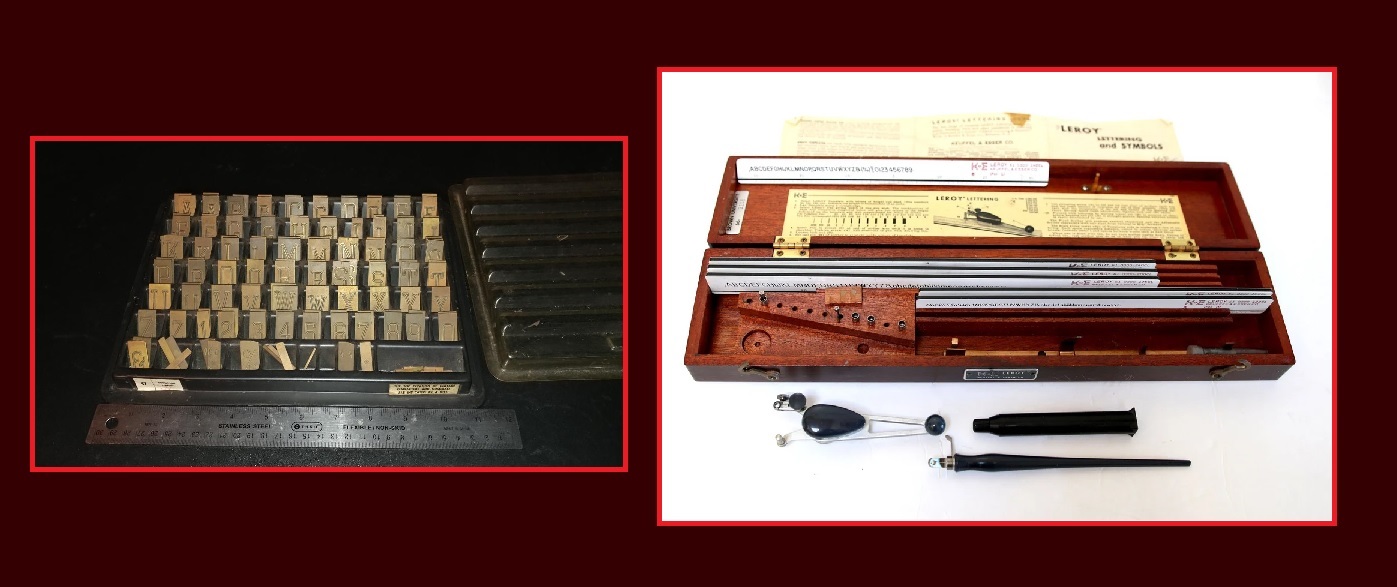
'Font' also is the correct term for letters/ figures used in manual pantograph/ drag engravers. Each letter, number (many punctuation marks are combined) is a brass plate, cut as a ball nose endmill would, into the surface. That is what's guiding the stylus. They range in size, IIRC in pica graduations, pantograph arms adjusted desired size further by ratios. I'm sure they could be had in various languages and styles; only familiar with that resembling Arial, Times Roman, Old English.
Illustrated here on the left.
Attachment 42157
Illustrated on the right;
Another device, best known is the 'Leroy', worked nearly same way, but all the figures on a single plastic plate. They were used in drafting too, especially final inked sheets meant for lots of handling, or to be retained indefinitely. I bought an old patent application from 1948-1950; they are inked, sharp as day they were completed.
Quote:
Originally Posted by 12bolts
Individual exposures vary; I was speaking more on the epidemiological usage of 'us'. but the vast majority of people were exposed to decades of lead to some degree or another, and the 'safe' dose is very very low.
Folks in the suburbs weren't living in the big cities, but they certainly were driving everywhere. And pollution controls like catalytic converters, etc were aimed at smog-producing emissions like nitrogen oxides; tetra-ethyl lead got mostly burned to lead oxides and went out the tailpipe as fine particulates. If you lived your whole life out in the boonies, you definitely got a lower dose, but if you lived around a gasoline powered vehicle. you got some.
The sad and infuriating thing was this was known from the beginning. https://www.smithsonianmag.com/smart...ted-180961368/
Ethanol works better than TEL to raise octane.
Well, I'm sure their excuse was "Follow The Science", and turns out they publish excerpts and findings tuned to bolster certain targeted minds.Quote:
Originally Posted by bruce.desertrat
One side only has a goal; the other follows an agenda.
Unfortunately all metals "rust" so a block of lead will always have some oxides on it, and mercury metal converts to the more toxic form in nature by the action of bacteria.Quote:
Originally Posted by bruce.desertrat
Font is also used for Linotype/Intertype, Ludlow and other matrices used in linecasting or type casting equipment as well. Still, the fixed quantity of a particular typeface, weight and size pretty much applies.
Yes, it's interesting because the house I grew up in still is fed with a lead water pipe from the street mains and we suffered no ill effects from that. When the city came around and installed water meters on old houses that had been on a flat rate, I thought they would have a fit when they ran across that lead line. Nope, they had adapters to fit and never said a word. Recently the city has begun a program to replace all those old lead lines and apparently there are a lot of them still in use, more than I had imagined.
As I previously said about my daily exposure to Linotype, Ludlow and lead based type didn't show any lead in my system, but my father had elevated levels of lead from his jewelry store being on a main business avenue during the leaded gasoline era. Lead eventually "chelates", I believe is the term, out of the body unlike asbestos and some other toxins.
And of us older than 26 (leaded gasoline was banned in '96) have been exposed to enough teratethyl lead to demonstrably affect our cognitive functions to some extent https://www.nbcnews.com/health/healt...tudy-rcna19028[/QOUTE]
Followed the science. Thought I discovered source of feeble politicians!
Darn it all, there goes hypothesis.Quote:
Originally Posted by the harmonious blacksmith
The line of thinking that feeble Politian's were at one time exposed to excessive amounts of teratethyl lead as to the root cause of their failing cognitive abilitiesQuote:
Originally Posted by Toolmaker51
Would be to suggest at one time they may have been gearheads. Being somewhat of an older gearhead myself I know quite a few who are much older than I am, and like me most will profoundly acknowledge using leaded gasoline as their go to cleanser for all their mechanic work back in the day. So far as I know not very many career Politian's even know the difference between a screw driver and a pair of plier
Workers lower a lifting device onto a 100-inch telescope mirror. Mount Wilson Observatory. California, 1935.
Fullsize image: https://diqn32j8nouaz.cloudfront.net...s_fullsize.jpg
https://diqn32j8nouaz.cloudfront.net...or_workers.jpg
There are a few places (museums) that have kept various lead typesetters functional for demonstration purposes.
I was recently in a up-cycle store that had an actual full type font storage cabinet (no type) the ones in large newspapers like this would have been had to be serviced with a rolling ladder.
Over the past 5 decades, many font job case drawers where scrapped and many of the 2" deep drawers were turned into wall mounted what-not displays.
The cases holding the drawers are categorized by font, size and upper and lower case letters. (upper case was on top, lower case on bottom.)
You might imagine how many pieces were needed for a large edition newspaper.
Linotype machines were extremely complex machines and had an enormous network of parts once described
to me by a former newspaper typesetter as "a manual typewriter met a concert organ".
One of the downsides was working long-term with molten lead and it's fumes.
The dreaded fail of a typesetter was 'pieing'.
The machine had a metal framed 'chase' which the metal mirror reversed type was placed in to have molten lead form the casting to mount in the printing press. Once the type was in place, it was locked into the chase with quoin locks which placed lateral pressure to the chase sides.
There is no bottom. After the chase was full, it was locked and removed from the machine.
If the type is not locked well or if one piece is askew, the entire set can be lost due to 'Pieing'. All of the metal hits the floor in thousands of pieces which have to be swept up, dusted off and re-cased into the correct font drawers and the typesetter starting over at the first letter.
The were a few makers of equipment, Merganthaler being the maker of 'Lino-Type' equipment and was market dominant.
Another was Monotype. Monotype is still in business and largely produces intellectual property licensed as computer type fonts.
Monotype bought out the Linotype catalog of fonts.
Merganthaler proceeded into the early computer typesetting era and saw the transformation of most new typesetters were women.
Merganthaler was purchased by and became a division of Heidelberg (printing press manufacturer.
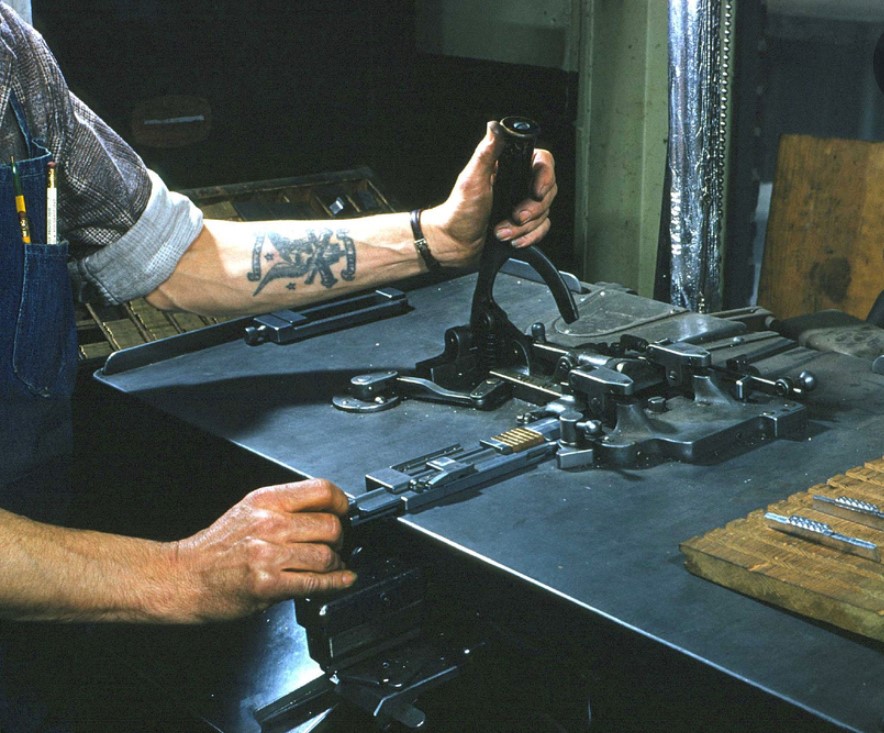
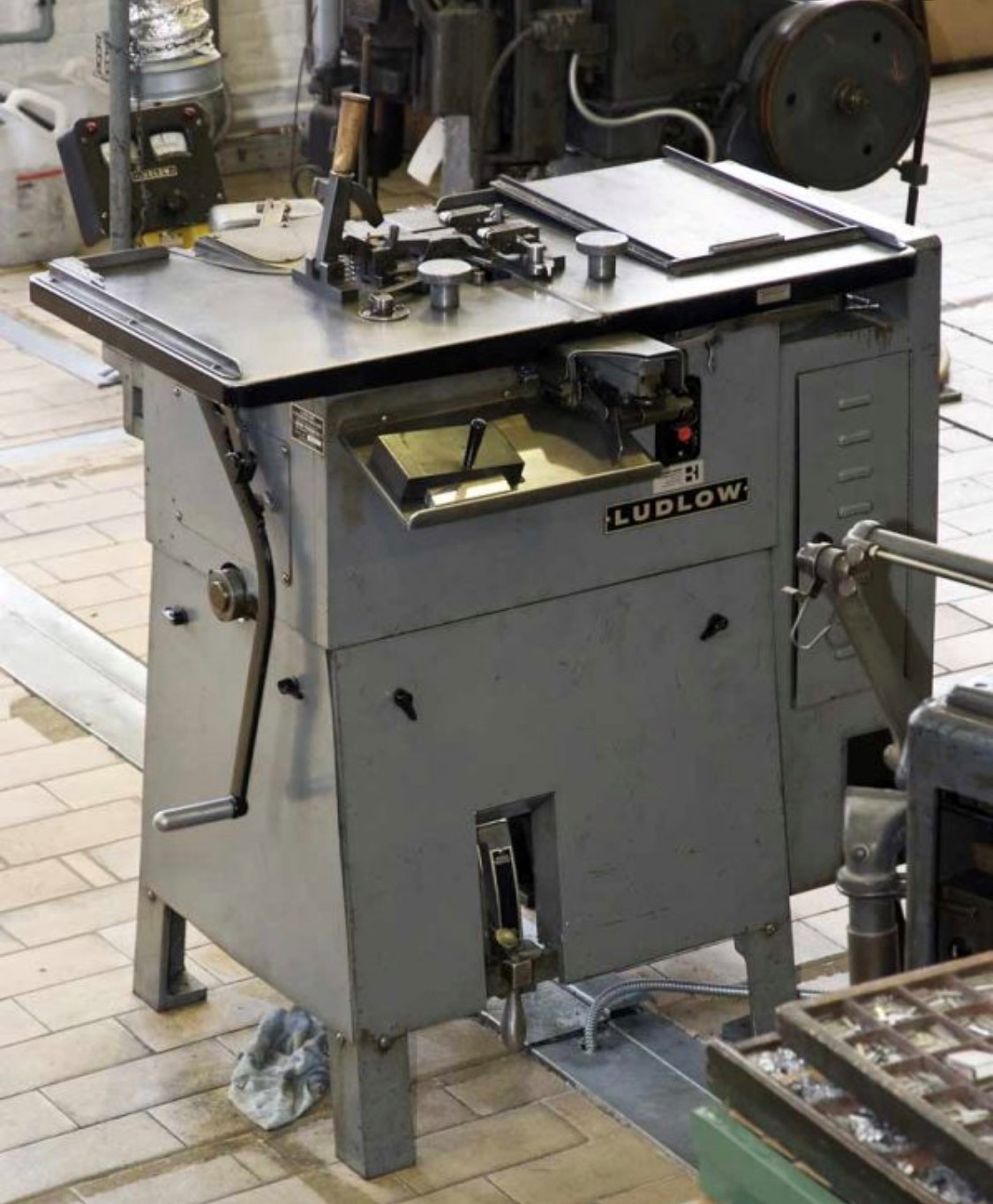
Another common, smaller machine was made by Ludlow. They made smaller units that cast lead into type set by hand.
These were single type line machines known as 'Headliners' and typically used for very large font sizes above 24 point type.
There are still shops turning out work on Ludlow machines for custom work. (expensive work)
Attachment 42185Attachment 42186
Mesta Machine Company foundry workers.
Fullsize image: https://diqn32j8nouaz.cloudfront.net...s_fullsize.jpg
https://diqn32j8nouaz.cloudfront.net...ne_workers.jpg
That is a heck of a complex casting.
Ive often wondered in old pics like this so disorginized everything juts how many relatively new guys are walking around wondering wft am I supposed to be doing??