Shenanigans. We're rebranding utter chaos. I cannot comprehend why.

Printable View
Shenanigans. We're rebranding utter chaos. I cannot comprehend why.
If the shenanigans of the individuals are discouraged, then the chaos of groups can be prevented. Should have been done at the parental level long before preschool age and continued throughout the formulative years.Quote:
Originally Posted by Toolmaker51
Reminds me of something I read recently, 2 very young boys about the age of 4 decided it was time for them to try their hand at using curse words, the mother asked Tommy what he wanted for breakfast, Aw, H**l mom I think I'll just have a damned bowl of Cheerios. 'SMAK'. Johney what would you like for breakfast? Sh*t Mom! You can bet your A** it won't be none of those damned Cheerios.
I heard it was Muesli.
Reminds me of the story where Johnny's father tells him to fetch a switch...
Engineers and metallurgists inspecting the cap for the top of the Washington Monument. 1884.
Fullsize image: https://diqn32j8nouaz.cloudfront.net...s_fullsize.jpg
https://diqn32j8nouaz.cloudfront.net...allurgists.jpg
When aluminum was the rarest of metals on the earth.
I was just going to look "what metal is it?" up........Quote:
Originally Posted by mwmkravchenko
Engineers and metallurgists inspecting the cap for the top of the Washington Monument. 1884.
I can hardly wait for 'them' to try making aluminum with wind or solar power.
"...it comes from the building!"Quote:
Originally Posted by jimfols
Sure it does.
https://www.youtube.com/watch?v=tfC_-Ub9lRM
Edited, to note correction/ amplification offered next by hemmjo, stating "This video is from a documentary created by Michael Moore. I am even LESS a fan of Michael Moore. He is notorious for spinning things to his point of view. He edits clips to distort facts."
I am not a fan of Electric Cars for many reasons. Someday, but not now.
This video is from a documentary created by Michael Moore. I am even LESS a fan of Michael Moore. He is notorious for spinning things to his point of view. He edits clips to distort facts. This clips is from around 2010. It was not GM that said 95% of the electric for EV's come from coal. It was executive of the Lansing Board of Water & Light.
There is so much miss information spread around it makes it too easy for people to disprove statements made in defense of some cause. Saying that GM said the EV is charged with 95% coal is false. That appears to make the whole video false, and therefore one would assume the EV's are not that bad. We need to give REAL, truthful arguments for bad ideas, not arguments that are so easily refuted.
I believe this is very good.
An old saying coined mostly by science fiction writers goes like this "There ain't no such thing as a free lunch". I find that saying to hold true in every aspect of what we do in our daily lives. Just like over unity, from what we know of physics in our little spectrum of knowledge of the universe you cannot get something from nothing nor can you create more of anything out of less than what is already there.
BEVs are being touted as the end all saving grace of vehicles, but nothing could be further than the truth than the purposeful omission of the cost of energy to produce them, the added strain on natural recourses to produce them.
Hybrids are as has been mentioned probably the better of the 2 worlds. However, from a purely economic means of going to town and back. If for instance you don't need anything more than transportation if you had a duel chargeable Hybrid or even a BEV that you could plug in to recharge the battery when it is parked at your home from solar panels instead of being charged from the grid once the initial cost outlay was covered from miles driven not having to pay the utility company for your electricity you would realize at net savings of cash, Driving the duel chargeable hybrid sensibly you might not even have to run the engine very much at all.
But none of anyof this will do a thing to save the planet as they like to say, unless you maintain and keep the vehicle for its full life cycle. This trading for new every year or even every 5 years will do nothing but continue the cycle of waste.
I bet my 30-year-old diesel pickup that gets around 20 MPG is as green if not greener than most vehicles sold within the past 5 years will ever be if they are not kept on the road for at least 15 years, assuming any of the plastic laden electronically overburdened pieces of junk will last that long
BEV can be what they propose. But I like your caveats. Electricity has to be renewable. And the lifecycle of the car has to be reasonable. The two largest opposing forces are in play here. Big business not wanting to do anything bad for business margins ( almost makes sense ). A consumers habits. Uphill both ways.Quote:
Originally Posted by Frank S
I like the idea of a relatively cheap to drive vehicle. I see the quality of the engineering involved. But the battery type has to change. There isn't enough Lithium available right now for demand. Nor is there enough Nickel. Again there are alternatives. But there is 20 years of know how into making Lithium ion cells. And that is the true problem. Any other battery type is just not alive long enough in large production capacities to have the engineering expertise available to make this work. Another Big business versus profits versus commodity availability conundrum. Not saying businesses are not willing to produce at a loss what they see long term as a profitable product. There are many examples of large companies being willing to foot the bill. And that is probably what will have to be done to make these electric cars viable.
From what I have seen for true mileage numbers from hybrids they are kind of a does nothing better but costs a lot more situation. Peoples normal driving habits do not give a person better fuel economy in these hybrid cars. You have to want to chase the efficiency. Some get awesome MPG. But most people I have talked to don't get a whole lot more than I did in my little Toyota pickup or my Little Toyota van.
As for efficiency. I drove Diesel Jetas around for over 15 years. I'd get nearly 50MPG in the city and over 60MPG on the highway. Now you get half of that. I'm not a chemist. But isn't double the mileage mean that you have potentially half of the pollutants?
Yeah, it would be kinda hard for 95% of the electric for EVs to come from coal, when coal accounts for less than 11% of the electric generation in this country. And we all should remember that we are in the infancy of this technology. I don't think battery powered vehicles are a long-term solution--fuel cells seem like a much better idea once they are developed further--but batteries are a workable power source for now. Also, there are plans for vehicles to draw power from the roadways, which would make virtually unlimited distance travel possible, once the infrastructure is implemented. Right now, though, we are where we were back a century ago, when gasoline infrastructure was just being built out. Lots of changes are coming, but I think fossil fuels are dying out, if for no other reason than burning them is a waste of a finite resource that has so many other uses.
According to this...Quote:
Originally Posted by schuylergrace
https://www.eia.gov/tools/faqs/faq.php?id=427&t=3
about 22% of electricity is generated using coal.
That is how it figures in my book, We can once again thank government intervention for poorer milage figures across the board. All while claiming to clean up the air.Quote:
Originally Posted by mwmkravchenko
In 1989 my oldest daughter bought her first brand new car a Chevrolet GEO metro 5 sp standard shift. Kept a record of every dollar spent every mile driven and where she drove those miles. every gallon of gas bought whether she bought the lowest grade the mid-grade or premium for 18 months of driving. This was done to be part of her master's thesis. I'm sure you can visualize how meticulous and diligent she was in her record keeping. Purchase price of car after all discounts and 1st time buyers' incentive, she paid cash the night she bought it a drove off after writing a check for $5,600.00. total additional monies spent over the 18 months a whopping $2000.00 this included insurance, ( under my policy) the gas and everything else averaging 58 MPG for 75,000 miles driven. bringing the total cost of owning and operating that car to $7,600.00 or just a little over $0.10 cents per mile. If she had sold the car for half of what she paid for it, still at that time the blue book was nearly the same as her negotiated purchase price, she could have boasted a nickel a mile driving expense. Try operating any vehicle for even 5 times that even adjusted for inflation today.
I went back and looked at my source (https://usafacts.org/earth-day-facts...waAvG-EALw_wcB), and it apparently covers all energy production, not just electricity. Your numbers are closer to what I remembered, which still don't have coal being the primary source of energy for electric vehicles. Thanks for a better picture of this energy sector, alone, which is what we were talking about.Quote:
Originally Posted by mklotz
The other elephant in the room so to speak is transmission lines are already carrying more energy than they were designed for. Disregard how that energy is going to have to be produced, there is an upper limit to the amount of energy the lines can carry. One way to carry more energy is to up the voltages Transcontinental high-tension powerlines can currently have between 66 to 750 kilovolts depending on the distances required for the energy to travel. Higher voltages mean more leakage until at some point the leakage and resistance to current becomes greater than the amount of energy received at the substations.
One way to counter the losses from overloading the current grid system would be to have community micro generation plants. I can just hear the NIMBY's screaming already. A problem with these power plants is multifold Solar is one source it only works while the sun is shining. Wind being another only works when the wind blows and there are already many associated issues with both of those with storage being the number one for energy on demand. Small hydro plants along flowing rivers may be viable in some instances on a small scale but the restrictions already in place on all waterways in the USA prevent the construction along the riverbanks let alone having any thoughts to building dams. Oil is partially renewable contrary to public beliefs not all oil is 65 million years old, but we are faced again with supply and delivery systems trucking, rail or pipelines. Natural gas is arguably probably one of the environmentally cleanest forms or energy which can at this time be used to produce electrical energy, but it also requires the same mode of transportation as does oil. Nuclear would be or I should have said could have been one of the best had the stigma of nuclear power being associated with the bomb and the difficulty of disposing spent fuel rods not taken over the benefits of using it, and for the most part ground further advances in research to a halt years ago. It is not even worth mentioning converting plant matter into an energy source since the farmers are already having to literally rape their lands to produce crops now. Wait until there are 12, 15 or 20 billion souls to feed we might even reach 8 billion in a couple of years as it is. Coal is out before even adding it to the equation.
In my mind it is going to require a judicial use of every resource we currently have to just keep up let along cover the added strain of adding more and more electric vehicles. I believe we have more options that are not being perused being kept from us probably done by lobbyist and big corps coercing government puppets.
If I remember correctly Texas has one of the whimpiest transmission line systems in the USA.Quote:
Originally Posted by Frank S
But even here.
https://www.cer-rec.gc.ca/en/data-an...s-ontario.html
You see we produce just over 60% of our power from Nuclear. Actually we have one of the largest single site Nuclear facilities in the world next to China of course! But when a large solar farm or wind farm is installed they have to run new transmission lines. A large part of the cost.
We too have a lot of NIMBY people. Louder than the others of course.
I think we crack 8 billion this year Frank. And India surpassed China in the number of people. China created their own particular problem with the one child policy and longer lifespans. Now like Canada the mean age is going up by leaps and bounds. Makes it harder to find people to work.
Biomass burning is not really solution when you consider how important it really is for the health and long term wellbeing of the coils on our farms. Keep removing the closed cycle system of plants and then decomposing plants and you end up with a situation of requiring immense volumes of fertilizer. Not so good for the bugs and earthworms that do the bulk of keeping soil fertile. I grew up amongst large farms in rural Manitoba. Where the farms used a lot of fertilizer there were few seagulls looking for worms when they were plowing. And plenty is adjacent fields that the farmer did not fertilize.
If it were to be done over again distributed generation of electricity and storage of electricity would be the go to method. Mandating that every house have solar panels on their roofs and localized batteries of either electrochemical or other means is a way to make this kind of idea work.
Here's one I think is brilliant:
https://eteq.com/worlds-first-carbon...pens-in-italy/
They are doing a megawatt scale plant now to. Nothing in this system is cutting edge. Only it's assemblage. Engineering like this is a way to bridge the gap in Solar and in Wind. And scaled down to a few house lots maybe 6 in size (guessing here) you have 24/7 electricity. And many more people to have jobs in maintenance. Remember maintenance? Almost a four letter word now.
I remember correctly Texas has one of the whimpiest transmission line systems in the USA. No argument there. Texas is basically on it's own grid system and shares very little with other states the exception being the neighboring states. Ercop dropped the ball last winter due to the high reliance on wind and solar, for each megawatt of wind or solar there is supposed to be an equally sized Natural gas generator as back up or standby. Natural gas generators are the only thing that can be powered up and brought online on demand. due to the nationwide scamdemic many natural gas intensifying stations were left short staffed or in many cases taken off line completely, the high demand for gas to heat homes and run other things reduced the quanity and pressures required to run the generators,many of the generators were not even maintained to be brought online at all so there was power outages. This summer we are in an 11 to 12 year heat cycle causing much higher than normal electrical power requirements. so once again many areas are experiencing some outages, Nothing like California sees frequently but when it the temps. are in the triple digits any your power goes out you get uncomfortable really fast. Most of the outages seem to happen in the larger cities where their grid system is even more over stressed.Quote:
Originally Posted by mwmkravchenko
Mandating that every house have solar panels on their roofs and localized batteries of either electrochemical or other means is a way to make this kind of idea work. Would be one good way however the word MANDATE would have to be changed to offering an equitable incentive otherwise once I had enough solar/ wind and storage to meet 125% of my needs I'd take an ax to the grid lines and they know I would not be alone in doing so.
Yeah. Only poor word use is my fault really, and people getting all riled up over being told what to do. The simple facts of life are that we are all told what to do. And it's generally for our good, and other peoples good. Freedom of choice stops where our freedoms impinge on other peoples freedoms. And the deeper we analyze that simple principle the less "freedom" we really have. The one part of freedom that amuses me the most is our freedom to accept the consequences of poor choices. I agree that incentives are required for any large group of people to make significant changes. That would be a given fact in regards to the initial cost of this kind of idea. For me the interesting thing is that pretty much only government has the ability to fund something like this as there is to little payback for pretty much any company. And it would effectively put the nails in the coffins of most if not all major utility providers. Residential neighborhoods would be self sufficient. Only industrial users of electricity would need to have peaker plants to keep up with demand. Or much better renewable and storage of some truly large scale capacity.Quote:
Originally Posted by Frank S
We can dream. But I think there's to much money and profit tied up in the present system worldwide to change without there being a truly ground shifting thing like what should be done.
The problem in allowing the government to get involved in anything is it makes everything 10 times more costly than it should be and is never efficient. Big corporate would never go for it for many of the reasons mentioned plus top management wouldn't be able to siphon as much profits away from the shareholders as everyone having their own micro-grids would be in effect investors
I agree. Just look at the latest NASA rocket or the F35 for well run and managed fiscally responsible programs created to line the pockets of large companies. Wasn't it Eisenhower who used the term military industrial complex. That's one of the largest drivers of the U.S. economy. Making it monetarily accountable would cost a great many well paying jobs. Similar things go on in Canada and every other developed nation. Truly sad. What needs to be done is known very well. Will it get done? I doubt it in my lifetime.Quote:
Originally Posted by Frank S
I'll let this state what freedom is . . .
Attachment 43258
Subjective, in every sense of the word
I think we have run this thread run off the rails, time for Jon to post us another picture to put us back on track
In fact, a study done by the state showed that wind and solar played a large part in propping up the grid. The problems were twofold: 1.) The natural gas production facilities supplying the generating stations were never properly winterized, so they were going offline as they froze up, and 2.) After ERCOT ordered all the utilities to start cutting power to keep the grid from completely going down and suffering major damage, some cut power to the natural gas suppliers and distributors, which made the problem even worse. However, even though folks early on blamed renewable energy producers as the problem, they were online with all their normal production facilities and actually saved the day (along with nuclear and coal, to be fair). Interestingly enough, the Texas legislature took relatively quick action to "ensure" this doesn't happen, again, but with one major shortcoming--they didn't require the gas producers to take steps to properly winterize their facilities, which was the cause of all this mess.Quote:
Originally Posted by Frank S
But I do agree that distributed generation is going to be the wave of the future, if the big utilities don't get their way. In nearly every state, they are trying to push through laws that will restrict implementation of independent home/business solar systems and stop states from forcing them to purchase excess power that's generated. It only makes sense to take the physical grid out of the equation in large part, both to cut electrical losses, as well as reduce construction and maintenance costs. Of course, you'd still need the grid to dump excess power onto, to support homes and businesses that don't have solar (or wind or water), and to provide power when the local source is down for whatever reason. But it wouldn't need to be nearly the grid we have today, especially the huge, long distance transmission lines.
Just a quick reminder: The government is us. We elected people to make those laws and regulations in order to live in a more ordered and civilized society. So, blaming "The Government" is simply blaming yourself and everyone else who lives here. You may not agree with the way the government is working, and we have remedies for that via your vote and your voice. Personally, I don't want to go back to the days when you could just take whatever land you wanted or build a house with faulty wiring and sell it to some unsuspecting person or have just anyone behind the wheel of a Mack truck.Quote:
Originally Posted by Toolmaker51
Electric automobiles were around before the first gas powered vehicle and to this day batteries still do not have the same power density as fossil fuels. I remember Katrina back in 2005 and big areas of Louisiana was without power, some for weeks, there was no power at my house for 6 days. There were long gas lines at what few stations open.....have these Greenies contemplated how to charge a battery in a "grid down scenario"? I suspect they will bring in diesel powered generators.
Yes, but before electric vehicles, there were steam powered vehicles, and we still use steam technology (in a much more refined way) to generate electricity today. Batteries are the same--we went from one-use cells to rechargeable to today's high power density (but not yet the same as gas), and they, along with electric motor technology, continue to improve. Gas and diesel engines have to some extent, but not on the scale of electric (or steam, for that matter). There are also more important and less dangerous uses for our finite oil reserves.Quote:
Originally Posted by TrickieDickie
And regarding your how to keep your house and car running in the event of a grid disaster, the ideal solution would be to have your own generation and storage capability (solar panels or turbines and batteries). Your house would operate primarily off your own generating capacity, but you can pull from the grid when you turn on your three-phase milling machine or dump your excess power back onto the grid after your batteries charge. In fact, Tesla has already delivered several larger generating stations/batteries to areas struck by natural disasters to localize power. You'd just have the same gear--it's available today--in your home, but on a smaller scale. We aren't there, yet, and there will be major growing pains, but I really think that's the way we are headed.
AGREED!!!!Quote:
Originally Posted by Frank S
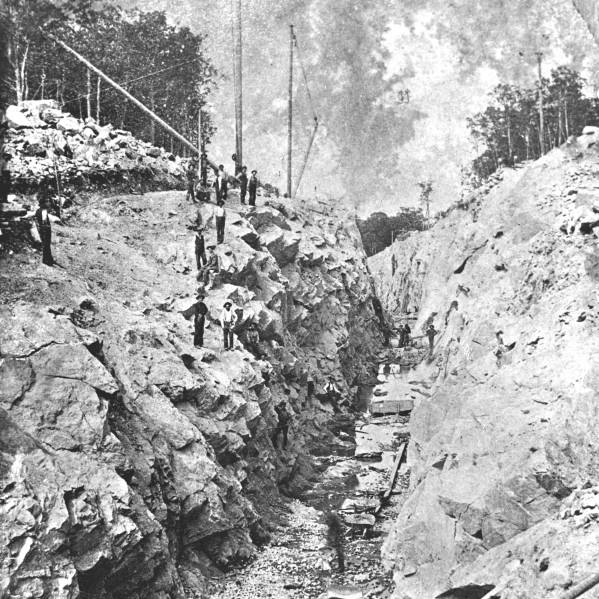
The Iron Range & Huron Bay Railroad (IR&HB) is a defunct railroad constructed to haul iron ore in Michigan's Upper Peninsula during the 1890s. Financial and engineering problems prevented the railroad's operation; it remains an unusual example of a railroad which was completed but never used.
Attachment 43259
The terrain for the line proved forbidding. The country was hilly and broken; grading the roadbed proved an expensive and intensive activity. By June 1891 an initial workforce of 500 men had swelled to 1,500, which strained the local transportation network. The builder, Wallace Dingman of Battle Creek, Michigan, ran out of money in August and abandoned work, leaving the IR&HB with unpaid bills and swamping Marquette County's limited poor relief resources.[7] New contractors were hired and the grading was finally finished in the summer of 1892, reportedly at the cost of $400,000–well above the $265,000 budgeted for the project. One major obstacle was a 1,000-foot (305 m) cut near Mount Arvon, from which 40,000 cubic yards (31,000 m3) of rock were removed. The rails were laid between July and November 1892.
The ore dock was built on the shores of Huron Bay for $170,000 under the supervision of John Munro, Jr. It measured 1,000 feet (305 m) in length and required 2,000,000 board feet (4,719 m3) of lumber. A sawmill was constructed to process the vast amounts of timber necessary for the project.
Although the IR&HB completed the 42-mile (68 km) line[10] between Champion and Huron Bay and purchased two 4-8-0 "Mastodon" steam locomotives from the Brooks Locomotive Works, no trains were ever operated. Reference Barnett implies 35 miles in his calculates; Dompier claims 42 miles, as does the Times article cited below. The completion of the line coincided with the Panic of 1893, which reduced the demand for iron ore. Additionally, the ore mines around Lake Michigamme–which the IR&HB had intended to serve–began to play out. There were richer mines in Ishpeming to the east, but the IR&HB lacked the wherewithal to construct such a line, which would have spanned 15 to 20 miles (24 to 32 km). In places the IR&HB line exceeded a grade of 5%, which would have made the haulage of freight difficult. For a standard-gauge non-rack rail railroad like the IR&HB, 3% was "excessive" and anything over 4.5% unheard of. Some sources claim the IR&HB exceeded 8% in places.
A test run was done with one of the newly delivered locomotives. A number of internet sources cite differing times, length of the travel and the outcome. A fair use quote of the 2 M ride page from Sam Beck, a railroad watchman: “As the last eleven miles of the road were downgrade, we decided the uphill run from Huron Bay would be a good test. I was in the cab with the engineer and we had proceeded just a short distance up the grade when the railroad gave way and we went into a ditch.” “From that moment on, the Iron Range and Huron Bay Railroad ceased to exist as a railroad!”
By 1893 the IR&HB found itself in serious financial difficulties. In 1890 it had begun with $1,400,000 in capital through an initial stock issue coupled with the sale of bonds. Additional bonds worth $600,000 were sold to cover construction overruns and keep the railroad afloat, but its debts mounted. Finally, in 1900, the company's owners sold it outright to the Detroit Construction Company for $110,000.
You can still visit this location today if you are willing to do a bit of hiking.
The aluminum Apex was the largest piece of aluminum at the time, and had the value of silver. Carl.
I have a 105year old 5 ton electric truck sitting in my shop that belongs to my partner. 6 of the 9 Edison batteries will still take and hold a charge.Quote:
Originally Posted by schuylergrace
As far as 3 phase power goes for years there have 3ph DC to AC converters at the commercial scale. While I was in Kuwait the company I was with was contracted to provide a pir of 750 KW diesel backup generators, the switch gear, the battery bank and the UPS to insure a 100% clean uninterrupted 50hz 415VAC power to a research lab in the American University of Kuwait. Our factory was powered by diesel generators as at our location no electric service of sufficient size was available to us my office ran 24/7 on battery power charged during the day by our 500KW generator 14 computers and associated equipment stayed on day and night even during the hours the generator was shut down. it would not have been too much of a stretch to add solar, had we had enough surface area for such an array
My guess is that those batteries are repairable to. I have derailed so much one more is not a stretch. If as much time and R&D was put into batteries as oil and derivatives we would be in a far different state of transportation now. J.P. Morgan summed it up by saying he had nothing to sell a battery electric vehicle owner other than the initial purchase. Internal combustion, well you pay from day one to the end. Tycoons like Morgan and Morgan himself literally bought and closed many electric car manufacturers. Of course electricity is not free either. But a lot less expensive.Quote:
Originally Posted by Frank S
Engineers installing a 100 kW transmitter at KWID radio. San Francisco, CA. 1942.
https://diqn32j8nouaz.cloudfront.net...stallation.jpg
There's a few large vacuum tubes in there somewhere...
Waynesboro, Tennessee mobile firefighting crew. 1942.
Fullsize image: https://diqn32j8nouaz.cloudfront.net...s_fullsize.jpg
https://diqn32j8nouaz.cloudfront.net...refighters.jpg
Looks like the whippersnappers with the fancy boots will be lighting the back fires...
Sure would like to have that truck!!!
Long as they can don them in time?Quote:
Originally Posted by IntheGroove
When they're not tending to their moonshine!
Alcoa apprentices. Massena, NY. 1931.
Fullsize image: https://diqn32j8nouaz.cloudfront.net...s_fullsize.jpg
https://diqn32j8nouaz.cloudfront.net...pprentices.jpg