Free 186 More Best Homemade Tools eBook:  
New: 300+ fresh build posts/day from 275 forums → BuildThreads.com

User Tag List

Page 2 of 2 FirstFirst 1 2
Results 11 to 13 of 13

Thread: 1950s Adcock and Shipley Universal Machine Tool - photos

Hybrid View

  1. #1
    Supporting Member Toolmaker51's Avatar
    Join Date
    Feb 2016
    Location
    Midwest USA
    Posts
    5,355
    Thanks
    7,074
    Thanked 3,580 Times in 2,213 Posts

    Toolmaker51's Tools
    Judging by responses, we seem centered on what transport and rigging issue were encountered, and what it's like to run.
    Don't recall ever seeing an 'all-in-one' machine that was other than a bench-top sized configuration. Can simultaneous work remain in place while running another function? It appears so and probably the biggest selling point. I'm certain to market them, a special order versus mass production, made speculation an ordeal. An equivalent to immense radial drills, limited market, and dependent on tremendous amount of capital investment. Hate to think how many unappreciated examples went to scrap or otherwise lost.
    While not ideal, so few solutions are; I admire the condensed element. Would like to have been the 'fly on wall' to see design evolve, and certainly the process of manufacture. That alone indicates serious product dedication, certainly an endeavor of not so compact small scale.

    Sincerely,
    Toolmaker51
    ...we'll learn more by wandering than searching...

  2. #2
    Supporting Member Frank S's Avatar
    Join Date
    Aug 2015
    Location
    Peacock TX
    Posts
    12,623
    Thanks
    2,680
    Thanked 11,125 Times in 5,401 Posts

    Frank S's Tools
    Since I have already cut this poor machine to the bone in post #6 As I said also there is proof of concept and ingenuity involved in its obvious deliberate design. Since it was as I understand it primarily designed for shipboard use Most likely aboard a smaller possibly cramped for space vessel As with most vessels the machine rooms and engine rooms are as low in the keel as possible The engines for obvious reasons. this machine due to its design meant you needed full access all the way around it so placing it near amidships directly over the spine of the keel where the ship would have the least motion would have been my choice. also the machine has one other characteristic unique to it that being the shared total mass and rigidity of a single large frame which all functions or work stations on the machine would have benefited from this. It is unlikely that more than a few of these were ever used simultaneously since there would have been probably only a machinist and maybe 2 machinist mates sharing duty under normal conditions.
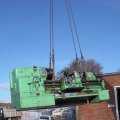
    As far as rigging to install or remove it this would have been done with the use of an "H" shaped spreader bar with a minimum of 4 rigging lines while it was still bolted to a shipping pallet made out of either a large wood frame work or a welded steel pallet the rigging lines would have been attached to special pocket hooks which would have been secured near each of the 4 corners these pockets can be seen in the first photo these pockets are also where some of the anchorages to secure the machine to the floor are
    Never try to tell me it can't be done
    When I have to paint I use KBS products

  3. The Following User Says Thank You to Frank S For This Useful Post:

    Toolmaker51 (Nov 25, 2017)

  4. #3
    Supporting Member
    Join Date
    Feb 2017
    Posts
    126
    Thanks
    15
    Thanked 81 Times in 55 Posts
    Frank S - thanks for the interesting read. Placement of this tool as you suggest makes sense. I had forgotten the importance of keeping that equipment low and amidships where it would experience the least motion in heavy seas. The rigging you suggest makes sense although it probably wouldn't be much help in getting the machine into a small building. But then I've seen some pretty clever professional machine mover do the darn near impossible with two big forklifts and operators who to say the least were a real team.
    This does motivate some internet searching on the subject of machine shops aboard Navy ships and the roles of the machinery repairman rate. My one experience at sea was a 10 day reservist training cruise on a WWII Navy Gearing Class destroyerout of Norfolk, VA, that was nearing the end of it's life in 1963. Turned out the guy in the crew who gave everybody haircuts was a 1st class machinery repairman. We got to talking when I got a haircut and he ended up showing me the compartment where the shop was located, just aft of midships and one level above the main machinery deck. It had an about 12 inch lathe and drill press, all I remembered. No mill and if there was a bandsaw I didn't remember it. The whole setup wasn't much more than 8x10 feet.
    I ended up going to OCS and sailing a desk in the Navy air training command for 3 years. The only other Navy ship I ever had a chance to look around was a nuclear attack submarine docked nearby the destroyer when we got back to port from the training cruise. And all I saw of the inside of that one was forward of "you can't go there without a security clearance" wall forward of the machinery. A bit cramped but noticeably better living quarters than on the tin can.

  5. The Following User Says Thank You to Ed Weldon For This Useful Post:

    Toolmaker51 (Nov 25, 2017)

Thread Information

Users Browsing this Thread

There are currently 1 users browsing this thread. (0 members and 1 guests)

Bookmarks

Posting Permissions

  • You may not post new threads
  • You may not post replies
  • You may not post attachments
  • You may not edit your posts
  •