
 LinkBack URL
 About LinkBacks

Hi Ralph,
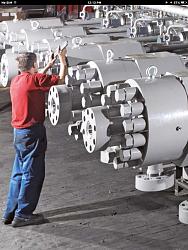
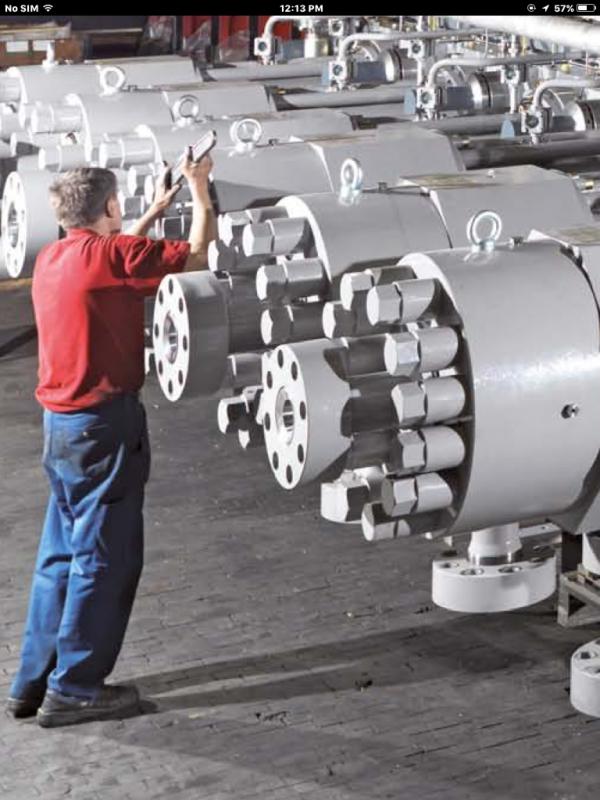
The flanges/bolts at the discharge of the high pressure reciprocating compressor (hyper compressor) are well illustrated in the attached photo extract from the website of Burckhardt (one of the leading high pressure compressor manufacturers).
My guesstimate of the discharge flange components in this picture (reinforced by a fading memory of 1970s recollections) are as follows: flange diameter/thickness/no. of bolts (18"/6"/8), bolt head/bolt diameters (4"/1-1/2"). The suction/discharge flange orientation is top entry/bottom discharge. The full picture shows a 12 cylinder (6 x 6) machine and is part of an brochure on the Burckhardt site (https://www.burckhardtcompression.co...er-compressor/), simply titled 'Hyper Compressor'. The brochure includes a good schematic of the LDPE process and details the major compressor components.
The pressure retaining parts flanges/tubing/piping are typically all fabricated from high strength alloy steel and autofrettaged. The bolts are typically fabricated from high alloy steel, quenched and tempered, with a tensile strength >100,000 psi. The tubular reactor (downstream of the primary/hypercompressors) has an open/close discharge valve (cycling on/off several times/min.) - This combined with pulsating flow from the two stages of compression subjects the pressure retaining parts to pulsating pressures and makes them highly susceptible to fatigue failure (micro cracking at the inner bore). Consequently, these parts are all autofrettaged (pre-operation pressurization) which stresses the inner bore to just below the metal yield stress - This induces residual compressive stresses into the near bore portion, spreads the operational pressure stresses into more of the metal thickness, increases fatigue failure resistance and, importantly, reduces the required metal thickness by a factor of ~1.5.
All the above is, I am sure, more detail than you would ever like to know - A far cry from the materials we hobby machinists use.
Regards,
Gary (kngtek)
Calgary, AB


 Reply With Quote


Bookmarks