 LinkBack URL
 About LinkBacks
Epoxy granite metal lathe. By Robert Steinwandel.
7:57 video:
13:25 video:
18:16 video:
13:38 video:
9:04 video:
8:57 video:
9:08 video:
11:19 video:
14:55 video:
9:44 video:





Epoxy granite metal lathe. By Robert Steinwandel.
7:57 video:
13:25 video:
18:16 video:
13:38 video:
9:04 video:
8:57 video:
9:08 video:
11:19 video:
14:55 video:
9:44 video:
New: BuildThreads.com - 300+ build posts/day (with photos)
EnginePaul (Oct 30, 2022), Little Rabbit (Oct 31, 2022), mwmkravchenko (Nov 6, 2022), nova_robotics (Oct 27, 2022), tonyfoale (Oct 29, 2022)
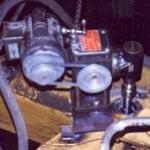

A nice job, but he made the same mistake the mini lathe makers do. The spindle is way too short
Never try to tell me it can't be done
When I have to paint I use KBS products
mwmkravchenko (Nov 6, 2022)

Is your concern the distance between the bearings or is there something else on your mind?Originally Posted by Frank S

got it in one. Lathe manufactures of old, used to make the distance between the spindle bearings significantly greater than total swing diameter up to 1 1/2 to 2 times the distance to help control runout and reduce the loading on the rear bearing which could be smaller than the bearing behind the chuck.
Even the manufactures like Southbend, Sheldon and Atlas, who primarily made smaller lathes maintained a slightly longer distance than total swing diameter, but their spindles were slimmer with a smaller overall diameter creating a possibility for flex along its length.
Many of the mini lathes have a spindle length so short the distance between the bearings is only the swing radius, done this way because their thoughts are the lathe since the lathe is small and light weight the cut and feeds will be only a fraction of what a larger lathe is capable of preforming so runout and flex will be negligible or nonexistent in most cases, allowing them to save weight and costs of manufacture.
the Lathe this guy has made out of granite will have great stability for its size due to its mass and the rigidity of the stone the one limiting factor will be the length of the spindle and probably the diameter of the bearing next to the chuck
Never try to tell me it can't be done
When I have to paint I use KBS products
mwmkravchenko (Nov 6, 2022)
One of the reasons that some machines have a large distance between the bearings is to have room for speed change pulleys etc. There is a compromise here behind bearing loading and shaft rigidity. You reduce both bearing loads with greater spacing but you lengthen the spindle which increases its compliance. Bearing loads can be catered for by appropriate bearing selection. In this case the diameter and wall thickness of the spindle would indicate that shaft rigidity should not be an issue. My gut feeling is that this lathe is in a good part of the compromise curve.
This lathe does not have great stability as the video shows. What would concern me about this lathe is its susceptibility to temperature change, stated to be due to the different coefficients of expansion between the bed and steel fittings. Which surprised me because epoxy granite is often stated to have a similar coefficient to steel.
This problem that the builder had with this lathe is of great concern to me because I am currently gathering bits to make a precision surface grinder based on epoxy granite. I just rechecked expansion coefficients and got this based on steel at 100%
Steel 100
Epoxy 425
Granite 60
The epoxy is very high and the granite is low, but what counts is the epoxy granite mix. I did a simple mixture calculation and got proportions for the mix of 89% granite with 11% epoxy which would have the same coefficient as steel. General guidelines for epoxy granite are 90 to 95% granite. I have seen videos of homemade tools which use a much lower percentage, I guess because it needs the right mix of aggregate sizes to fill 90% and also mixing 90% with 10% resin would not be physically easy. I suspect that this lathe has too low a granite percentage, which would explain why the rails bent so much when the temperature changed. This emphasises the importance of getting the correct aggregate sizes ratio and then epoxy ratio. Is pretty easy to test how well you have mixed aggregate sizes to fill 90%. Mix the different aggregate sizes and use water to check the void volume, only then get the appropriate amount of resin mixed.
In the case of the featured lathe the pictures of the bed show that the smaller aggregate, sand, has fallen to the bottom (I guess that was the top when cast) and the larger pieces are at the top, both areas will have too much void space which will need to be filled with excessive resin. The small grains need to be well mixed with the big stuff to fill the voids.
I had been thinking about using solid granite rather than epoxy granite but it needs that ~10% resin to match the coefficient of steel.
EnginePaul (Oct 30, 2022), mwmkravchenko (Nov 6, 2022)
I'll be the first to admit I never watch anyone's videos to their entirety if the video is longer than half a minute. Additionally, I hardly ever put on my head [phones to listen to their dialog, consequentially I did not note anything about expansion issues and wouldn't think there could be much change within the normal range of temperature changes in most shops. where the climate could be controlled within 10 to 20 degrees one way or another, I know where there is a huge lathe made out of concrete with iron rails for the ways that is over 100 years old it is used to make 100 ft long shafts for hydroelectric turbines
I did notice in one of his videos where he used tapered roller bearings for the spindle bearings. A lot of lathes used those but nearly all of them that are of any quality also have an angular contact ball bearing next to the larger roller bearing at the chuck end of the spindle
Never try to tell me it can't be done
When I have to paint I use KBS products
Here's a thought, call it random brain flatulence if you like. When considering making castings out of a composite of materials would it not be feasible and indeed possibly prudent to create a wireframe steel endoskeleton out of something like small rebar maybe even as small as 1/4inch or an open woven wire mesh with a minimal mesh weave size of about 1 inch square for larger thicker castings possibly 2 or more layers, My line of thinking is the added tensile strength of the steel going in so many different directions within the cast member would serve to stiffen and possibly help to stabilize movement of flex due to climatical or temperature variances . To help insure a good cohesive bond between the mixture and the steel i think I would sand blast the steel to remove any mill scale as well as to create a rougher surface for the bonding.
Never try to tell me it can't be done
When I have to paint I use KBS products
Frank, that is not a brain fart. It is not uncommon with these constructions to have a cast in frame and in fact is what I plan for my upcoming surface grinder. It is not the tensile strength that is important but the rigidity of steel. There another poster on this forum who made a large router, I think that it was with concrete not epoxy granite, in which he had a steel frame work. Search this forum for Bongo and you'll probably find it. Interesting chap who enjoys his work.
i get the idea that you are not all that familiar with the use of epoxy granite for machine tools but it is a well proven technique used commercially as well as for DIY stuff. Commercially it is used for prototypes and one offs because it is cheaper than getting one offs in cast iron, the traditional material. For DIY it is a method that can be used at home. When done properly it can result in a superior machine than cast iron because it has a lot more damping. Unfortunately a lot of DIY efforts are spoilt because the builders use aluminium instead of steel. Aluminium has 3 times the compliance of steel and a higher coefficient of thermal expansion. However, aluminium is easier to machine if you have a router or low quality mill.
Even though epoxy granite is a technique that can be used for homebuilt, that does not mean that it is always done well. Youtube is full of poor quality builds and a small number of quality builds. I intend to use a steel structure for my precision surface grinder embedded in epoxy granite but the steel will be bolted together not welded in order to eliminate the possibility of internal stresses disturbing the initial alignment. I shall be using linear rails like Robert used on his lathe.
 I may be able to answer some questions about the lathe, although I’d love to hear more as it sounds like you all have quite a bit more experience than I do here.
For the epoxy granite, it’s admittedly been a few months since I’ve thought too much about it but I spent weeks reading the entire cnc zone main epoxy granite thread for the bulk of my research, and based on that "Pin It")
Hi Frank and everyone. (Hope this works first post here ever) I may be able to answer some questions about the lathe, although I’d love to hear more as it sounds like you all have quite a bit more experience than I do here.
For the epoxy granite, it’s admittedly been a few months since I’ve thought too much about it but I spent weeks reading the entire cnc zone main epoxy granite thread for the bulk of my research, and based on that I believe 11% by weight is close enough to optimal that chasing lower epoxy percents would have diminishing returns. ckelloug took stiffness measurements on many samples of eg and although around 7-8% by weight was better, 10-11% was very similar stiffness.
The look of the side of my casting looks like a total disaster lol, I absolutely see why you think it had terrible settling problems. I actually switched aggregate sources for one of my sizes of granite, the original source was black the new one white. So it looks like there was bad settling, but that was just me gradually switching to the white aggregate as I ran out of black (graded to the same size range of course).
As for thermal issues, honestly Im very concerned about that as I do not have a conditioned shop to work in, so my temps range from around 10F to 100F through the year. I think I can minimize warp with strips of steel attached to the bottom of the casting so when there’s a temp change it at least has even pressure on the top and bottom and doesn’t tend to “banana” so badly
I’ll stop typing now in case this doesn’t post or something lol, but hopefully that at least clears a few things up I forgot to mention on YouTube!
EnginePaul (Nov 2, 2022), Jon (Oct 31, 2022), Little Rabbit (Oct 31, 2022), tonyfoale (Oct 31, 2022)
Robert, glad that you chimed in, welcome.
Stiffness is important although that can be controlled by using a steel frame cast into the EG.
It is good to know that settling was not a problem.
Yes, that is cause for concern. I have read a few of the CNCzone posts and saw that stiffness was of more concern than thermal stability. This is a big mistake because, as you have found, thermal distortion can easily exceed any potential distortion from load. When I saw the problems that you had I was shocked because I have often seen that EG had a similar thermal expansion coefficient to steel. It was simple calculation to see that based on the coefficients of the constituents an 11% resin content by volume would match the coefficient of steel. There would be no commercial machines made if they had the same problems that you have.
As I mentioned before, your lathe design/construction is very high up on my list of best DIY lathes, pity about the thermal issues. If you do add steel underneath I would suggest that you mirror what you have on top, that would give a more balanced structure. Perhaps a better solution, although not easy to do, would be to drill one or two holes through the length of the base and fit steel rods threaded on the ends so that you can pretension them like prestressed concrete. The tension could be adjusted, after experimentation to provide the minimum distort over the temp range.
There are currently 1 users browsing this thread. (0 members and 1 guests)
 Posting Permissions



 Reply With Quote
Bookmarks