Post deleted by author

Printable View
Post deleted by author
Back in the day while working on Cat equipment it was pretty easy to tell which system a particular machine was built under by simply checking the serial number if it was an older machine made domestically it was imperial everything made off shore it could have been a mix if it contained domestic components later machines became more metrically .leaning until virtually everything became metric. However it was not uncommon to find fasteners clearly marked in metric grades but with US imperial threads and diameters replacement bolts usually wound up being Imperial grade 8 since the only way to buy them from cat was by serial number of the machine. Now all late model cat equipment is full on metric but there are still and probably always will be many propitiatory fasteners seals o rings and other parts which will never be true to either system but a combination of both just so you have to buy your replacements from cat
Yes, most assuredly. It screens out certain wannabe mechanics; to capture a lyrical phrase "...cant' find what I'm lookin' for".Quote:
Originally Posted by Frank S
Only for some folks...We know how to measure, read a catalog and order! Anyone else have a McMaster-Carr sized set of web bookmarks?
Maybe not that large yet. my bookmarks runs 5 folders deep my other bookmarks folder has so many pages and folders in it that it is easier to just type in what I am looking for in the browser and hope to not have to sift through 1000's of erroneous do nothing mean nothing unrelated web pagesQuote:
Originally Posted by Toolmaker51
It's my C drive where I find most of what I need, since I have nearly as many folders running sometimes 10 sub folders deep, as Microsoft has line codes for their OS
One stands out, a key to the problem:martini::martini::martini::martini: By the time smaller drums were measured, too plastered to hold out for the largest!Quote:
Originally Posted by mklotz
I'm comfortable enough twixt imperial and metric, using them when advantage suits.
The case for changing navigation units though will be a difficult sell. "60" is their mistress. Even the US Navy still shoots sextant daily and gyro vs compass in 1/2 hour intervals underway for dead reckoning. The divisions of a 24 hour day are an important contributor. https://en.wikipedia.org/wiki/John_Harrison Harrison essentially dedicated his life to the solution.
All of it verifies electronic results - NOT the other way around. Relation of time - speed - distance inescapably points out the wonder of algebra.
The instant results of 360' circle, arc to time, the 6000 foot mile, latitude and longitude in same unitary combination are critical to avert collisions and minimum closest point of approach by every seagoing vessel, just like English is required in all ship to ship communications regarding right of way.
Marv points out the true nautical mile of 6076.12 correctly. Habit on my part quoted 6000, and both are correct at specific times. Until recently lat & lon couldn't be measured so closely in a vehicle subject to wind, current, waves. The 'missing' 76' feet are absorbed by set and drift nautically, averaging out well between point of departure and arrival. And rhumb-lines are still stepped off with dividers.
The nautical mile (6076.12 ft) is a good example of a useful occupation-specific unit. Because it was originally made equal to the length of an arcminute of latitude, a navigator could easily read distances off his charts marked with latiude and longitude. However, since the earth is an oblate spheroid, the length of an arcminute of latitude is not constant so the unit value was indeterminate. Given the utility of the unit though, it was incorporated into the SI system and is now defined as exactly 1852 meters. The unit of maritime speed, the knot, is also included in SI and is set at one nm/h (1852 m/h).
The trick with such useful derived units is not to let them loose in the world at large. Use of the nautical mile is largely confined to the areas of nautical and aeronautical navigation. Nobody is putting up road signs showing distances in nm, nor are drapers selling cloth by the milli-nm.
Chalking the number of times a sheet of steel has been through the rollers is probably useful in a rolling mill. But once you start selling sheet steel forget those chalked numbers and list it by thickness using the commonly accepted measurement system (which means metric most everywhere).
But ONLY in the USA where some clown/committee with the power to do so in a fit of petty bastardry (or just to prove he/they had POWER) decided to misspell all metric measurements and did not have the brains to realize that the proper spelling of metre and meter automatically indicates the nature of the subject - metre for a measurement and meter for a measuring instrument.Quote:
Originally Posted by mklotz
Obviously the same clown/committee decided that the proper spelling of Aluminium (again as used in every country except the USA) was another way to deliberately create confusion and prove how powerful he/it was.
On the other hand when it comes to total METRIC stupidity then Australia takes the cake.
The first formal thread system invented was the British Whitworth system and was a great leap forward for mass production and ease of repair.
Early on the Americans also used Whitworth but soon realized that the 47 degree thread angle was not as strong as a 60 degree thread angle and created the American National Course (ANC) threads using the British TPI for most threads but with a 60 degree angle. They also recognized that the British head sizing sucked and fixed that problem.
During WW2, with lend lease, hardware interchangeability became a massive problem and the British and Americans jointly decided to address the problem with a new thread combining all the best features of both the Whitworth and ANC systems (and the related ANF and BSF systems) and created the Unified threads in 1947. Both countries transitioned as quickly as possible.
In November 1946 (71 years ago) the Brits classified Whitworth as Inactive for new design.
By 1952 Whitworth had disappeared from the vast majority of British mass produced products.
Sixty five years later in Australia Whitworth is still the preferred thread for many people and industries and small Unified hardware such as 8-32 and 10-32 is extremely hard to find in shops. Using Whitworth in an export item is a great way to destroy an export market as anyone outside of Australia will instantly recognize because no-one outside Australia has Whitworth hardware and tools.
In 1947 Australia signed the Metre Convention making metric units legal for use in Australia, and in 1970 passed the Metric Conversion Act with the aim of making the metric system the sole system of legal measurements in Australia.
By 1974 every school in Australia was teaching metric only. This means everyone over the age of 49 was schooled exclusively in metric and those as old as 61 received some schooling in metric. Early on it was illegal to sell goods in inferial (a great word Marv) but now it is legal to use both and many companies owned or managed by troglodytes have gone backward to inferial. The next time I am in any of several large clothing shops I shall photograph a typical trouser size label INCHES in big letters and cm in a much smaller font. I do not shop in those stores any more. And no, these are house brand products, not name brand products imported from the US or UK.
But getting back to threads and other steel products.
Australia loves Whitworth so much that they have recently introduced the 13mm bolt. When you measure it up it is 100% a 1/2 inch Whitworth bolt. No other country has a 13mm bolt as a common standard, let alone one that is a 100% bulls**t size.
When Australia started to manufacture Metric bolts they decided to use the head sizes of the nearest Whitworth size bolt.
When you buy an ISO standard tool set you do not get, as an example, an 18mm spanner because an 18mm tool is not used for any International Standard metric bolt.
In Australia you must buy the 18mm spanners and sockets because Australia, unlike the real world, uses the 18 head size. Naturally when Australia exports "metric" goods that means that when the customer goes to assemble or maintain or repair the product he/she does not have the right tools in their tool kit. Another great way to destroy an export market as anyone outside of Australia will again recognize.
And then we get to tubing - I will cover that in a few days time but the Australian tube diameters are, like Whitworth, from an archaic British measurement system. I have purchased REAL metric tubing from the US for several projects recently because it is not available here. Another great way to destroy an export market.
Even in the machine shop it is just a number but troglodytes in some countries cannot realize that.Quote:
Originally Posted by KustomsbyKent
Two examples
In WW2 GMH in Australia started to manufacture the British deHavilland Gypsy Major engine under license. To quote the company history "GMH War Record" they totally redid all the blueprints and converted 41,500 dimensions from metric to imperial, many to five decimal places.
Why?
Surely it would have been far more cost effective to train the machinists and inspectors to use metric measuring tools and gauges - especially since the majority of the production and inspection staff were women and other new hands with no previous experience in manufacturing who had to be taught the absolute the basics of using their tools anyway. Much of the sizing was done using go-nogo gauges that are "just a size".
In the USA Packard did the same with their license built Rolls Royce Merlin engines - 100% new drawing in inches to replace the Rolls Royce metric drawings. What a waste of skilled labour.
Early on the Americans also used Whitworth but soon realized that the 47 degree thread angle was not as strong as a 60 degree
Actually Whitworth has a 55 degree included angle.It should be noted that Joseph Whitworth designed his thread at this angle for several reasons, the most obvious is the materials in use at the time, mostly cast iron of one sort or the other and the head sizes were made at the ,(large to us today),sizes so as to distribute the load, the thread also has rounded peaks and roots for strength, Whitworth is actually a very good thread form. If you do some homework you will find that the ISO metrickery size threads are very closely related to Whitworth. As for common metrickery sizes those damn French who came up with it use 7,11,15 and other weird sizes,(probably a 13 in there too), and yes you do need 16,18,20mm size spanners and sockets to work on their stuff. They also label their engines backwards so there is no hope for them.
As someone from the civilised side of the ditch I would love to hear more about this new sizing system in Australia, perhaps some French consultants were brought in to advise?
Tell me - where do you get micrometers and verniers that read in 64ths, 128ths and 256thsQuote:
Originally Posted by NortonDommi
And the Pyramids were built in cubits not feet and inches. The local Egyptian cubits in use on that project to be more accurate given that no two areas cubits were the same.
Quote:
Originally Posted by bill_h
Ahh but which pintQuote:
Originally Posted by Marv
The British one
The old Australian hotel one (smaller)
The current Australian hotel one (much smaller)
The next Australian hotel one (much much smaller)
A lot of mechanics, engineers of all kinds have these really neat steel rules with a sliding pocket clip on them that doubles as a measurement stop. Quality micrometers if Imperial ones usually have decimals and their fraction equivalents etched in the frame, some verniers,(nearly spelt verynears), have the same on the back of the vernier frame.
If you wish to know more about ancient measurement systems and what they were based on and why the Egyptians had common and Royal Cubits have a look here:
Ancient Celtic New Zealand
There is over twenty years worth of research that NOBODY has yet managed to refute.
The next Aussie pint will be metrick and measure in milliliters.
And everyone whose profession involves aviation level quality control knows that every time you do a conversion on a measurement you introduce a potential error. Gimli glider and Mars Climate Orbiter being classic examples of the results of this. see http://www.homemadetools.net/forum/e...rbiter-61787-3Quote:
Originally Posted by NortonDommi
Reading the dimension as .0001 inches or .001mm then converting to 128ths to find you are 1/256th out and converting that back to thous before making your next cut is introducing multiple fail points.
I suspect that you still calculate your cars "fuel consumption" in Miles per Gallon rather than litres per 100km because that is the way your great grandfather did it.
L/Km involves dividing the Km your odometer says you traveled by the quantity of fuel added. One simple calculation, minimal chance of errors.
MPG involves converting the km on your odometer to miles, first chance of failure, then converting litres to gallons, another chance of failure, and then the third calculation to get not your fuel consumption but distance traveled for a set volume of fuel. Then when you have to work out how much fuel you need to travel 625km you need to do a far more complex calculation than just multiplying the fuel consumption by 6.25.
There is an old saying in aviation about the three ways to do a job - the right way, the wrong way and the British way because the British have a single design law - why make it easy when with a little bit of thought you can make it bloody near impossible.
Are they related to millilitres?Quote:
Originally Posted by NortonDommi
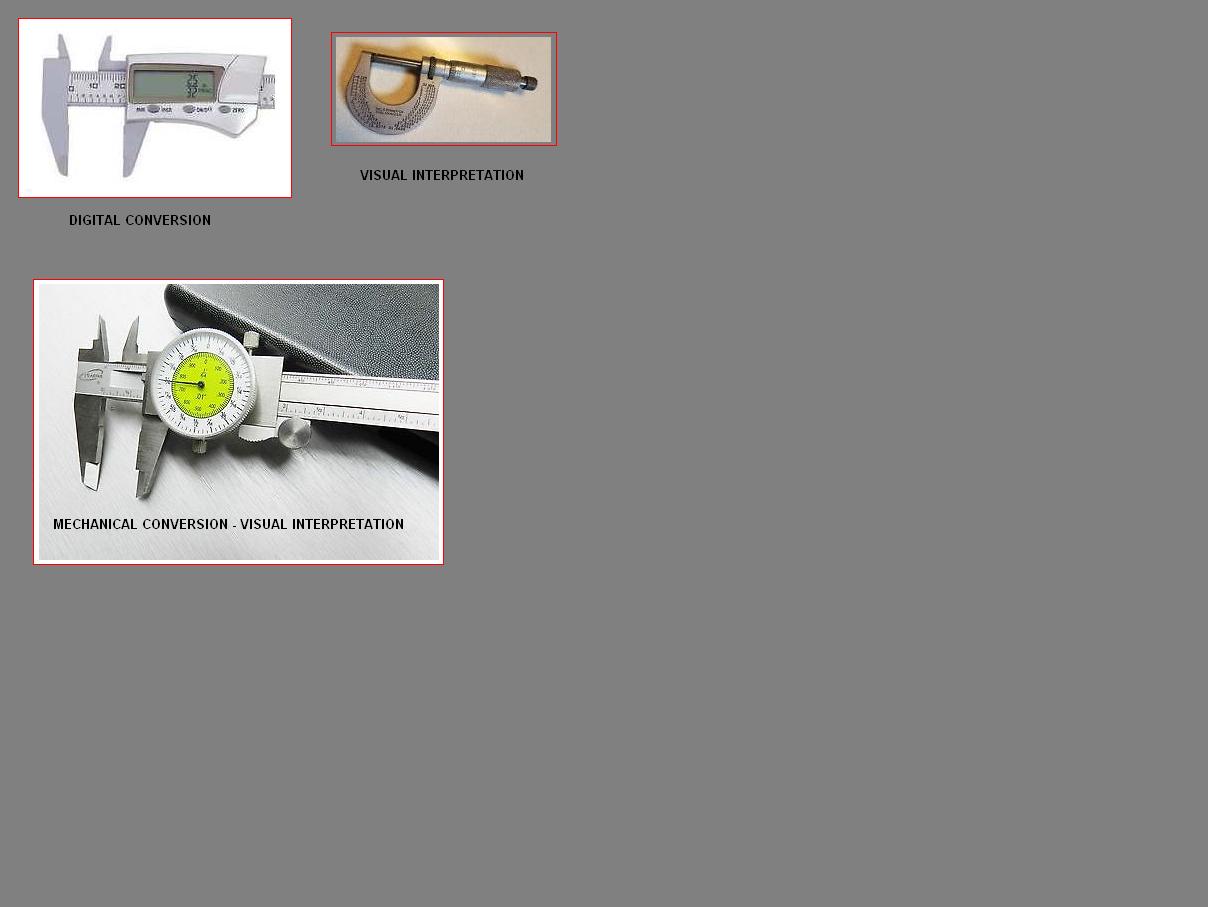
There are reasonably accurate vernier calipers that work in 1/128th's (0.0078125 inch), RCBS marketed one to reloading hobbyists. That degree of accuracy doesn't apply past sorting cases before re-assembly into cartridges. And I say hobbyist because 1/128 is not universal, just convenient and fully analog [a dial isn't exactly analog, it's mechanical interpretation] measure of relatively fine units. 1/256 (0.00390625) is worse yet. As such, a fractional micrometer would be impractical, visibility issues connected with marking increments of barrel and thimble for readability. It was common to engrave .001/fraction conversions on frames of 1" micrometers. That accommodated people handling a range of materials measured by different gauges, such as wire, sheet stock, and specialty materials.Quote:
Originally Posted by MiTasol
Now digitally-speaking, you can have your cake and eat it too. There are LCD displays on calipers, at push of a button convert the "BIG 3" [metric, imperial thousandths, imperial fractions], though I doubt they range past 300mm/12"; probably just 150mm/6". It isn't hard to imagine their popularity in the average homeowner scenario, desiring one single instrument. They are inexpensive; can't judge the lifespan or repeatability, the accuracy is within their range of increments and ability to display.
Attachment 18686
It might be a surprise, but I'm not an advocate of any particular system. Pure economics; I can't earn acceptable income restricting myself to one or the other. I often have projects, dovetailing all three easily within a single and complete assembly. Can't [don't] I cut 4 lengths square tubing; 2 different lengths in a horizontal saw set to a stop that 'look' long enough, fillet weld adjoining corners, measure interior rectangle fractionally to cut a corresponding panel to weld inside that frame, mount in a large mill - layout and drill 4 foundation bolts to an inch-based pattern - then locate metric-patterned motor, pump and reservoir?
I'd say it's pointless to force unitization on unrelated materials. Globalization dictates near infinite choice in materials, specifications limit acceptable materials. There is no question more long range thought went into establishing Teutonic Metrics, [than evident for Imperial] undeniably made them first real practitioners of precision. Sure many ancient cultures devised their own versions of precision too; Mayas, Incas, Mediterranean, Asian, Middle Eastern...That they used those systems more on projects than products, limited impact past their own shores. The Imperial system went near world wide in successive waves of Colonization - Projects AND Products.
So the culprits aren't the users, the instigators are. No doubt supported by extensive lobbying.
The solution? 14 dollar digital calculators. Makes my vast inventory of instruments is perfectly happy.
I believe our own HMT'er Paul Jones observed homogenization of our different systems [reduced need to retain varied information] a potential root of dementia. Who wants that?
I'm American through and through, 16th gen paternal, 2nd maternal. Yes, British designers have a knack for nutty intricacies, like how many fittings can we consume mounting & feeding this carburetor? Or Joe Lucas Prince of Darkness.
But then again, Harrison solved timewise longitude, Turing and crew cracked Enigma, Alexander Wood hypodermic dispensing, Jethro Tull seed drill, that guy Darwin...
The variation of pints above is driven by profit. Surely the newer pint costs the same as larger, likely more. Not been to Australia, but differences already existed in 70's era Singapore.Quote:
Originally Posted by MiTasol
Research is more or less conclusive, being heavily dependent on information collected, not necessarily practical, but still lands on some point at or near hypothesis.
Universal measurement isn't likely, any more than attempts at currency, language or government. Streamlining makes more sense in physical properties like aeronautics and hydrodynamics, than administration.
It is apparent and personal observation, that nearly everyone has a preference if not advocate. There also seems a bit more bias toward Metric and less acceptance of Imperial, where persons familiar with Imperial will calculate for results readily. I'd think that arrangement is ideal.
The issue with stacked tolerances is inappropriate instruments more than number of placeholders, either side of the decimal point.
It;s Winter her so what system should I measure the temperature in? Celsius, Fahrenheit, Kelvin or Rankine?
None of them take into account that the temperature you feel against you bare skin without having to calculate and factor in Barometric pressure wind velocity and relative humidly adjusted for altitude now when they come up[ with a gadget I can hang on the wall and instantly read the actual feels like temp everything already factored in they can name it what ever they want because that will be the name I'll use to tell my wife what she may want to wearQuote:
Originally Posted by NortonDommi
A few years back I was in a place where it was negative 40° my wife asked me is that Celsius or Fahrenheit because I'm always telling here it is one or the other without explaining which
I told her is doesn't matter both scales are equall at this point and both agree its **** cold
There is no such thing as bad weather; just bad clothing.Quote:
Originally Posted by Frank S
Metric hardware is too expensive for most home shop folks in the USA. That includes me (retired mechanical engineer) But nowadays there is a lot of metric equipment around; so some concessions to metric measuring tools and fasteners is needed. I'm in the middle of identifying all the metric stuff that isn't immediately identifiable with red color markings. Red shrink tube is especially handy for hex wrenches. Red spray paint for sized wrenches. Red nail polish on the drills (right at the junction of the helix and shank.). Metric fasteners are fairly identifiable to the experienced eye. Only used for repairs and small scale model building (where metric is pretty much a standard due to the predominance of foreign sources of model trains, etc.). The biggest metric problem for me is the shift to use of metric measurements in specs for various products of interest to engineering types. I always try to keep conversion charts handy. Metric engineering measurements are a double whammy for folks like me who trained and grew up visualizing all manner of physical phenomena in English units. Metric measurements beyond simple linear dimensions are not only less instinctive but are too often out of the range of the human scale and our innate limitations in comprehending large numbers. You get used to it; but it is still a pain to have to deal with kilowatts of mechanical power, newtons and kilopascals when searching a list of engineering specifications.
But I guess that all doesn't matter in a society where anything not on a video screen is foreign and 90% of the population couldn't manufacture a ham sandwich if their life depended on it. .............. Ed Weldon, Los Gatos, CA
I might argue that having been caught out in just about every kind of weather nature can throw at me while trying to repair an oil drilling rig. Chipping 4 inch thick Ice off of some structure of a cat walk under the rig 30 ft from water below so you can mount a safety cage before you can begin to weld a broken pipe when a rouge wave slams into the rig washing you 4 other guys and all of your gear away from the rig snapping several lines of securement in the process the only thing saving all of you is the tether of the crane line Right them you could care less if the wind velocity temperature or oceanic upheaval was caused by Ms MPH, F°/C°, Nm or Ftlb your are just preying that the tether is strong enough in any measurement to hold 5 guys and give or take short or long a couple of tons of gearQuote:
Originally Posted by Toolmaker51
Yes! Get rid of the last prototype. Wonderful...plus the idea of defining mass in terms of quantum mechanics ought to drive the inferial dinosaurs right over the edge.Quote:
Originally Posted by tonyfoale
"I'm afraid that peeking may be about all though. at least until manufactures of materials normally listed in gauge sizes adopt a decimal measurement system"
To change, they'd have to be "encouraged" somehow. I don't see these dinosaurs changing on their own, unless their bottom line finally suffers. Not likely in my lifetime - at seventy eight.
Mark, I certainly couldn't have said it any better. Congratulations on an excellent exposition.
Now, about "I live in the USA, the only industrial nation on earth that hasn't adopted the metric system". I recall having read that in addition to the USA there is one other nation with the same predicament. It is a minor nation in Africa, can't remember which. It may not qualify as an "industrial nation", however.
What's this "USA, the only industrial nation on earth that hasn't adopted the metric system" all about? We most certainly have adopted the metric system. In the same sense that a family can adopt more than one child we have more than one measurement system. Our laws don't mandate the use of one or the other in most parts of our economy. (good thing we've avoided that trap) Defense contracts may be an exception (I'm decades removed from any of that). The automotive industry has mostly adopted the metric system in their design engineering process for good reasons. But which system to use is seldom mandated throughout America. There would be way too many potentially disruptive changes required in laws and legal practice. It's largely up to the businesses to do what is best for them. Major change will likely take most of this century. I expect to be long dead and forgotten before 4x8 sheets of plywood are as hard to find as 2 meter sheets are today (other than Baltic/Russian birch).
A thought on this ---- As each of us adopts a personal digital profile that we can easily communicate when necessary I suspect a time will come when any point of interaction with a digital device that involves measurements will include presentation of those measurements in the system in our personal preference profile. Like you stick your debit card in the gas pump and it knows to report the amount of gasoline you receive in liters or gallons or some other measure you prefer. (like you buy around a gallon of gas and the pump display shows "26 miles" because the pump already knows what kind of car the gas is being pumped into as well as the average mileage the car has gotten in some past period of usage.
Ed Weldon
You can still get 4x8 sheets of ply in other countries they just call them 122x244cm
For whatever reason, I land on this thread repeatedly. It is more than enjoyable; because sophistication of measure required in various work. Just as the different contributors. Its best to be aware and practice measurements in accord with project at hand. And NortonDommi's bit of wordplay (nearly spelt verynears) tickles my humor-sense every time.Quote:
Originally Posted by NortonDommi
Over the years, a set of conditions makes my vernier collection pretty damn extensive. Ranging from a treasured 6" to a near unwieldy 60"; meaning some are marked dual, most imperial.
The attraction?
1, all have adjustable calibration, and all but one have fine adjustment screws for the moving leg, same as a proper height gauge. Also benefit from sturdy flat and radiused anvils compared to short beveled type. A bearing ball easily tells the legs are in parallel. |O|
2, Digital instruments are commonly not so equipped, and verification [by other means] is problematic increasing with distance.
3, A vernier is practically self verifying, including less bulk and width than equivalent micrometer.
4, Known thickness shim stock detects contact, not so easily felt when those 60"s are used.
5, 1-2-3 or 4-5-6 blocks are nice perches on which to insure a fairly decent plane to surface plate to reduce sine errors, since few [any?] calipers sit flat.
6, With calculator at hand, who cares imperial or metric created the original, replacement must fit.
The African nation you're recalling is Liberia. It, Myanmar (formerly Burma) and the USA are the only nations that don't use the metric system.Quote:
Originally Posted by volodar
I wouldn't describe Liberia or Myanmar as "industrial", hence what I said in the quote.
BTW, my name is Marv, not Mark.