Free 186 More Best Homemade Tools eBook:  
New: 300+ fresh build posts/day from 275 forums → BuildThreads.com

User Tag List

Results 1 to 8 of 8

Thread: glue tube cap

  1. #1
    Supporting Member
    Join Date
    May 2016
    Posts
    86
    Thanks
    4
    Thanked 251 Times in 55 Posts

    Don42's Tools

    glue tube cap

    Tawk about gilding turds! Tonight’s little project might be the epitome of absurdity. I love projects like that!

    My tube of Barg cement dried out because the stupid too-thin polyethylene cap cracked when I had to use pliers to unscrew it. That happens a lot with tubes of stuff like JBWeld, super glue, etc. About nothing sticks to polyethylene, but sticky stuff can gum up the threads enough so it takes more torque with pliers to unscrew the cap than the cap can structurally withstand.

    That may not be an accident. Using another 0.1 cent worth of PE in the cap would probably make it robust enough to keep being a cap until the stuff in the tube is used up – but then we'd be buying new stuff less often.

    I decided to make a robust cap for my new, as yet unopened, tube of Barg cement.

    I studied the threads on the neck of the tube at great length. They are very crappy threads; so crappy I was unable to determine the pitch with thread gages. Metric or inch, who knows?

    I got out the 30X quill-mount made-in-Taiwan microscope I’d bought from Enco a zillion years ago for maybe twenny bux, grabbed it in a 3/8” R-8 collet in my Bridgeport, got it focused on the very crappy threads. I centered the crosshair on the center of one crappy crest. Zeroed the DRO on the mill, moved the table in X to where the crosshair was again centered on the crest of the next crappy crest.
    The DRO said .0500”. How about that! 20 TPI inch threads.

    I probably spent most of an hour trying to figure out what OD and ID should be. I’m retired and a little slow some days. The threads on the neck of the tube are nowhere near full-depth well-formed V threads: they are, at best, sloppy approximations of threads thrice removed from any kind of thread spec, more like trapezoidal pasta wound around a sausage. I finally concluded that, while the threads were 20 TPI which would have crest-to-root depth of about 34 thou if truncated to 80% , these were more like .020 deep at most.

    I decided to make the major diameter of my new cap large enough to clear the crests of the tube’s threads by a coupla thou, make them truncated slightly rather than sharp but not quite trapezoidal, and make the roots plenty deep because it wouldn’t matter if they’re deeper than necessary; I’m not looking for a gas tight seal in the threads. That’ll happen when the flat bottom of the cavity in the cap butts against the flat end of the tube’s neck.

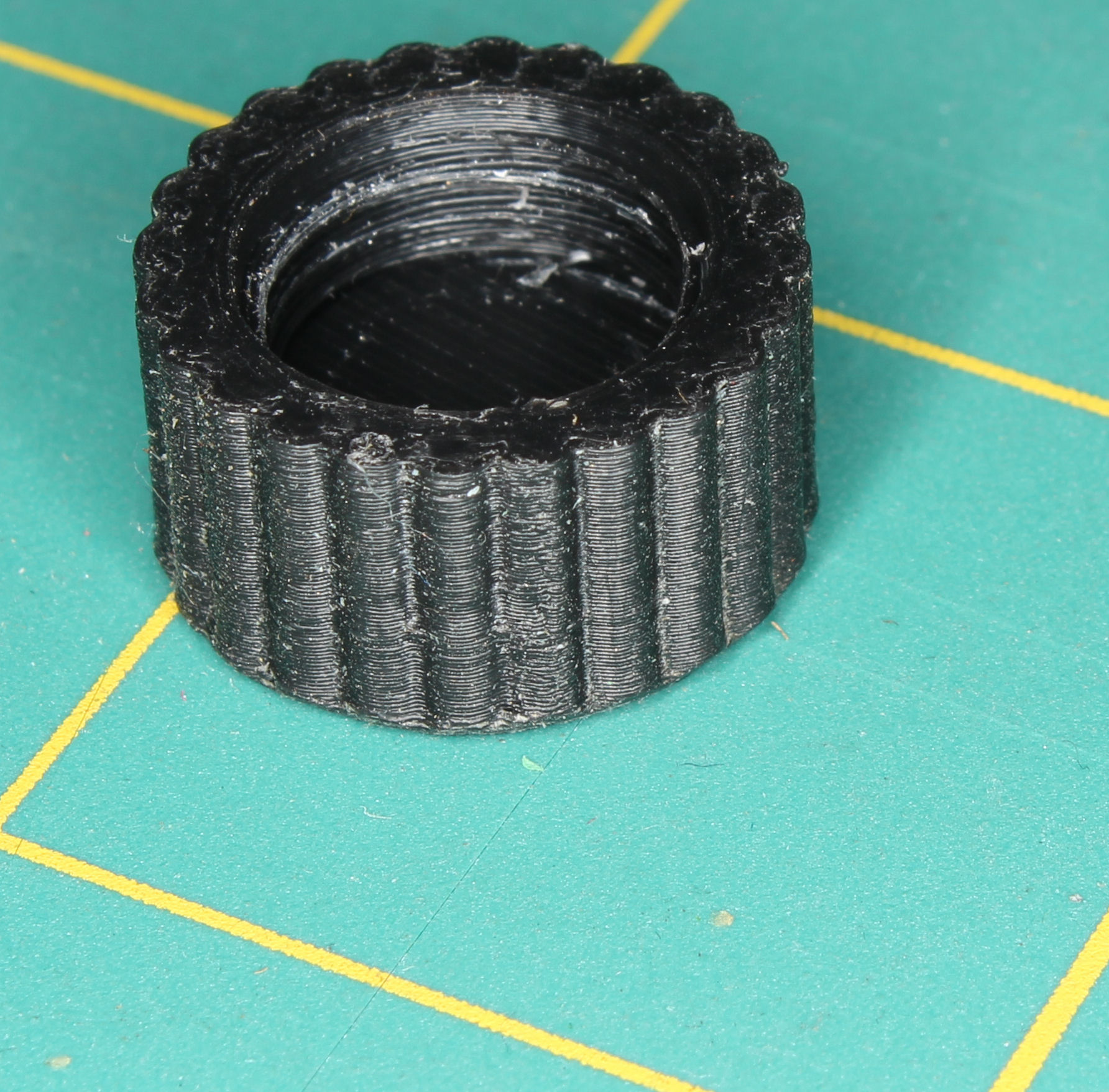
    I 3D modeled it and then made one on my entry-level Creality Ender 3 3D printer.

    It works! It fits as well as or better than the crummy skimpy fragile factory cap, and this cap won’t crack. It looks a bit crusty because entry-level 3D printing is far from the precision even we old crank-turner machinists routinely expect, but it works.


    glue tube cap-barg-cap.jpg

  2. The Following 7 Users Say Thank You to Don42 For This Useful Post:

    baja (Nov 17, 2023), ductape (Nov 19, 2023), emu roo (Nov 21, 2025), Frank S (Nov 12, 2023), Jon (Nov 16, 2023), mr mikey (Nov 14, 2023), rebuilder1954 (Nov 19, 2023)

  3. #2
    Content Editor
    Supporting Member
    DIYer's Avatar
    Join Date
    Aug 2013
    Posts
    3,049
    Thanks
    848
    Thanked 2,969 Times in 2,523 Posts


    Thanks Don42! We've added your Glue Tube Cap to our Miscellaneous category,
    as well as to your builder page: Don42's Homemade Tools. Your receipt:


    New: BuildThreads.com - 300+ build posts/day (with photos)

  4. The Following User Says Thank You to DIYer For This Useful Post:

    emu roo (Nov 21, 2025)

  5. #3
    Supporting Member hemmjo's Avatar
    Join Date
    Feb 2017
    Posts
    3,298
    Thanks
    410
    Thanked 2,127 Times in 1,228 Posts

    hemmjo's Tools
    That is one of those, "why would you do that" kind of projects.

    The answer being, "because I can" or perhaps, "just to see if I can"

    Either is a perfectly good answer.

    We learn by doing stuff.
    Last edited by hemmjo; Nov 14, 2023 at 05:31 AM.

  6. The Following User Says Thank You to hemmjo For This Useful Post:

    emu roo (Nov 21, 2025)

  7. #4
    Supporting Member mklotz's Avatar
    Join Date
    Aug 2015
    Location
    LA, CA, USA
    Posts
    3,720
    Thanks
    376
    Thanked 7,190 Times in 2,348 Posts

    mklotz's Tools
    I've had the same thing happen so I can appreciate the solution.

    However, lacking a 3D printer setup, it inspired me to an idea that I intend to try on my next tube of glue. On first opening, I'm going to carefully smear the tube threads with grease before replacing the cap. I'm fairly sure the glue can't adhere to the grease so the cap won't be able to glue itself to the tube. I'll report on how successful this technique is.
    ---
    Regards, Marv

    Smart phones are to people what laser pointers are to cats
    Homo sapiens is a goal, not a definition

  8. The Following User Says Thank You to mklotz For This Useful Post:

    emu roo (Nov 21, 2025)

  9. #5
    Supporting Member
    Join Date
    May 2016
    Posts
    86
    Thanks
    4
    Thanked 251 Times in 55 Posts

    Don42's Tools
    Hey, Marv,
    Some suggestions for glue cap release agents: Collinite Insulator Wax, Permatex Anti-Sieze, maybe teflon plumber's tape. Some guys use Kiwi natural shoe polish as a release agent when pillar bedding rifle barrels with epoxy. I use Synlube 1000 Release Agent, mostly because I have some on hand. Let us know what works.

  10. The Following User Says Thank You to Don42 For This Useful Post:

    emu roo (Nov 21, 2025)

  11. #6
    Isambard's Avatar
    Join Date
    Aug 2019
    Location
    Hawke's Bay, New Zealand
    Posts
    179
    Thanks
    0
    Thanked 77 Times in 51 Posts
    For years now, I seal the tube with saran wrap before replacing the cap...One layer suffices.

  12. #7
    bigbobcohen's Avatar
    Join Date
    Jul 2020
    Posts
    3
    Thanks
    7
    Thanked 1 Time in 1 Post
    On Ya Don, yours is as good a reason for doing something as any other. There's a need and you can do something about it, so why not. I bet if you 3D printed up hundreds or thousands of them to fit generic sized tubes you would likely sell them all. It would probably be a royal pain in the arse though LOL.

  13. The Following User Says Thank You to bigbobcohen For This Useful Post:

    emu roo (Nov 21, 2025)

  14. #8
    Supporting Member Philip Davies's Avatar
    Join Date
    Dec 2015
    Location
    Reading, Berks, UK
    Posts
    1,085
    Thanks
    1,551
    Thanked 1,192 Times in 429 Posts

    Philip Davies's Tools
    Very useful post. I keep a stock of replacement caps, because all too frequently, thecapis invisible when I want to replace it. Wish they standardised threads.


    2,500+ Tool Plans

  15. The Following User Says Thank You to Philip Davies For This Useful Post:

    emu roo (Nov 21, 2025)

Thread Information

Users Browsing this Thread

There are currently 1 users browsing this thread. (0 members and 1 guests)

Bookmarks

Posting Permissions

  • You may not post new threads
  • You may not post replies
  • You may not post attachments
  • You may not edit your posts
  •