Free 186 More Best Homemade Tools eBook:  
New: 300+ fresh build posts/day from 275 forums → BuildThreads.com

User Tag List

Results 1 to 9 of 9

Thread: Nautical Line Winding Fixture

  1. #1
    Supporting Member rgsparber's Avatar
    Join Date
    Nov 2012
    Location
    Phoenix, AZ
    Posts
    1,392
    Thanks
    802
    Thanked 3,091 Times in 741 Posts

    rgsparber's Tools

    Nautical Line Winding Fixture

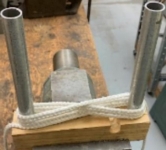
    Although I'm a rank novice when it comes to boating, I have learned that coiling woven lines will cause it to kink when unbundled. Proper winding of heavy lines is easily done with just your hands. But thin lines are harder to manage. I run out of hands. The fixture offered here solves the problem.

    If you are interested, please see

    https://rick.sparber.org/LineWindingFixture.pdf


    Your comments are welcome. All of us are smarter than any one of us.


    Thanks,

    Rick

    Rick

  2. The Following 10 Users Say Thank You to rgsparber For This Useful Post:

    baja (Sep 5, 2020), chy_farm (Sep 5, 2020), emu roo (Dec 5, 2025), high-side (Sep 4, 2020), Jon (Sep 10, 2020), mklotz (Sep 4, 2020), Priemsy (Sep 4, 2020), Tonyg (Sep 5, 2020), Toolmaker51 (Sep 6, 2020), volodar (Sep 4, 2020)

  3. #2
    Supporting Member mklotz's Avatar
    Join Date
    Aug 2015
    Location
    LA, CA, USA
    Posts
    3,720
    Thanks
    376
    Thanked 7,190 Times in 2,348 Posts

    mklotz's Tools
    A variant of your alternate winding direction method is the way roadies wrap cables so as to make them uncoil without tangling. I've adopted this technique and find it more to my liking than the contractor's typical chain-link approach because it produces a more compact final product.

    For the benefit of folks not familiar with the roadie method, good demonstration videos are available here...

    https://lifehacker.com/coil-your-ext...r-u-1706890537
    ---
    Regards, Marv

    Smart phones are to people what laser pointers are to cats
    Homo sapiens is a goal, not a definition

  4. The Following 5 Users Say Thank You to mklotz For This Useful Post:

    baja (Sep 5, 2020), cmarlow (Sep 6, 2020), emu roo (Dec 5, 2025), Inner (Sep 7, 2020), Toolmaker51 (Sep 6, 2020)

  5. #3
    Supporting Member rgsparber's Avatar
    Join Date
    Nov 2012
    Location
    Phoenix, AZ
    Posts
    1,392
    Thanks
    802
    Thanked 3,091 Times in 741 Posts

    rgsparber's Tools
    Quote Originally Posted by mklotz View Post
    A variant of your alternate winding direction method is the way roadies wrap cables so as to make them uncoil without tangling. I've adopted this technique and find it more to my liking than the contractor's typical chain-link approach because it produces a more compact final product.

    For the benefit of folks not familiar with the roadie method, good demonstration videos are available here...

    https://lifehacker.com/coil-your-ext...r-u-1706890537
    Marv,

    You prove my point. Consider coiling up a thin line where you want the overall length to be 3-inches.

    Rick
    Rick

  6. The Following 3 Users Say Thank You to rgsparber For This Useful Post:

    emu roo (Dec 5, 2025), trigger (Sep 4, 2020), volodar (Sep 4, 2020)

  7. #4
    Supporting Member hemmjo's Avatar
    Join Date
    Feb 2017
    Posts
    3,298
    Thanks
    410
    Thanked 2,127 Times in 1,228 Posts

    hemmjo's Tools
    Quote Originally Posted by rgsparber View Post
    Marv,

    You prove my point. Consider coiling up a thin line where you want the overall length to be 3-inches.

    Rick
    Thin line can be easily wound between the little finger and the thumb. For larger line wrap between the open hand and the elbow. Always wrap in the figure 8 pattern to prevent twist.

  8. The Following User Says Thank You to hemmjo For This Useful Post:

    emu roo (Dec 5, 2025)

  9. #5
    Content Editor
    Supporting Member
    DIYer's Avatar
    Join Date
    Aug 2013
    Posts
    3,049
    Thanks
    848
    Thanked 2,969 Times in 2,523 Posts


    Thanks rgsparber! We've added your Nautical Line Winding Fixture to our Miscellaneous category,
    as well as to your builder page: rgsparber's Homemade Tools. Your receipt:


    New: BuildThreads.com - 300+ build posts/day (with photos)

  10. The Following User Says Thank You to DIYer For This Useful Post:

    emu roo (Dec 5, 2025)

  11. #6
    Supporting Member rgsparber's Avatar
    Join Date
    Nov 2012
    Location
    Phoenix, AZ
    Posts
    1,392
    Thanks
    802
    Thanked 3,091 Times in 741 Posts

    rgsparber's Tools
    Quote Originally Posted by hemmjo View Post
    Thin line can be easily wound between the little finger and the thumb. For larger line wrap between the open hand and the elbow. Always wrap in the figure 8 pattern to prevent twist.
    hemmjo,

    I tried your technique but used my pointer and thumb and it worked very well. I have updated the article.

    Thanks!

    Rick
    Rick

  12. The Following User Says Thank You to rgsparber For This Useful Post:

    emu roo (Dec 5, 2025)

  13. #7
    Supporting Member Toolmaker51's Avatar
    Join Date
    Feb 2016
    Location
    Midwest USA
    Posts
    5,355
    Thanks
    7,074
    Thanked 3,569 Times in 2,209 Posts

    Toolmaker51's Tools
    With a few decades of boating [the big gray ones] and who knows how ma&ny cables wrapped, I'll add this; they have a distinction.
    And that is Braid vs Twist. When Mr. Sparber posted about laying down long garden hose, that demonstrated 'faking down', a form of figure eight, but the ends aren't adjacent, they are stepped. That allows smooth deployment without tangle, because nothing intersects. Braid and twist both react correctly. Braid has very little tendency to kink because how it's made, the strands do intersect each other, equaling the binding natural in twist material. His fixture accomplishes compact faking that maintains shape for use because the bitter end taken through the upper end of the hank. It could even be passed or thrown a distance and remain compact.

    Twisted material are made [laid] just as it sounds, whether stranded electrical wire & cords, wire rope, or line; twisted into lengths of merchandise. The effects are seen in different situations. Unspool some wire, connect some circuits, then try winding it back in place. The normal tendency is spool in one hand [stationary] and wrapping the wire - held tight enough for grip - around the spool; it's near unavoidable, your wrist imparts a new incorrect twist.
    The remedy turns the spool, attaining wire in same twist as made.
    If you wrap an extension cord [most do it clockwise only] you still induce twist; unless you 'feel' for the natural twist and release before it reaches the loop. Usually it will still birdnest if you hold one end and throw.
    The electricians chain is barely half an answer. The multiple knots control tangle, if 100' of Shirley Temple trip hazards works in your environment. Using it, at least double up overall length [one half] beforehand.
    Our own Mr. K's link offers simplest method for TWIST material like cords, by over-under aka the roadies method, which inverts the twist alternately.
    Sincerely,
    Toolmaker51
    ...we'll learn more by wandering than searching...

  14. The Following 2 Users Say Thank You to Toolmaker51 For This Useful Post:

    emu roo (Dec 5, 2025), rgsparber (Sep 14, 2020)

  15. #8
    Supporting Member Paul Jones's Avatar
    Join Date
    May 2014
    Location
    Del Mar, California
    Posts
    1,232
    Thanks
    5,820
    Thanked 1,654 Times in 740 Posts

    Paul Jones's Tools
    The figure 8 wind is how I set out all my water hoses. These unwind with no kinks no mater the temperature. My dad who was a ship captain taught me the technique based on how tug boats would coil their tow lines and never had any kinks when letting out their tow lines to the ships.

  16. The Following 2 Users Say Thank You to Paul Jones For This Useful Post:

    emu roo (Dec 5, 2025), Toolmaker51 (Sep 7, 2020)

  17. #9
    Supporting Member Toolmaker51's Avatar
    Join Date
    Feb 2016
    Location
    Midwest USA
    Posts
    5,355
    Thanks
    7,074
    Thanked 3,569 Times in 2,209 Posts

    Toolmaker51's Tools
    Yep. Nautical line handling is a set of techniques developed over centuries, lessening problems in one place that can multiply them quickly, very quickly.


    2,500+ Tool Plans
    Sincerely,
    Toolmaker51
    ...we'll learn more by wandering than searching...

  18. The Following 2 Users Say Thank You to Toolmaker51 For This Useful Post:

    emu roo (Dec 5, 2025), Paul Jones (Sep 20, 2020)

Thread Information

Users Browsing this Thread

There are currently 1 users browsing this thread. (0 members and 1 guests)

Tags for this Thread

Bookmarks

Posting Permissions

  • You may not post new threads
  • You may not post replies
  • You may not post attachments
  • You may not edit your posts
  •