Free 186 More Best Homemade Tools eBook:  
New: 300+ fresh build posts/day from 275 forums → BuildThreads.com

User Tag List

Results 1 to 7 of 7

Thread: A Calibrated Pull Test Tool

  1. #1
    Supporting Member rgsparber's Avatar
    Join Date
    Nov 2012
    Location
    Phoenix, AZ
    Posts
    1,400
    Thanks
    802
    Thanked 3,103 Times in 748 Posts

    rgsparber's Tools

    A Calibrated Pull Test Tool

    I will be tapping 1/4-20 holes into what I think is bronze. It is essential that I do not strip out the threads as I pull on the eye bolt secured into this hole. My goal is to perform a pull test with a known force and then inspect the threads for damage.

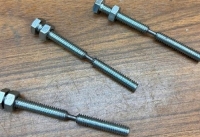
    I don't have a scale able to measure 250 pounds, so I decided to make a set of sacrificial bolts that will break at a known force. Here is the story.

    Click here.

    Your comments and questions are welcome. All of us are smarter than any one of us.

    Rick

    Rick

  2. #2
    Content Editor
    Supporting Member
    DIYer's Avatar
    Join Date
    Aug 2013
    Posts
    3,049
    Thanks
    850
    Thanked 3,001 Times in 2,552 Posts


    Thanks rgsparber! We've added your Calibrated Pull Test Tool to our Fastening category,
    as well as to your builder page: rgsparber's Homemade Tools. Your receipt:


    New: BuildThreads.com - 300+ build posts/day (with photos)

  3. #3
    Supporting Member Frank S's Avatar
    Join Date
    Aug 2015
    Location
    Peacock TX
    Posts
    12,639
    Thanks
    2,686
    Thanked 11,143 Times in 5,411 Posts

    Frank S's Tools
    Rick, I can understand your concerns about pulling the threads out of the bronze frames. Your method of testing the strength of the bolts will tell you if they are strong enough but you haven't mentioned the one critical factor regarding the strength of the material they will be screwed into. Which in your case happens to be your primary concern, of not pulling the threads out of the frame when dealing with similar materials such as a bolt and a nut it is generally thought that a nut of 80% thickness relative to the diameter of the bolt the male threads will fail before the female threads. If a bolt is threaded into cast iron or brass the machinery's handbook recommends 1.5 times depth or length of thread per diameter. Aluminum and tough plastics at 2 times. But when it pertains to castings a lot depends on the quality of the pour, but 2x generally as a rule of thumb will suffice if in doubt err on more depth of thread engagement, if at all possible, possibly 2.5 times if feasible.
    With bronze depending on the age, you could be looking at as low as 12 to 15 KSI up to 28KSI on the upper end of the scale.
    Would it be possible to drill and tap a hole somewhere that won't be seen or used to a depth that will allow thread length of 2x the diameter then screw a bolt in a torque to the specs of the bolt if the thread does not pull out at the max recommended torque, then you should be golden.
    Last edited by Frank S; Today at 07:32 AM.
    Never try to tell me it can't be done
    When I have to paint I use KBS products

  4. #4
    Supporting Member rgsparber's Avatar
    Join Date
    Nov 2012
    Location
    Phoenix, AZ
    Posts
    1,400
    Thanks
    802
    Thanked 3,103 Times in 748 Posts

    rgsparber's Tools
    Quote Originally Posted by Frank S View Post
    Rick, I can understand your concerns about pulling the threads out of the bronze frames. Your method of testing the strength of the bolts will tell you if they are strong enough but you haven't mentioned the one critical factor regarding the strength of the material they will be screwed into. Which in your case happens to be your primary concern, of not pulling the threads out of the frame when dealing with similar materials such as a bolt and a nut it is generally thought that a nut of 80% thickness relative to the diameter of the bolt the male threads will fail before the female threads. If a bolt is threaded into cast iron or brass the machinery's handbook recommends 1.5 times depth or length of thread per diameter. Aluminum and tough plastics at 2 times. But when it pertains to castings a lot depends on the quality of the pour, but 2x generally as a rule of thumb will suffice if in doubt err on more depth of thread engagement, if at all possible, possibly 2.5 times if feasible.
    With bronze depending on the age, you could be looking at as low as 12 to 15 KSI up to 28KSI on the upper end of the scale.
    Would it be possible to drill and tap a hole somewhere that won't be seen or used to a depth that will allow thread length of 2x the diameter then screw a bolt in a torque to the specs of the bolt if the thread does not pull out at the max recommended torque, then you should be golden.
    Frank,

    Thanks for your help.

    I'm not sure we're on the same page here. My plan is to screw a calibrated bolt into the threaded hole in the bronze frame, which I will later use to lift the frame. Then do the pull test.

    All other hardware associated with the lift is rated at 2 to 3 times the expected load.

    By depth of thread, I assume you mean the number of threads cut into the bronze. This is part of my concern. That is why I want to test the individual threaded holes.

    Where possible, I will be drilling a 1/2" hole and using SNAPTOGGLE anchors, which will spread the load on the back side of the bronze. In 1/2" thick steel, these anchors are rated at over 1200 pounds.

    Isn't a torque test partially dependent on the friction between the nut and the threads? What is assumed? Such a test would let me avoid machining the necked-down section of these bolts, which is very attractive.

    Thanks,

    Rick
    Rick

  5. #5
    Supporting Member Frank S's Avatar
    Join Date
    Aug 2015
    Location
    Peacock TX
    Posts
    12,639
    Thanks
    2,686
    Thanked 11,143 Times in 5,411 Posts

    Frank S's Tools
    Quote Originally Posted by rgsparber View Post
    Frank,

    Thanks for your help.

    I'm not sure we're on the same page here. My plan is to screw a calibrated bolt into the threaded hole in the bronze frame, which I will later use to lift the frame. Then do the pull test.

    All other hardware associated with the lift is rated at 2 to 3 times the expected load.

    By depth of thread, I assume you mean the number of threads cut into the bronze. This is part of my concern. That is why I want to test the individual threaded holes.

    Where possible, I will be drilling a 1/2" hole and using SNAPTOGGLE anchors, which will spread the load on the back side of the bronze. In 1/2" thick steel, these anchors are rated at over 1200 pounds.

    Isn't a torque test partially dependent on the friction between the nut and the threads? What is assumed? Such a test would let me avoid machining the necked-down section of these bolts, which is very attractive.

    Thanks,

    Rick
    Perhaps I should have said depth of hole and length or number of threads.
    A torque test would determine the shear strength or the point which threads in the bronze would strip out, but since you are planning on using the snaptoggle anchors I sense some confusion on my part. I was thinking you were going to drill #7 holes in the bronze and thread them to 1/4-20
    Never try to tell me it can't be done
    When I have to paint I use KBS products

  6. #6
    Supporting Member rgsparber's Avatar
    Join Date
    Nov 2012
    Location
    Phoenix, AZ
    Posts
    1,400
    Thanks
    802
    Thanked 3,103 Times in 748 Posts

    rgsparber's Tools
    Frank,

    Sorry for the confusion. I will use a tapped 1/4-20 hole in the bronze where I must. But in some places, there is room to put in the snaptoggle anchor, which I prefer.

    When I broke my calibration bolt with an estimated 275 pounds of force, it took very little torque. Do you have a reference for correlating pull to torque? From what I read, they aren't the same. I plan to finger-tighten my eye bolt into the threaded hole in the bronze, then pull rather than tighten it to the same force. My finger-tight eye bolt will have almost zero pull on the threads, while the lift will provide almost all of the pull.

    Does this help clarify my situation?

    Rick
    Rick

  7. #7
    Supporting Member Floradawg's Avatar
    Join Date
    Jul 2018
    Location
    Flora, MS
    Posts
    1,493
    Thanks
    2,156
    Thanked 456 Times in 351 Posts

    Floradawg's Tools
    Hi Rick, I don't know if you're already locked in to 1/4-20 due to existing parts. If not, 1/4-28 will be stronger. I'm sure you already know this.


    2,500+ Tool Plans
    Stupid is forever, ignorance can be fixed.

Thread Information

Users Browsing this Thread

There are currently 19 users browsing this thread. (1 members and 18 guests)

  1. rgsparber

Tags for this Thread

Bookmarks

Posting Permissions

  • You may not post new threads
  • You may not post replies
  • You may not post attachments
  • You may not edit your posts
  •