
 LinkBack URL
 About LinkBacks


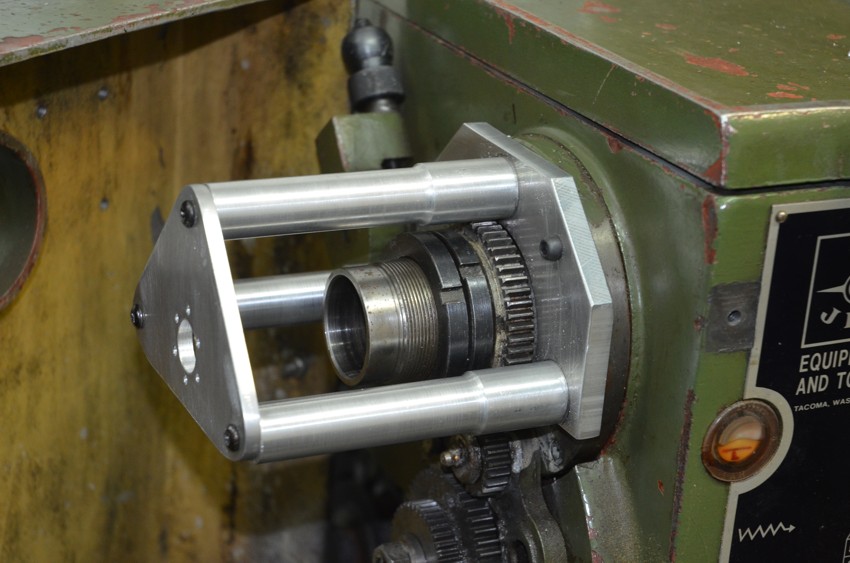
There are many ways to do it. The easiest would probably be to put an encoder on the spindle which will tell you where that is. I am actually waiting for an encoder to arrive and I attach a pic. of the mounting that I have made for it. Then use a stepper motor on the screw, or geared down to the screw. Then it is only a matter of training some electrons to feed steps according to the gear ratio "spindle to screw" that you need. An Arduino with a stepper motor shield could run the electron circus at very low cost. Although this is probably the easiest way to do the job, it is not the best. If you use the half nuts for screw cutting you still have the need to engage them manually at the correct moment and you still have the reversing out problem when cutting metric threads with an inch lead screw and vice-versa.Originally Posted by olderdan

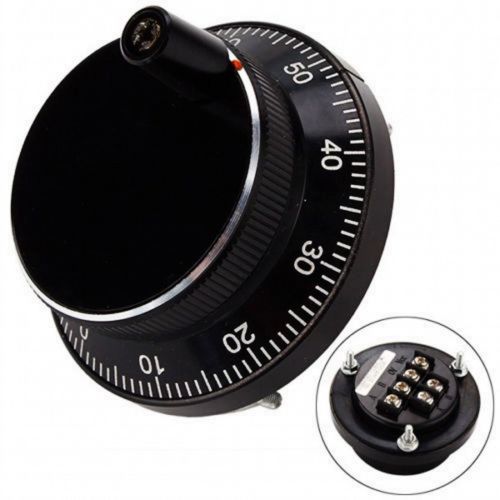
One better method using the same basic hardware would be to define a "home" position of the saddle, which the control system would find on each startup. Then the position of the saddle is always known relative to "home", as long as you don't open the half nuts. If you accept not opening the half-nuts then you might as well replace the nuts and lead-screw with ball nut and screw (not overly expensive now). The downside is that you are then prevented from moving the saddle manually so you add a pulse wheel (see pic) to the apron.
Now that you've got that far you might as well do the same to cross slide and then you have a full CNC lathe.
Personally I don't like trusting steppers to never miss a beat and I prefer using servo motors and linear slides for position, but the cost is higher than the first option and fitting the slides is not always easy.
Pulse wheel.
Bracket for rotary encoder. Smart Alex will note that it prevents long stock being used. That bracket was designed to hold an encoder with none of the backlash or flex associated with a belt driven unit. This is for a specific accurate measurement task and not for general lathe work.
I hadn't much of a workshop for 20 years after I moved from England to Spain, but 10 years ago I came across the one pictured, but no sooner had I got it up and running than I got a job offer out of the blue from Segway and I went to live in the US for 3 years. Over there I acquired a nicer lathe, albeit smaller, a CNC Bridgeport mill and a bunch of other stuff which I shipped back. Workshop space was at a premium so I got rid of the big lathe. A decision that I regret on the odd occasion. Although it cleaned up nicely, it had had a hard working life and the bed was heavily worn, so precise work had its problems.


 Reply With Quote

Bookmarks