
 LinkBack URL
 About LinkBacks


AGREED!!!!Originally Posted by Frank S

The Iron Range & Huron Bay Railroad (IR&HB) is a defunct railroad constructed to haul iron ore in Michigan's Upper Peninsula during the 1890s. Financial and engineering problems prevented the railroad's operation; it remains an unusual example of a railroad which was completed but never used.
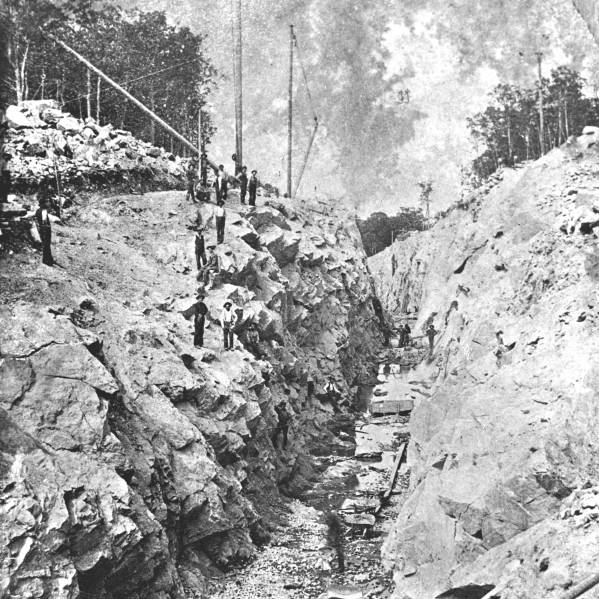
The terrain for the line proved forbidding. The country was hilly and broken; grading the roadbed proved an expensive and intensive activity. By June 1891 an initial workforce of 500 men had swelled to 1,500, which strained the local transportation network. The builder, Wallace Dingman of Battle Creek, Michigan, ran out of money in August and abandoned work, leaving the IR&HB with unpaid bills and swamping Marquette County's limited poor relief resources.[7] New contractors were hired and the grading was finally finished in the summer of 1892, reportedly at the cost of $400,000–well above the $265,000 budgeted for the project. One major obstacle was a 1,000-foot (305 m) cut near Mount Arvon, from which 40,000 cubic yards (31,000 m3) of rock were removed. The rails were laid between July and November 1892.
The ore dock was built on the shores of Huron Bay for $170,000 under the supervision of John Munro, Jr. It measured 1,000 feet (305 m) in length and required 2,000,000 board feet (4,719 m3) of lumber. A sawmill was constructed to process the vast amounts of timber necessary for the project.
Although the IR&HB completed the 42-mile (68 km) line[10] between Champion and Huron Bay and purchased two 4-8-0 "Mastodon" steam locomotives from the Brooks Locomotive Works, no trains were ever operated. Reference Barnett implies 35 miles in his calculates; Dompier claims 42 miles, as does the Times article cited below. The completion of the line coincided with the Panic of 1893, which reduced the demand for iron ore. Additionally, the ore mines around Lake Michigamme–which the IR&HB had intended to serve–began to play out. There were richer mines in Ishpeming to the east, but the IR&HB lacked the wherewithal to construct such a line, which would have spanned 15 to 20 miles (24 to 32 km). In places the IR&HB line exceeded a grade of 5%, which would have made the haulage of freight difficult. For a standard-gauge non-rack rail railroad like the IR&HB, 3% was "excessive" and anything over 4.5% unheard of. Some sources claim the IR&HB exceeded 8% in places.
A test run was done with one of the newly delivered locomotives. A number of internet sources cite differing times, length of the travel and the outcome. A fair use quote of the 2 M ride page from Sam Beck, a railroad watchman: “As the last eleven miles of the road were downgrade, we decided the uphill run from Huron Bay would be a good test. I was in the cab with the engineer and we had proceeded just a short distance up the grade when the railroad gave way and we went into a ditch.” “From that moment on, the Iron Range and Huron Bay Railroad ceased to exist as a railroad!”
By 1893 the IR&HB found itself in serious financial difficulties. In 1890 it had begun with $1,400,000 in capital through an initial stock issue coupled with the sale of bonds. Additional bonds worth $600,000 were sold to cover construction overruns and keep the railroad afloat, but its debts mounted. Finally, in 1900, the company's owners sold it outright to the Detroit Construction Company for $110,000.
You can still visit this location today if you are willing to do a bit of hiking.


 Reply With Quote

Bookmarks