Attachment 39117
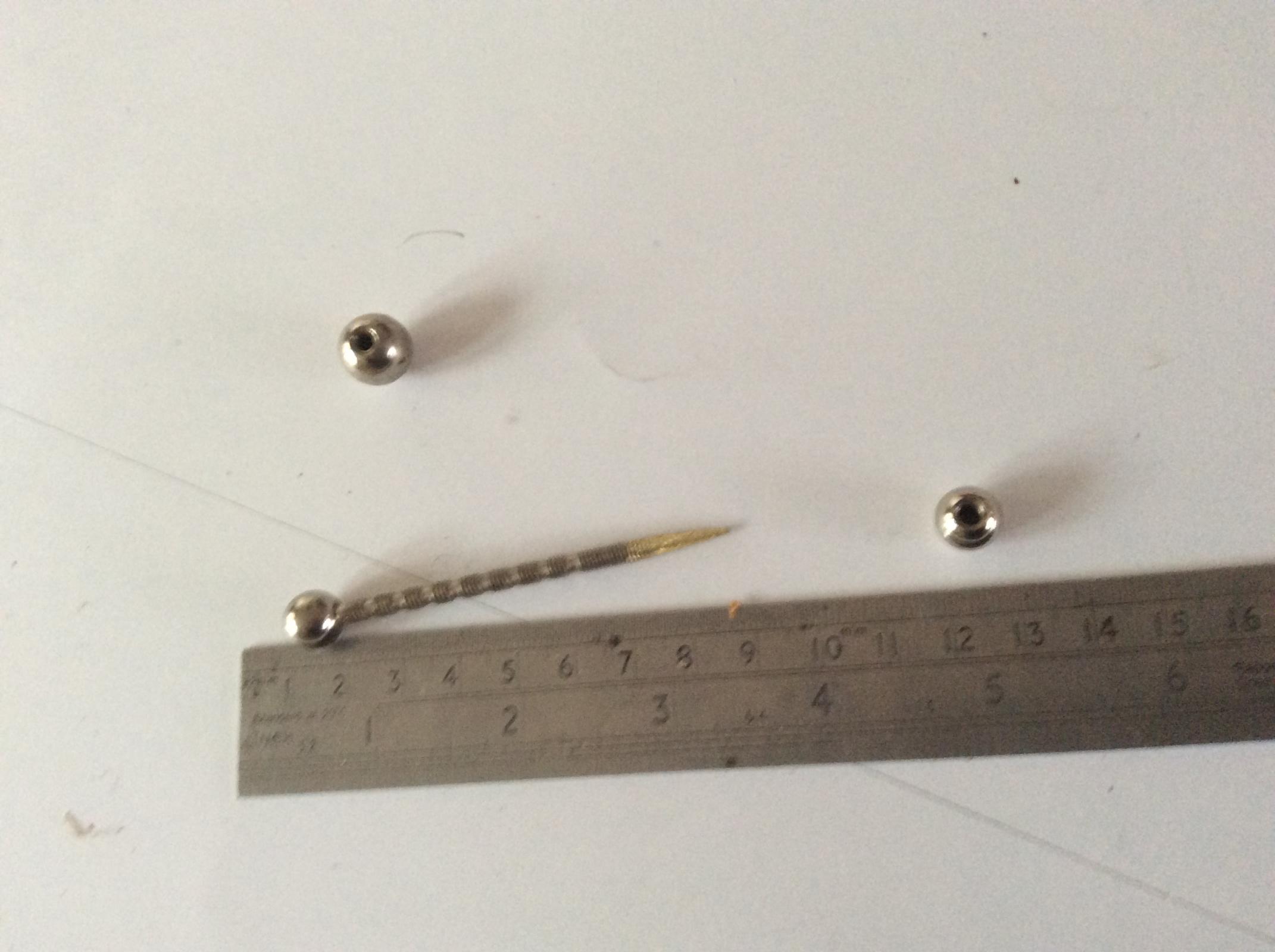
Possessing several steel threaded ball bearings, I thought that I would make a wiggler, but cannot get it to run true. Any comments?

Printable View
Attachment 39117
Possessing several steel threaded ball bearings, I thought that I would make a wiggler, but cannot get it to run true. Any comments?
I'm not exactly sure what you mean by "run true", but best guess follows.
Maybe the threaded holes are not precisely radial.
In other words, if the axis of the pointer does not pass through the exact center of the sphere, the pointer will be eccentric.
With enough friction at the ball joint, the "point" could still "run true", but enough friction may be counterproductive regarding easy use of the "wiggler".
Agreed. Most wigglers act like a truck ran them over. Use two metal scales, even pallet strapping to get point spinning true. The spindle will coincide and then represent center, for crossed scribe lines, center punch...It's best to give the ball a little vertical travel, a light spring above is fine. Cup in nose retainer does the rest.
Not gonna lie, I had to google this one up. I had no clue what you were talking about.
https://en.wikipedia.org/wiki/Wiggler_(tool)
Not much of a clue myself! I am too niggardly to buy one, or an edge finder. My interest in machining metal has grown since joining the forum, and I would like to start milling, but have no experience. So, try to make one! I am also especially interested in how early toolmakers managed without dial indicators.Quote:
Originally Posted by mlochala
Yes, sorry not to be clearer. The pointer was eccentric and the wobble could not be eliminated, as I had hoped.Quote:
Originally Posted by rayh__
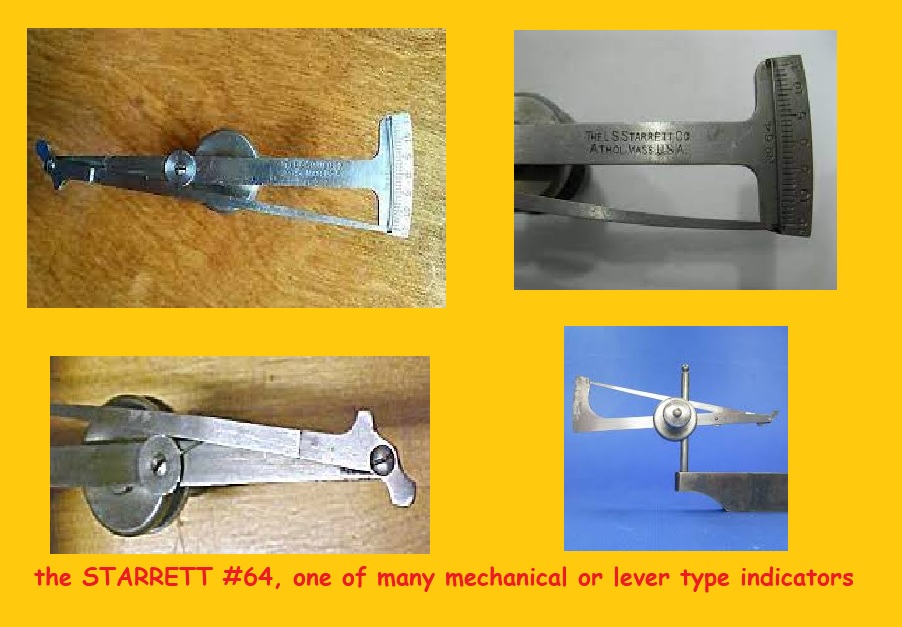
Few [none?] of us are old enough to have depended on the precursor of dial indicators. They were lever operated affairs, while graduated in .001, had limited travel.
Attachment 39126
With that limitation, indicating was done differently than today.
Now, machinists rely on long travel instruments, say clocking stock in a 4 jaw. Some cannot visualize the undertaking, and 'lose' sight of high side, ending up making many adjustments beyond that required to get zeroed in.
A lever indicator doesn't necessarily avoid it; but it does induce a visual aspect. They'd have spun the chuck, the tip only contacting intermittently. Compared to a wildly swinging needle, that makes clocking far easier.
It's how I started, and rely on. Even with a dial indicator, especially on rougher material. Attached on the cross slide, as readings stop, just dial in a few to reacquire contact.
Much faster than it sounds.
I could go on 'how it was', prodded sufficiently. Interestingly, there are occasions where the 'old way' remains the only way.
Thank you. I shall look out for one of those!
<!-- BEGIN /var/www/html/homemadetools/protected/modules/zeus/views/tool/postUpdate.php -->
Thanks Philip Davies! We've added your Wiggler to our Metalworking category,
as well as to your builder page: Philip Davies's Homemade Tools. Your receipt:
<div id="blocks"> <div class="block b1 pngfix"> <div class="bimg"> <div> <a href="https://www.homemadetools.net/homemade-wiggler-2"> <img src="/uploads/248397/homemade-wiggler-2.jpeg"/> </a> </div> </div> <div class="head pngfix"></div> <div class="left pngfix"></div> <div class="right pngfix"></div> <div class="blockover b1 pngfix"> <div class="title"> <a href="https://www.homemadetools.net/homemade-wiggler-2">Wiggler</a> <span> by <a href="https://www.homemadetools.net/builder/Philip+Davies">Philip Davies</a></span> </div> <div class="tags">tags: <a href='https://www.homemadetools.net/tag/centering'>centering</a> </div> </div> </div> </div>
<!-- END /var/www/html/homemadetools/protected/modules/zeus/views/tool/postUpdate.php -->