 LinkBack URL
 About LinkBacks
Jesus, Frank — you da man! There's some serious vision, design, and engineering went into putting that together. Not anything like I'm used to seeing in a "wheel forge."





Jesus, Frank — you da man! There's some serious vision, design, and engineering went into putting that together. Not anything like I'm used to seeing in a "wheel forge."

I went overboard in some areas and underboard in others.Originally Posted by Scotsman Hosie

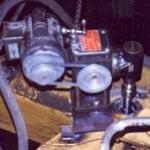
One thing I would have done differently had I taken the time to think it through while I was building it is the way the iris blades are connected.
At the start while figuring out their placement shape and pivoting at first I had thoughts of simply extending a flat tab out from the end of them but they go through more than 90° of rotation, this would have required some seriously long slots in the perimeter of the toyere housing up next to the bottom of the forge. Had I done it that way it would have been next to impossible to get a reasonable enough air seal in order for the blower to be able to deliver enough air through the bottom of the forge to create a good burn.
Now looking back at it I see it would have been much easier for me to have not mounted their pivots to the forge bottom which inturned caused me to have to make the gilflirted offset control rods so I could make them rotate concentrically to the mounting studs.
Once I struck upon the idea of utilizing the 2nd smaller rim as the housing after I cut out the center I had to figure out how to go from a 9 inch diameter hole down to say 3 1/2 inches for the ash drop and the air delivery this was when I cam upon the idea of inverting the center and welding it back in place but I wanted it to have a continuous inward slope which meant forging it to a cone shape, I think this turned out well in keeping with how I wanted the results to be, the gradual deep cone shape will insure good ash flow downwards the guide sleeves for the iris rods and will allow minimal air leakage.
Where I went radically overboard is in the complexity of the stupid build. first off the mounting of the toyere housing could have just as easily been accomplished with only 3 tabs and 3 bolts I elected to use 6 tabs and 12 bolts simply because I could and besides how else am I ever going to use up over 400 lbs of 3/8 nuts in my life time given that I am not currently involved in production manufacturing any more .
I could have as easily used 7/16 , 1/2" ,5/8 or even 7/8" nuts as I probably have similar quantities of those as well.
After looking at this thing what I could have done was to have mounted the iris blades on a long straight stem then used a loner sleeve and had them mounted to the housing itself this would have greatly simplified the build and if I find out later on the offset stems give me problems it will be easy enough to modify
Never try to tell me it can't be done
When I have to paint I use KBS products
baja (Jun 1, 2020), Scotsman Hosie (May 26, 2020), Sleykin (Jun 1, 2020)
Happens to me all the time — unless I happen to catch myself. Simpler is just about always better. But you tend to get into the Tao of the hands-on build — which is 90% of the pleasure. And I've rarely cranked out anything that didn't suggest any number of possible improvements. Same excuse — using stuff on hand.
Still, it's vicariously fulfilling — to see the finished product, being created by cut, weld, and wire. Still watchin'.
Such was the case today as I had stated about the offset stems on the iris blades. Individually or moving a couple of them at the same time was simple enough however I noticed there was quite a bit of resistance getting all of the stems perfectly concentric to the blade mounting pivots was going to be a royal pain. Every thing was just too ridged even with reasonably slack tolerances hole to stem diameters was not going help much plus if for any reason I needed to disassemble the unit it would mean I would have to remove 28 nuts loose the adjustment of the blade positions before I could remove the housing then 12 more nuts to remove all of the blades if I wanted to remove all of them .
Did I mention I might own stock in Hillman fasteners/
Anyway I did need to disassemble the thing to clean out some welding slag lodged under the blades. So I have decided to go ahead and change the stems and the mounting of the blades to a less ridged method of mounting plus at the same time the mod will negate the need to disassemble anything other than simply removing the housing mounting nuts And yes I am keeping all 12 of them more because I like the looks of it even though they are under the bottom and no one will see them
Never try to tell me it can't be done
When I have to paint I use KBS products
Scotsman Hosie (May 27, 2020)
Crusty I had given that some thought of having a plate under the bottom of the fire bowl slotted with spiral slots in the opposite direction of the way I had drilled the holes that is even the reason there is a center hole drilled there to actuate the dampener plate it could have had coarse teeth on the perimeter and a single pinion mounted to a shaft extending through the toyere housing. I even did a preliminary drawing of just such a method. the nice thing is this option can remain on the table should I find I am less than satisfied with what I currently have. The housing would only have to be slightly modified the blade mounting studs would have to be ground off and the plate made. Air leakage could even be less than what I may have with the current build design another possible advantage would be the mechanisms would be simpler plus it may make it easier to break up and pass the occasional clinker which could become lodged in the holes as the knife action of a single plate as opposed to individual blades could be advantageous.
However for right now I am going to run with the design I have Most things that I will even need to put in the forge are going to require wide open balls to the wall thermonuclear sized fires anyway
Never try to tell me it can't be done
When I have to paint I use KBS products

I had to Google '8n'... And found this.
I have a 1972 Land Rover Series III Truck Cab/Pick-Up and a 1962 Land Rover Series 2a Carawagon Camper.

I've been thinking about this mechanism and I'm wondering if you had made the blades fixed in position and then made the fire bowl itself rotate to adjust the air flow would that work? It sure would be simpler to build. The support tray would have to be made fixed so that it extended over the upper edge of the bowl, the air chamber would have to be a reasonably close fit to the fire bowl so that there wasn't a lot of air leakage, and of course the blades would have to be close to the fire bowl holes.
If you can't make it precise make it adjustable.
I do understand staying the course that you've already chosen because of the hours spent in getting to where you are now, and I tend to do the same thing. Mostly it was just a thought exercise on my part since I'd like to have a forge too, but there's at least 4 other projects in line before that one comes to the top. Truth told, I'll probably put a simple wood stove type throttle plate somewhere in my air line.

If you can't make it precise make it adjustable.
There are currently 1 users browsing this thread. (0 members and 1 guests)
 Posting Permissions



 Reply With Quote
Bookmarks