
 LinkBack URL
 About LinkBacks


Novice metalworkers may not yet have a sinebar yet may encounter a situation where they need to machine an angle accurately. Folks who use angle blocks in lieu of a sinebar may not have the blocks needed to produce a particular angle.
All is not lost. The one accurate tool most budding machinists have available is a lathe. Using only this tool, it's possible to manufacture a precise quasi-sinebar for any angle of interest. The procedure depends on the following statement:
If I take two cylinders of diameters d1 (smaller) and d2 (larger) and lay them in contact with each other on a horizontal plate, a flat plate placed across them will form an angle, theta, with the horizontal given by:
d1/d2 = (1-sin(theta/2))/(1+sin(theta/2))
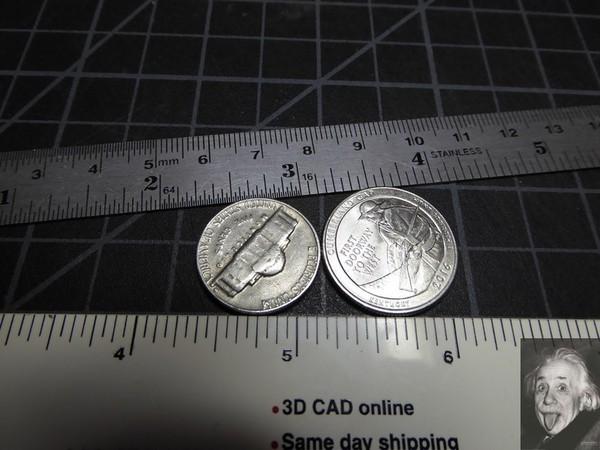
To visualize this (and because every tool post needs a picture), look at this cartoon of the process...
The white plastic scale represents the horizontal surface, e.g., the floor of the mill vise opening. The coins represent the two cylinders resting on the horizontal and contacting each other. The metal scale represents the platform for the part and makes an angle of theta with the plastic scale.
So, how does this work?
Given that you need the angle theta, plug that value into the right side of the equation and compute the ratio of d1/d2. [A scientific calculator will be a big help. They're available cheaply and essential in any shop with pretenses of accuracy.] This ratio will always have a value less than one.
Select a piece of stock of suitable size for d2 and measure its true diameter. Multiply the latter by the ratio calculated above to obtain the value of d1. Use the lathe to turn down a chunk of d2 to a diameter of d1. Simple and straightforward.
I'll run through an example to illustrate the calculation process.
Let's say I need an angle of 3.6 degrees. Then
theta = 3.6
theta/2 = 1.8
1 - sin(theta/2) = 1 - 0.0314 = 0.9686
1 + sin(theta/2) = 1 + 0.0314 = 1.0314
d1/d2 = 0.9896 / 1.0314 = 0.9391
Let's say I choose to use a piece of accurate 0.5" drill rod as d2. Then
d1 = 0.9391 * 0.5 = 0.4695"
So I machine the drill rod down to 0.4695" and put that chunk next to a chunk of the 0.5" material and, voila, I have my angle.



 Reply With Quote

Bookmarks