Free 186 More Best Homemade Tools eBook:  
New: 300+ fresh build posts/day from 275 forums → BuildThreads.com

User Tag List

Page 1 of 2 1 2 LastLast
Results 1 to 10 of 18

Thread: Heat Treatment Oven (with separate control cabinet)

Hybrid View

  1. #1
    Supporting Member Dr.Al's Avatar
    Join Date
    Jul 2018
    Posts
    48
    Thanks
    7
    Thanked 171 Times in 26 Posts

    Dr.Al's Tools

    Heat Treatment Oven (with separate control cabinet)


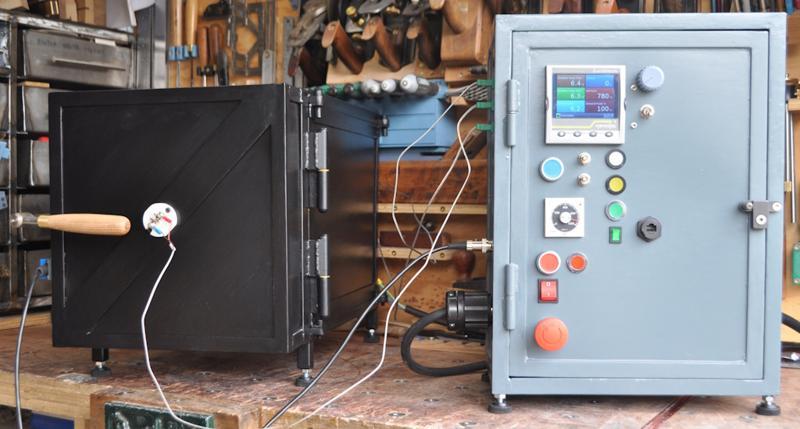
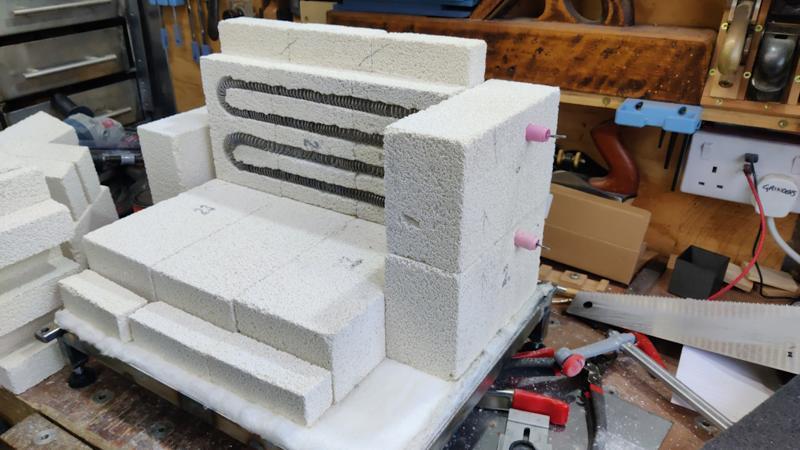
    This is my home-made heat treatment oven (for hardening and/or tempering of steel). I made it in two parts (a chamber and a control cabinet) for a couple of reasons. Firstly, it makes each individual part lighter so it's easier to move around (I don't have much space in my workshop so can't give the oven a permanent home). Secondly, it means I can use the control cabinet with other chambers (for example, at some point I'd like to make a vertical cavity chamber for casting brass). The control gear is quite advanced (with the ability to do ramps, dwells and have multiple different programs pre-loaded into the controller) and hence it was preferable not to have to make another one for a second chamber.


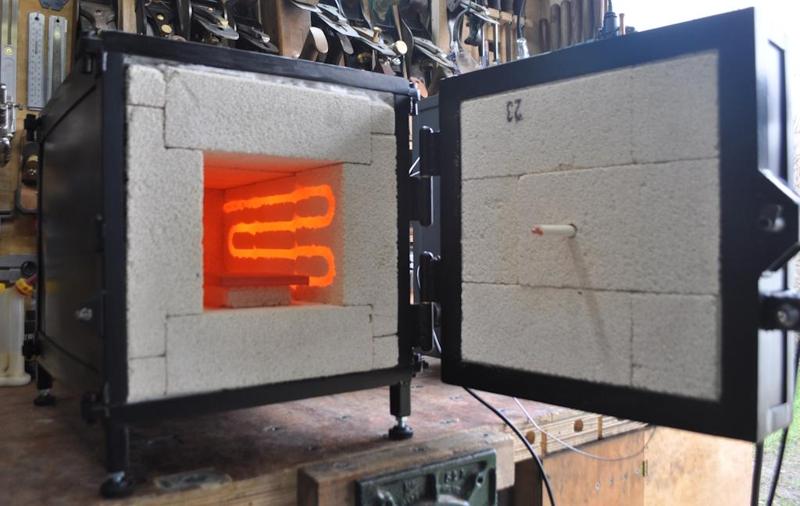
    There are loads of details about the build on my website, including a 35-page build log that goes into exhaustive detail, but I'll share some specifics here as well. The materials used in the chamber core (insulating fire bricks and Kanthal A1 heating element wire) are rated to about 1250°C, although I'll only use it at temperatures quite a bit lower than that to give a bit of safety headroom. In practice I can't imagine I'll ever need to take it much above 1000 degrees; most heat treating is done at around 800.


    It's designed to run off a 16 A single phase plug with the chamber itself taking about 12 A (about 2.8 kW); it heats up to 800 degrees in less than 20 minutes. The control cabinet has a current controller built into it, so I could in theory run it at a lower current (at the cost of a slower warm-up time) and then I could probably get away with using a standard 13 A three-pin plug.


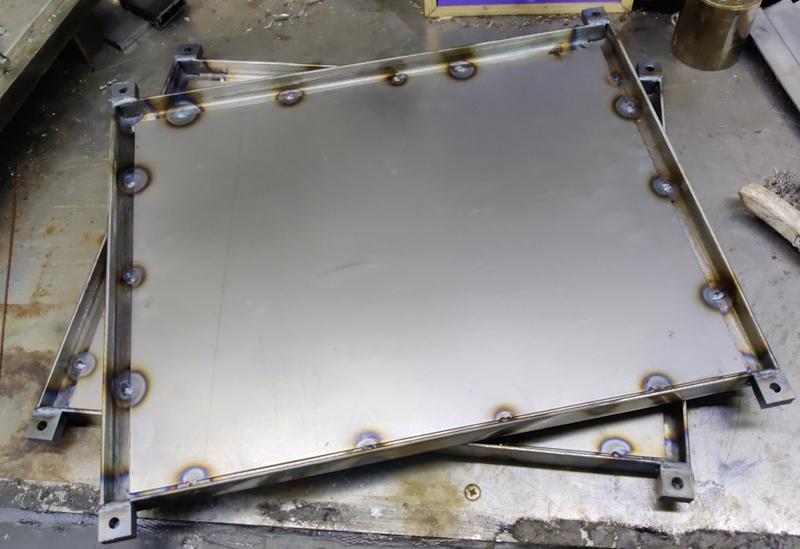
    The chamber and the control cabinet are both made out of 20 × 20*× 3 mm angle iron, with sheet steel filling in the gaps. It probably would have been much more sensible to buy a box for the control cabinet and just cut the holes in it, but I enjoy TIG welding and it was an enjoyable exercise making it from scratch.


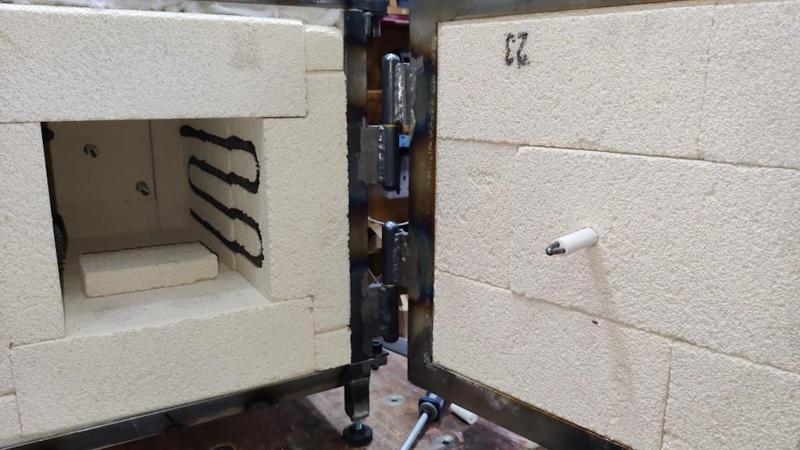
    Unlike most of the heat treatment oven builds I've seen on youtube, I elected (based on advice from another forum) not to use any mortar or fire cement in the chamber. The bricks are held together by a combination of the friction between them and the steel frame holding them firmly in place. While this will slightly increase the heat loss from the oven, it has the significant advantage of making the oven serviceable. The main frame can be dismantled by undoing a few M8 screws and then any damaged bricks can be easily replaced.


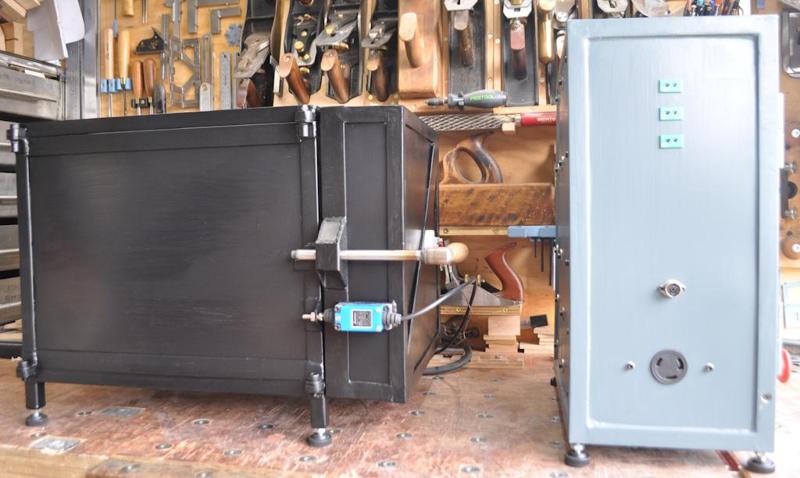
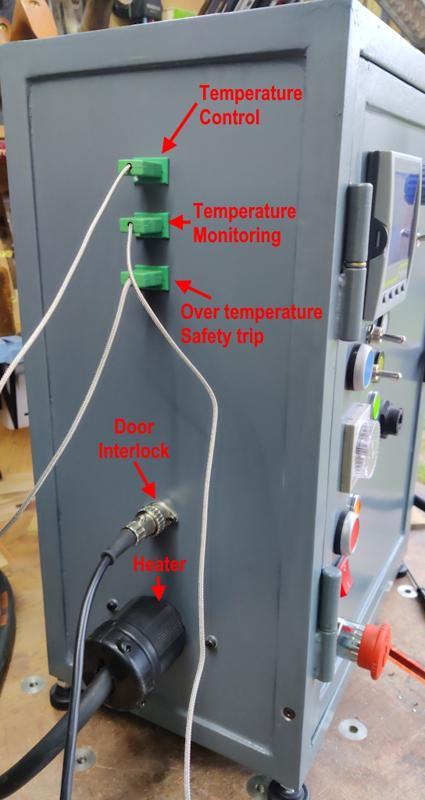
    The chamber has three K-type thermocouples (two at the back and one in the door), which plug into the three standard green sockets on the side of the control cabinet. One of the thermocouples is used for temperature control, one for a safety over-temperature trip and the third provides a way of monitoring the temperature in a different part of the chamber. There's also a fourth thermocouple monitoring the temperature inside the control cabinet. The controller I'm using allows for multiple inputs and you can use one for the control loop and then wait for another to reach (a separately configurable) temperature before moving on to the next stage of the temperature cycle (for example using the thermocouple at the back of the chamber for the control loop and the one at the front as a stabilisation point to ensure even temperature).


    The other connections from the chamber to the control cabinet are the power connector (also including a protective earth connection) and the one for the door interlock.


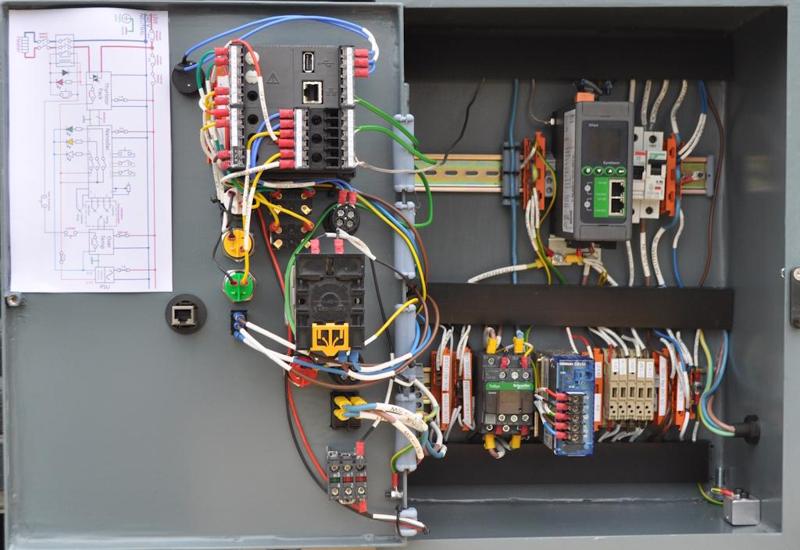
    This photo shows the inside of the control cabinet. I was very fortunate to be given most of the modules in this box by a very generous member of the MIG-welding forum, so I was able to make it a lot more advanced than I would have been able to had I been buying all the bits myself. The "Nanodac" controller in particular is very capable, with the ability to program ramps and dwells for heat treating more exotic materials (although so far I've only used it for gauge plate and silver steel). Having never wired something like this up before, I spent a lot of time trying to make it neat and traceable, with almost every wire individually labelled at both ends using heat-shrink printable labels.


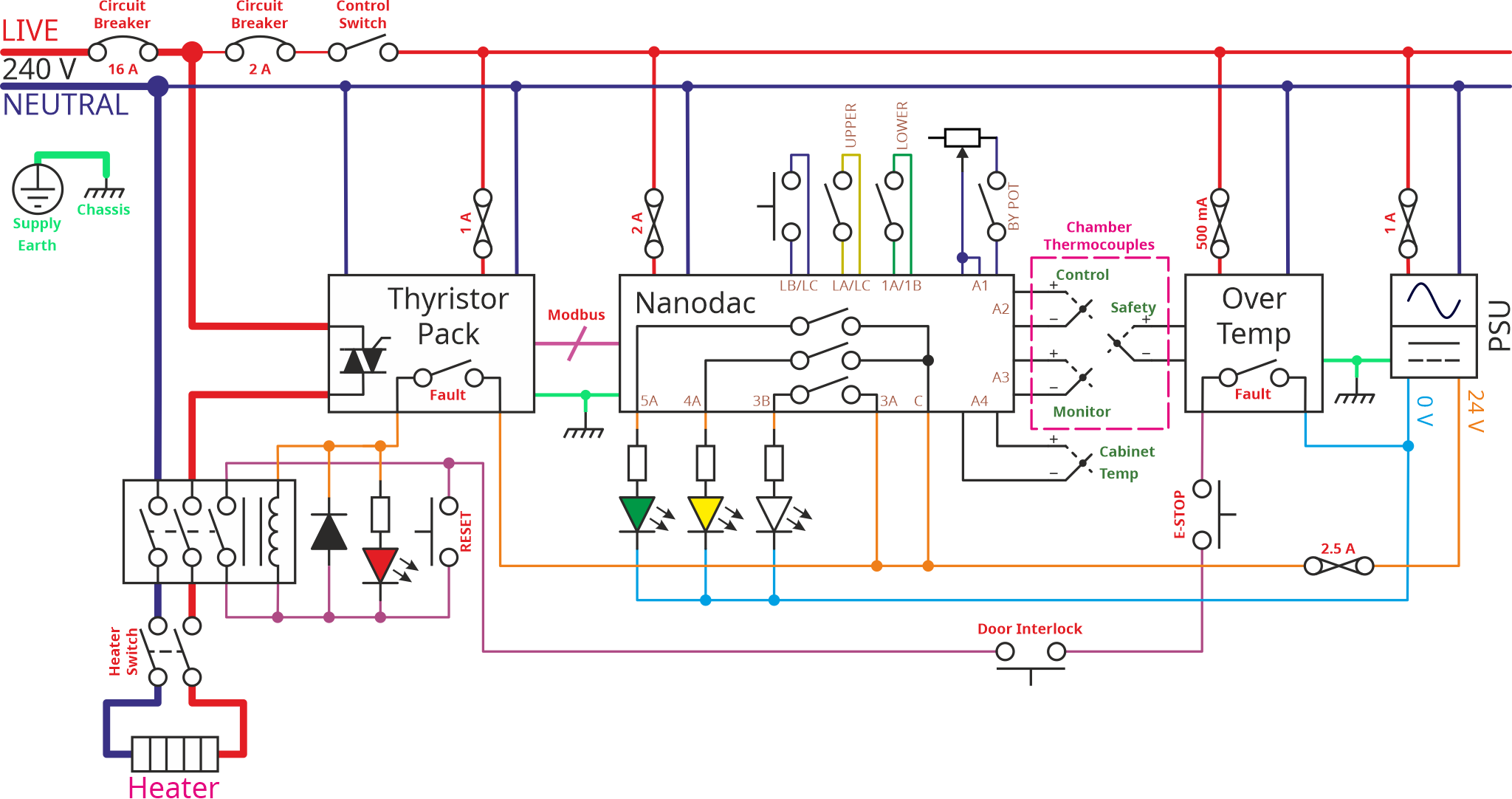
    This image shows the schematic for the wiring of the control cabinet. It seems to be cropped in the forum preview view; click here to see it in full. There's a lot more detail explaining what each bit of the schematic does starting on page 7 of the build log on my website.


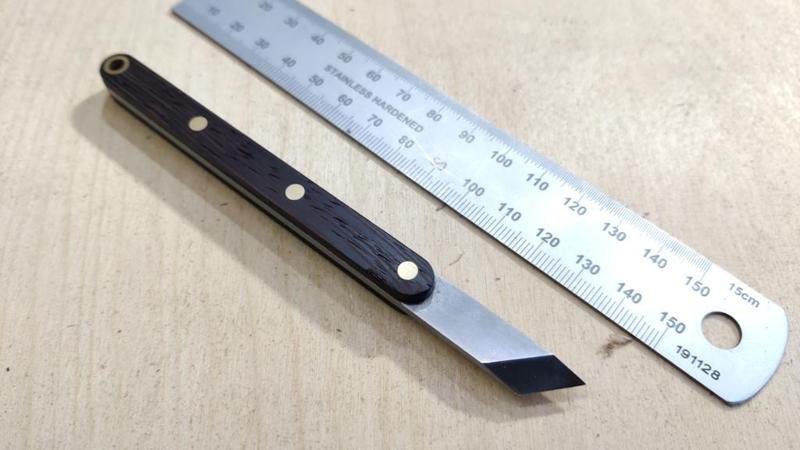
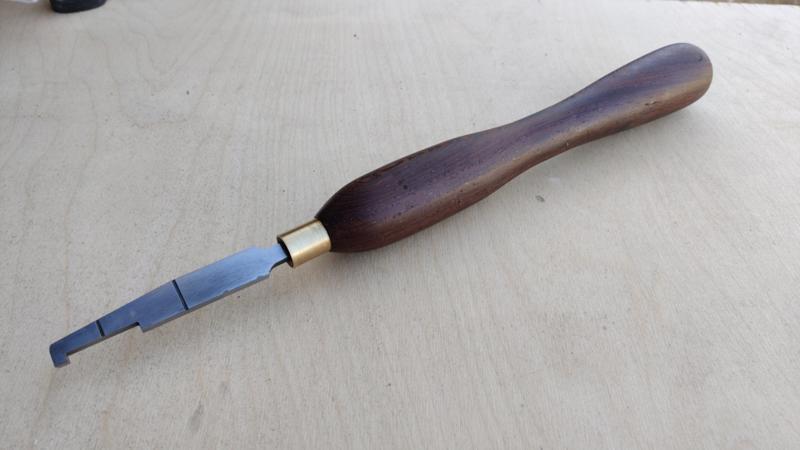
    These images show the first couple of things that I made using the oven. There's a simple marking knife with Wenge scales and a woodturning tool for cutting the grooves for Crushgrind branded peppermill mechanisms (the handle for which was made on my home-made woodturning lathe). Both of these were made from gauge plate (ground flat O1 tool steel) and both are small enough that it would be relatively straightforward to heat treat them with a blow-torch, but they provided a nice way to try out the oven and prove that it worked properly.

    Metalworking projects site: https://www.cgtk.co.uk/metalwork
    Woodworking projects site: https://www.cgtk.co.uk/woodwork

  2. The Following 5 Users Say Thank You to Dr.Al For This Useful Post:

    DIYer (Apr 6, 2025), hemmjo (Apr 5, 2025), Jon (Apr 4, 2025), mr mikey (Apr 5, 2025), nova_robotics (Apr 14, 2025)

  3. #2
    Supporting Member metric_taper's Avatar
    Join Date
    Mar 2017
    Location
    Marion, Iowa
    Posts
    760
    Thanks
    281
    Thanked 410 Times in 266 Posts

    metric_taper's Tools
    The Modbus between the Nanodac, and Thyristor pack, they must have an interface standard to write coils and read registers between them. I see what I believe is the Nanodac on a DIN rail mount. Nice safety backup. worked on autopilots, and all the safety things, back before they trusted a silicon switch for positive disengage of the servo motors, the switches in our cockpit panel, had 3 DPDT switches all ganged together and wired in series to ensure the +28VDC was removed from the engage clutch, one path for the elevator, and one for the aileron, the yaw damper had it's own separate system if needed. I learned you can't trust relays for anything, their failure rate is too small for aircraft safety. Preventing house fires is very important, I like seeing that.
    Last edited by metric_taper; Apr 6, 2025 at 08:18 AM. Reason: something burped, said a cookie expired and inserted <> junk in my text

  4. #3
    Supporting Member Dr.Al's Avatar
    Join Date
    Jul 2018
    Posts
    48
    Thanks
    7
    Thanked 171 Times in 26 Posts

    Dr.Al's Tools
    Quote Originally Posted by metric_taper View Post

    The Modbus between the Nanodac, and Thyristor pack, they must have an interface standard to write coils and read registers between them. I see what I believe is the Nanodac on a DIN rail mount. Nice safety backup. worked on autopilots, and all the safety things, back before they trusted a silicon switch for positive disengage of the servo motors, the switches in our cockpit panel, had 3 DPDT switches all ganged together and wired in series to ensure the +28VDC was removed from the engage clutch, one path for the elevator, and one for the aileron, the yaw damper had it's own separate system if needed. I learned you can't trust relays for anything, their failure rate is too small for aircraft safety. Preventing house fires is very important, I like seeing that.
    Thanks @metric_taper .

    The Nanodac is the thing that's mounted in the door; the thyristor pack on the DIN rail mount is an EPACK. Both come from Eurotherm, so they're well suited to talking to one another over the modbus TCP link. All that link does at the moment is write a set-point to the EPACK Thyristor pack and read the current back (for display).

    I also don't trust relays, but I don't trust thyristors or solid-state relays either! At least with the contactor (which is just a big relay really) it isn't switching as often as the thyristors are so there's a reasonable chance the contacts won't have welded. I do like having the physical switch in line with the heater coils as a belt-and-braces thing though. At least that means I can guarantee that the coils are electrical isolated even if something goes wrong with the contactor. For an overheat event to happen, there needs to have been at least two failures: something going wrong with the thyristor pack and something going wrong with either the over-temperature detection or the contactor. I'm sure that wouldn't be enough redundancy for an aeroplane application, but hopefully it's good enough for a heat treatment oven!
    Metalworking projects site: https://www.cgtk.co.uk/metalwork
    Woodworking projects site: https://www.cgtk.co.uk/woodwork

  5. #4
    Supporting Member metric_taper's Avatar
    Join Date
    Mar 2017
    Location
    Marion, Iowa
    Posts
    760
    Thanks
    281
    Thanked 410 Times in 266 Posts

    metric_taper's Tools
    Quote Originally Posted by Dr.Al View Post
    Thanks @metric_taper .

    The Nanodac is the thing that's mounted in the door; the thyristor pack on the DIN rail mount is an EPACK. Both come from Eurotherm, so they're well suited to talking to one another over the modbus TCP link. All that link does at the moment is write a set-point to the EPACK Thyristor pack and read the current back (for display).

    I also don't trust relays, and don't trust thyristors or solid-state relays either! At least with the contactor (which is just a big relay really) it isn't switching as often as the thyristors are so there's a reasonable chance the contacts won't have welded. I do like having the physical switch in line with the heater coils as a belt-and-braces thing though. At least that means I can guarantee that the coils are electrical isolated even if something goes wrong with the contactor. For an overheat event to happen, there needs to have been at least two failures: something going wrong with the thyristor pack and something going wrong with either the over-temperature detection or the contactor. I'm sure that wouldn't be enough redundancy for an aeroplane application, but hopefully it's good enough for a heat treatment oven!
    I was confused as I was seeing a LCD screen controller on the internet search of the product, and failed to look at your front panel holding the system, so I thought you had some micro-package version.
    I have had the SSR fail short, for room temperature heater using a low current controller. I end up using a conventional metal contact thermostat rated for the heater current. That's set up as a high limit off, so like you know, don't cycle current through contacts if you want reliability.
    I worked on the biz jet and commuter size aircraft. The biz jets were the BAE-HS125-800, Falcon 50/2000, SAAB2000, Piagio180, Bombardier RJ50/70/90/100/200 but started with the BeechCraft model 2000 Starship (carbon fiber pusher turbo prop, a dud design), and the BeechJet, which was a Mitsubishi Diamond II, sold to them, and now called a Hawker. they also bought the BAE125-800 jet design.
    The auto pilot I worked on was dual-dual, fail passive. Cant' use that for auto land. The air transport division of the company I worked at, did an early commercial Cat III autoland, that was the BAE L1011, that was triplex design, and analog. That was before my time, that morphed to digital, and they used the microslice 2900 chip set with their custom microcode. I was told they spent $8meg in 1980 dollars doing a verification analysis. But those guys/gals in air transport were in a different world of safety compared to my lesser pee-on division. Boeing became their #1 customer, and Airbus locked any content out of their airframe. The only saving thing was customers wanted Collins Radios, the name sake of the companies product line. When I left they were buying Ethernet data switches.
    So those two Boeing 737 Dash 8 that went down, that was pilot error, and a stupid design that fails any safety analysis. Our FAA, your JAA/(EU equivalent) requires pitch trim runaway to be an critical level of design prevention. So avionics uses the nuclear safety method of fault tree analysis, and adding up components in parallel or series to get the failure rate of 1 per million hours of operation for a pitch trim runaway. Having two weeks apart not good. But Boeing, let the pilot always fly the airplane. If these dumb underskilled pilots would have done that (one did, recovered, then reengaged to crash into the ground), they could have flown all the way to their destination. This underskill is a real problem. Many accidents where they want to use autoland all the time, and can't do a real landing outside a simulator. The real problem was the lack of annunciation of the AOA sensors (angle of attack), confusion with underskilled software subcontractor computer science educated, and no mentoring on safety. The specification was messed up, as some idiot at Boeing wanted to charge for some display feature. It was a major change to the airframe flying machine, and should have required training and instructional input at a minimum. That problem of safety at Boeing came from when they bought Mcdonald-Douglas, which was a reversal of management, and different safety ideas. The old guard safety people of the original Boeing were overkill. Airbus does not have this same mentality, and it has it's own issues. They take control from the pilot, so it's philosophy thing.

  6. #5
    Supporting Member hemmjo's Avatar
    Join Date
    Feb 2017
    Posts
    3,301
    Thanks
    410
    Thanked 2,131 Times in 1,230 Posts

    hemmjo's Tools
    very impressive. I am currently working on an electric crucible furnace for casting aluminum and brass. I had intended to make the control box separate from the furnace, but for now it is mounted on the side.

    I was not sure how critical the connectors are for the thermocouple. Right now I just have if connected with a terminal block. Can I just use something like a plug and jack like for a microphone?

  7. #6
    Supporting Member Dr.Al's Avatar
    Join Date
    Jul 2018
    Posts
    48
    Thanks
    7
    Thanked 171 Times in 26 Posts

    Dr.Al's Tools
    Quote Originally Posted by hemmjo View Post
    I was not sure how critical the connectors are for the thermocouple. Right now I just have if connected with a terminal block. Can I just use something like a plug and jack like for a microphone?
    I think the connectors are quite important if you want an accurate measurement. Thermocouples work by two different metals meeting at a point (and being welded together) and generating a tiny voltage. If you connect them to some other material then you effectively introduce another thermocouple junction where the thermocouple meets the other wire and hence add another tiny voltage, giving an offset reading. There's a bit of a discussion on this starting on the last comment on this page of the thread on the woodhaven2 forum.

    The green† K-type thermocouple connectors have the pins (and sockets) made of a material that doesn't introduce any offset (as long as you also have thermocouple cable the other side of the plug/socket going to the controller). The plugs and sockets aren't especially expensive - you can get some decent quality ones for a few pounds in the UK at least.

    † I've said green as that's the international standard colour, but I think a different colour (yellow I think) is used in America because, well, America!
    Metalworking projects site: https://www.cgtk.co.uk/metalwork
    Woodworking projects site: https://www.cgtk.co.uk/woodwork

  8. #7
    Supporting Member tonyfoale's Avatar
    Join Date
    Nov 2016
    Location
    Spain
    Posts
    1,821
    Thanks
    834
    Thanked 3,242 Times in 910 Posts

    tonyfoale's Tools
    Quote Originally Posted by hemmjo View Post
    very impressive. I am currently working on an electric crucible furnace for casting aluminum and brass. I had intended to make the control box separate from the furnace, but for now it is mounted on the side.

    I was not sure how critical the connectors are for the thermocouple. Right now I just have if connected with a terminal block. Can I just use something like a plug and jack like for a microphone?
    I agree with Dr.Al. You need the correct connectors for themocouples. They do not make special connectors for no good reason. Of course they'll work with other connectors but that will kill accuracy and that makes the whole point of measuring worthless.

  9. #8
    Supporting Member tonyfoale's Avatar
    Join Date
    Nov 2016
    Location
    Spain
    Posts
    1,821
    Thanks
    834
    Thanked 3,242 Times in 910 Posts

    tonyfoale's Tools
    Are you using Kanthal A1 wire for your heaters?

    Such an oven is on my todo list, for both Aluminium and steel. To ease the switching burden and maintain a more constant temperature I plan to split the heater into two parts. One part will not be controlled but its current, to maintain a near constant temp a bit below that needed for Aluminium, will be determined by experiment. Then the controlled part of the heating elements will only act as a top up. Time will tell how well that will work.

    I was surprised that you were able to get away with such a low power input, that is very encouraging because I only have a 5 kW mains supply and I was a bit concerned that it would not be adequate while lunch was being cooked at the same time. Aluminium requires very long soak times.

  10. #9
    Supporting Member Dr.Al's Avatar
    Join Date
    Jul 2018
    Posts
    48
    Thanks
    7
    Thanked 171 Times in 26 Posts

    Dr.Al's Tools
    Quote Originally Posted by tonyfoale View Post
    Are you using Kanthal A1 wire for your heaters?
    Yes.

    Quote Originally Posted by tonyfoale View Post
    Such an oven is on my todo list, for both Aluminium and steel. To ease the switching burden and maintain a more constant temperature I plan to split the heater into two parts. One part will not be controlled but its current, to maintain a near constant temp a bit below that needed for Aluminium, will be determined by experiment. Then the controlled part of the heating elements will only act as a top up. Time will tell how well that will work.
    That's an interesting approach and sounds quite sensible to me. You're always likely to need a certain amount of power to maintain temperature, so taking that out of the switched element means you can get away with a less powerful switch. Just don't forget to provide a way to disconnect power to both when you open the lid (so you don't electrocute yourself on the heating element).

    I like the idea of being able to melt aluminium and brass; for me steel feels a bit too ambitious, but maybe one day!

    Quote Originally Posted by tonyfoale View Post
    I was surprised that you were able to get away with such a low power input, that is very encouraging because I only have a 5 kW mains supply and I was a bit concerned that it would not be adequate while lunch was being cooked at the same time. Aluminium requires very long soak times.
    It probably helps that the cavity is relatively small, but I think if its insulated enough then it doesn't have to be that powerful. Less power just means it'll take longer heating up, but as long as the energy going in is more than the energy being dissipated, then eventually it'll get there.

    There are some (probably slightly out of date) power calculations at the bottom of page 3 of my build log. I compared it to a couple of commercial heat treatment ovens (based on their rated power consumption and cavity volume). The two commercial ones I looked at worked out as 188 watts/litre and 222 watts/litre. At the time of doing those calculations, mine would have worked out as 511 watts/litre, so there's more than enough power. The cavity size might have changed (I can't remember off the top of my head) and the current has definitely gone up, so that number probably isn't quite right now, but it gives you an idea of how little power is really needed.
    Metalworking projects site: https://www.cgtk.co.uk/metalwork
    Woodworking projects site: https://www.cgtk.co.uk/woodwork

  11. #10
    Supporting Member tonyfoale's Avatar
    Join Date
    Nov 2016
    Location
    Spain
    Posts
    1,821
    Thanks
    834
    Thanked 3,242 Times in 910 Posts

    tonyfoale's Tools
    Quote Originally Posted by Dr.Al View Post

    I like the idea of being able to melt aluminium and brass; for me steel feels a bit too ambitious, but maybe one day!
    I am only looking to heat treat not melt. Although I have had to melt some lead recently and melting aluminium might be useful. Perhaps I need to expand my vision.

Thread Information

Users Browsing this Thread

There are currently 1 users browsing this thread. (0 members and 1 guests)

Bookmarks

Posting Permissions

  • You may not post new threads
  • You may not post replies
  • You may not post attachments
  • You may not edit your posts
  •