
 LinkBack URL
 About LinkBacks


Thank you, nhengineer for sharing that.
Just my 2/3 thruppence worth, being an "early adopter" of the metric system, I scrutinize my own beliefs in this respect:
1) Measurement systems and/ or their units aren't TRUE in any ontological, cosmological, theological or absolute sense, merely arbitrarily chosen systems of units.
2) Some measurement systems are more logical: consistent, complete and coherent than others.
3) Some measurement systems are more pragmatic than others, i.e. has allowance for development, simplifications and revisions as needed.
4) Some measurement systems are more self-explanatory and simple to use than others.
So, perhaps being a heretic metric user I don't give a hoot about the age of the system itself,
neither do I get any problems if the system adopts a new definition of any base unit within,
nor if it infers yet another prefix, unit or anything else as long as it keeps up the system's own consistency.
Personally, I can share a profound moment in my youth, when I got hit by the insight of the SI systems "interconnectedness" between several of the
mechanical, kinematic, electromagnetic, thermodynamic, photometric derived units (I wasn't much into chemistry then).
On a daily, rational and pragmatic level, I just dig the SI system because:
-When I know THAT any derived unit could be put up as a base unit equation, then I also know HOW to use them and check for my mistakes.
Prefixes are also a pretty simple way of displaying ratios in my part of the world.
That's just good enuff for me, I don't need any sacred, eternal, "natural" or "true" units - but then call me "relativist, revisionist or any other -ist" if you need.
Also, pardon my eventual abuse of your English, as it's not my native language.
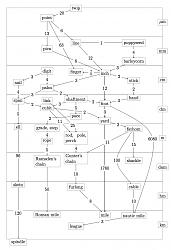
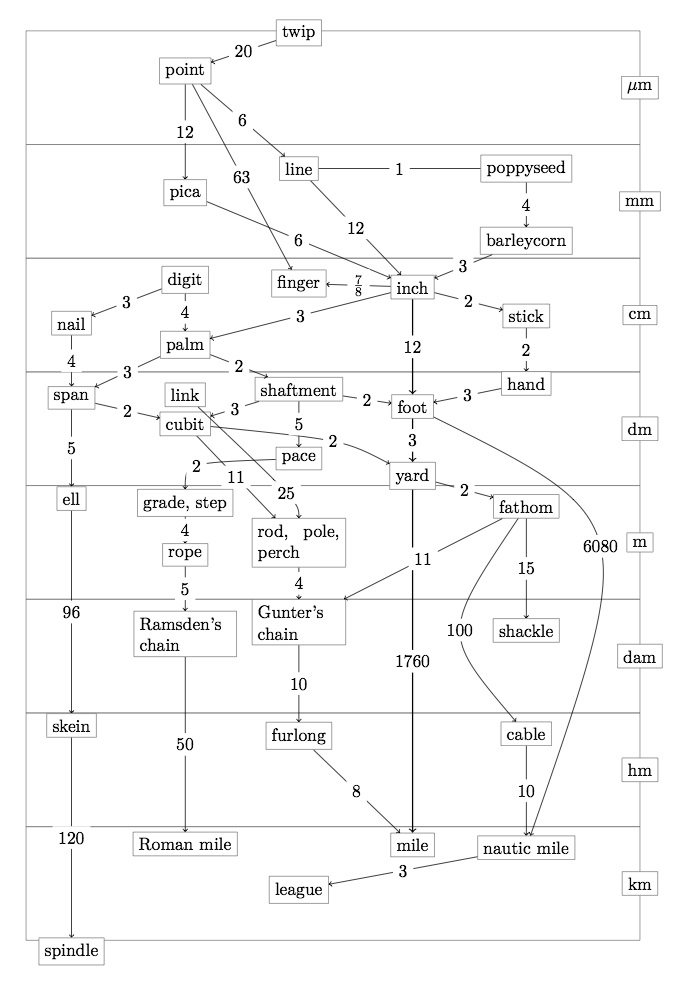
Following pic shows some Imperial units and their different (7/8, 1 (sic!), 2, 3, 4, 5, 6, 8, 10, 11, 12, 15, 20, 25, 50, 63, 96, 100, 120, 1760 & 6080) factors:


 Reply With Quote

Bookmarks