
 LinkBack URL
 About LinkBacks

Likely thehomeengineer and I will both agree generating low profile lateral motion is akin to how a vise works. If, by "clamping against the part" you mean to push a clamp against the workpiece with a thumb while clamping, will have only a fraction the mechanical advantage a cam produces.Originally Posted by petertha

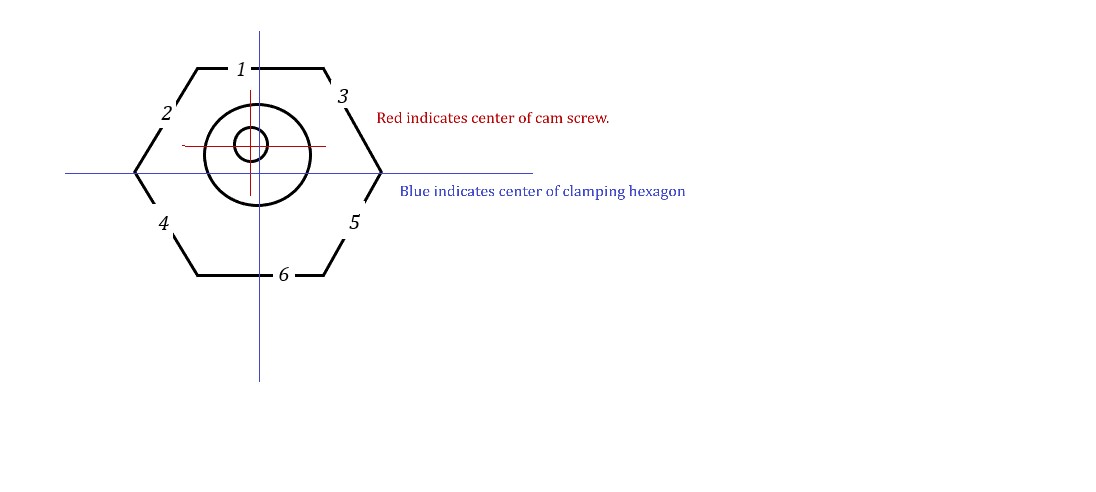
By selecting the 'correct' face of the hexagon, maximum force will be near the clockwise apex of cam rotation. At least one face might not contact at all, probably one or two won't allow enough rotation to let cam turn sufficiently.
So in principle, just pushing would register location effectively, minus effective clamping. The sketch might illustrate this better than a mere description.
[click on this to view at size]
Numbered sides simulate increased amount off center from cam screw center to edges of hexagon. Turning the screw [which is press fit in cam] causes shift in position of hexagon, both toward and away from intended clamp surface. One of the faces will press heaviest on workpiece when screw+cam rotate in the bore of hexagon.
Quick action like this is used in production vises; using a screw to approach size, a cam to actuate clamp action. Only the cam needs to be opened and closed to exchange parts.


 Reply With Quote

Bookmarks