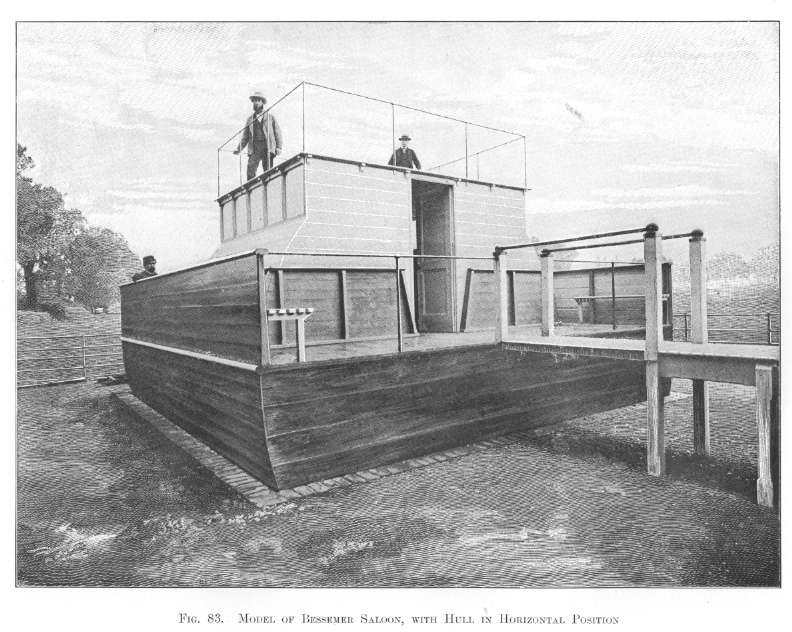
Few persons have suffered more severely than I have from sea sickness, and on a return voyage from Calais to Dover in the year 1868, the illness commencing at sea continued with great severity during my journey by rail to London, and for twelve hours after my arrival there. My doctor saw with apprehension the state I was in. He remained with me throughout the whole night, and eventually found it necessary to administer small doses of prussic acid, which gradually produced the desired effect, and I slowly recovered from this severe attack. My attention thus became forcibly directed to the causes of this painful malady, which I, in common with most other persons, attributed to the diaphragm being subjected to the sudden motions of the ship. Hence, as a natural sequence, its cure appeared only to require that some mechanical means should be devised whereby that part of the ship occupied by passengers should be so far isolated as to prevent it from partaking of the general rolling and pitching motions. In this way I entered, almost without knowing it, into an investigation of the subject; and gradually, as my ideas were developed, I determined to make a model vessel, small enough to be placed on a table, and to which the usual pitching motion of a ship was imparted by clockwork.
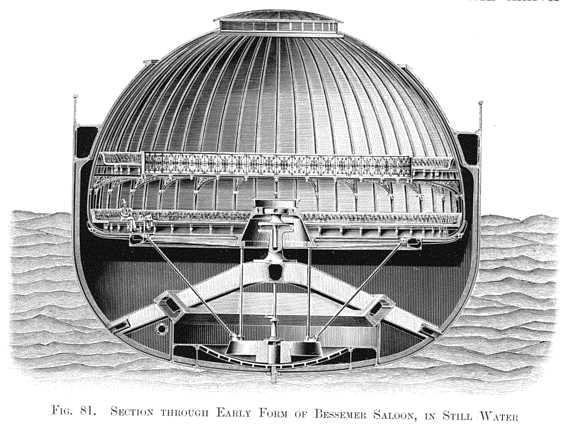
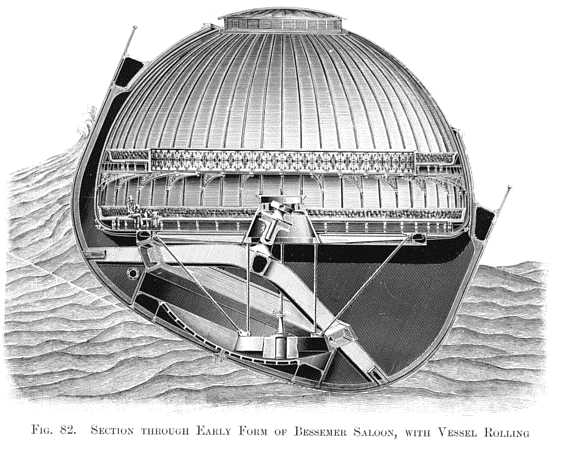
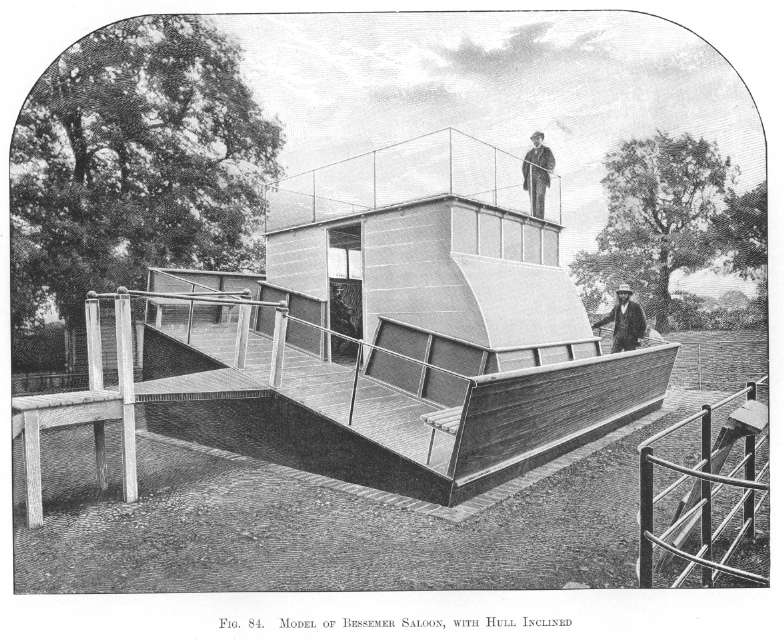
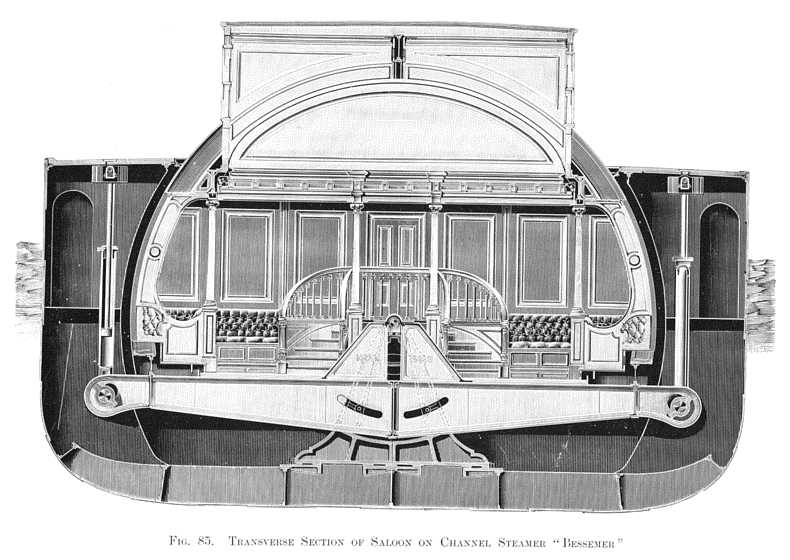
On this model was arranged a suspended cabin, supported on separate axes, placed at right angles to each other. I obtained a patent in December, 1869, for this invention, which is represented in two sectional engravings, Figs. 81 and 82, on Plate XXXVII.

 LinkBack URL
 About LinkBacks





 Reply With Quote


 inventor in 1868. Bessemer invented this type of ship to combat his seasickness. It worked nicely in model form, but was never built fullsize.
Few persons have suffered more severely than I have from sea sickness, and on a return voyage from Calais to Dover in the year 1868, the "Pin It")







Bookmarks