 LinkBack URL
 About LinkBacks
Passive tanker ship stabilization demonstration from Hoppe Marine. Looks like the strategy here is to remove the baffles?
More: https://www.hoppe-marine.com/?q=en/node/8





Passive tanker ship stabilization demonstration from Hoppe Marine. Looks like the strategy here is to remove the baffles?
More: https://www.hoppe-marine.com/?q=en/node/8
New: BuildThreads.com - 300+ build posts/day (with photos)
Seedtick (Sep 26, 2018)

Yeah left to right would be ok, I'm guessing but front to rear, nooooooo.Originally Posted by Jon


I agree with TM51. However the only crafts that I was ever on in deep water were either crew boats, barges or the occasional sailing vessel with up to a 3,500 lb keel.
The way I looked at if you can't stand the motion of the ocean buy yourself a mini van and take the kids to Disney world.
Never try to tell me it can't be done
When I have to paint I use KBS products

It uses the motion of the liquid to reduce roll, demonstrating the failure of the baffled system to do so. Rather akin to the self balancing dodads fitted to car wheels and grinding wheels. The strategy is not specifically to remove the baffles but to reduce roll.

I wonder if that Hoppe simulation would work if the liquid was at a different level. Or did they just carefully calculate and test different levels and baffle heights and numbers, that gave them the worse/best case scenario in a simulation. Ideally, and in the real world, you dont have a single tank with baffles across it, you have individual isolated tanks that can be kept pressed up so that the free surface effect is removed as much as is possible.
Phil
Toolmaker51 (Sep 25, 2018)

I agree with 12bolts. The Hoppe device has two baffles on the stable side retaining fluid opposite lowered side of 'hull' simulator.The fluid is an active counterweight. Not sure how that will be practical in a full size displacement hull. The pair of baffles would need a function to set a particular level for sea conditions at that time.
Don't visit Hoppe's site. This page indicates they have more than a little gray matter at hand....https://www.hoppe-marine.com/?q=en/node/17
Last edited by Toolmaker51; Sep 25, 2018 at 06:57 PM.
Sincerely,
Toolmaker51
...we'll learn more by wandering than searching...

I like this 3D Motion Compensator attachment for making offshore cranes more precise. 2:49 video:
More: https://www.macgregor.com/globalasse...sets/84094.pdf
New: BuildThreads.com - 300+ build posts/day (with photos)
MeJasonT (Feb 2, 2019), PJs (Feb 2, 2019), Seedtick (Feb 1, 2019), Toolmaker51 (Feb 1, 2019)
It appears a good method of compensation, and logical. The video rendering, also a fine depiction. I don't know much about floor variety cranes, but the MacGregor version, positioned horizontal is simplicity, regardless how much tech needed to keep it so.
But they forgot to give the ocean going freighter a pointy front end.
Lol.
Last edited by Toolmaker51; Feb 1, 2019 at 03:36 PM.
Sincerely,
Toolmaker51
...we'll learn more by wandering than searching...
MeJasonT (Feb 2, 2019)

The extension arm only allowing for a small lifting whip will not catch on. I have worked on projects where a 50 tonne crane has been performing 45 tonne lifts putting manifolds etc on the seabed. The industry will be looking for a more substantial lift capacity. What confuses me if they have integrated it into their existing controls then why not upgrade the existing crane and boom and don't bother with the rather light looking extension. market research may also be a great benefit, I worked for MPI installing offshore windfarms.
This was the vessel I was working on, once the pile is installed the pylon is attached. not possible to put a small container on top of the pile as per the video.
https://en.wikipedia.org/wiki/TIV_MPI_Resolution
Certainly one sure way of getting a fixed lifting platform for heavy lifts at sea.
Citizen of the "New democratic" Republic of Britain, liberated from the EuroNation
Jon (Feb 2, 2019), PJs (Feb 2, 2019), Toolmaker51 (Feb 3, 2019)
With regards sailing and unstable boats. MAN UP. Its man against the elements, its all part of the skill and experience. Whats next ice cold fires so idiots don't get burnt.
Citizen of the "New democratic" Republic of Britain, liberated from the EuroNation
Toolmaker51 (Feb 3, 2019)
There are currently 3 users browsing this thread. (0 members and 3 guests)
 Posting Permissions



 Reply With Quote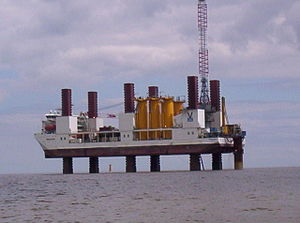
Bookmarks