Free 186 More Best Homemade Tools eBook:  
New: 300+ fresh build posts/day from 275 forums → BuildThreads.com

User Tag List

Page 1 of 5 1 2 3 4 5 LastLast
Results 1 to 10 of 48

Thread: Power Hack Saw help needed

Hybrid View

  1. #1
    Supporting Member garage nut's Avatar
    Join Date
    Jul 2017
    Location
    Port Elizabet, SA
    Posts
    246
    Thanks
    92
    Thanked 464 Times in 115 Posts

    garage nut's Tools

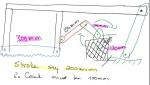
    Power Hack Saw help needed

    Looked at all the different ideas on here for making a "Power Hack Saw".
    Ended up liking the idea of the one with a frame at the back more than the conventional "Slide" type.

    Think there is going to be too much play on the slide and if you set it tight enough to stop the play a lot of power will be used just to overcome the friction.

    Has anybody got some dimensions for this type of saw?

    Basic givens...
    300mm x 25 Starett 14T blade
    Stroke 200mm to use maximum of the blade.
    That means the crank moving the blade has to be 100mm.
    That dictates that the pivot for this crank must be about 120mm above the base plate.
    Link from crank to saw blade frame also about 120mm.

    Just going to cut this all 1:1 from cardboard and figure out the frame and rear frame dimensions.

    Was thinking of using bearing ends as the bearings of the rear frame, setting them up so I can use their tread to fine tune the saw to cut square.

    Anything major I am missing?

    Attached Thumbnails Attached Thumbnails Power Hack Saw help needed-saw-scetch.jpg  

  2. The Following 3 Users Say Thank You to garage nut For This Useful Post:

    MeJasonT (Oct 3, 2017), olderdan (Oct 4, 2017), Seedtick (Oct 3, 2017)

  3. #2
    Supporting Member ncollar's Avatar
    Join Date
    Oct 2012
    Posts
    354
    Thanks
    23
    Thanked 229 Times in 158 Posts
    Garage Nut
    Send me a PM and I'll send you several sets of plans ofor a power hacksaw.
    Nelson


    ncollar1957 (AT) gmail (DOT) com

  4. The Following User Says Thank You to ncollar For This Useful Post:

    garage nut (Oct 4, 2017)

  5. #3
    Supporting Member MeJasonT's Avatar
    Join Date
    Jun 2016
    Location
    Lake District in UK
    Posts
    432
    Thanks
    456
    Thanked 312 Times in 176 Posts

    MeJasonT's Tools
    I have tried to build a power hacksaw, bought the motor and 24" Bahco hacksaw blades and every thing. was planning to use I beam to make the base and 4"x 2"box for the bow, then realised a bandsaw is a greater beast. at a 300mm stroke you will be able to cut a maximum of 6" wide at best, if you want to cut at 45 degrees then that's a whole new challenge. If you go down the route of a bandsaw then technically you can make it as big as you want - i was looking to cut I beam and 12" pipe so making a saw for a 18" throat wouldn't be such a big issue. There are standard blade lengths off the shelf, ok they can cost between $20 upwards but far cheaper than the beefy hacksaw blades, which incidentally always wear in the same place - the middle. The idea is still burning a hole in my head and not being burnt out of steel yet. I'm limited for space, there are 66 million people living in the UK in a country a quarter of the size of Kansas - it gets a bit cramped when you need a bigger home shop. I'm thinking a Ranch would be about the smallest piece of real-estate that could house all my ideas and projects.
    Ill be interested in seeing how you get on and following your progress.
    Citizen of the "New democratic" Republic of Britain, liberated from the EuroNation

  6. #4
    Supporting Member ncollar's Avatar
    Join Date
    Oct 2012
    Posts
    354
    Thanks
    23
    Thanked 229 Times in 158 Posts
    I seen a young man shop there in Aust. and was supprized the space he is utilizing and the quality of work preforms.

  7. #5
    Supporting Member Toolmaker51's Avatar
    Join Date
    Feb 2016
    Location
    Midwest USA
    Posts
    5,355
    Thanks
    7,074
    Thanked 3,569 Times in 2,209 Posts

    Toolmaker51's Tools
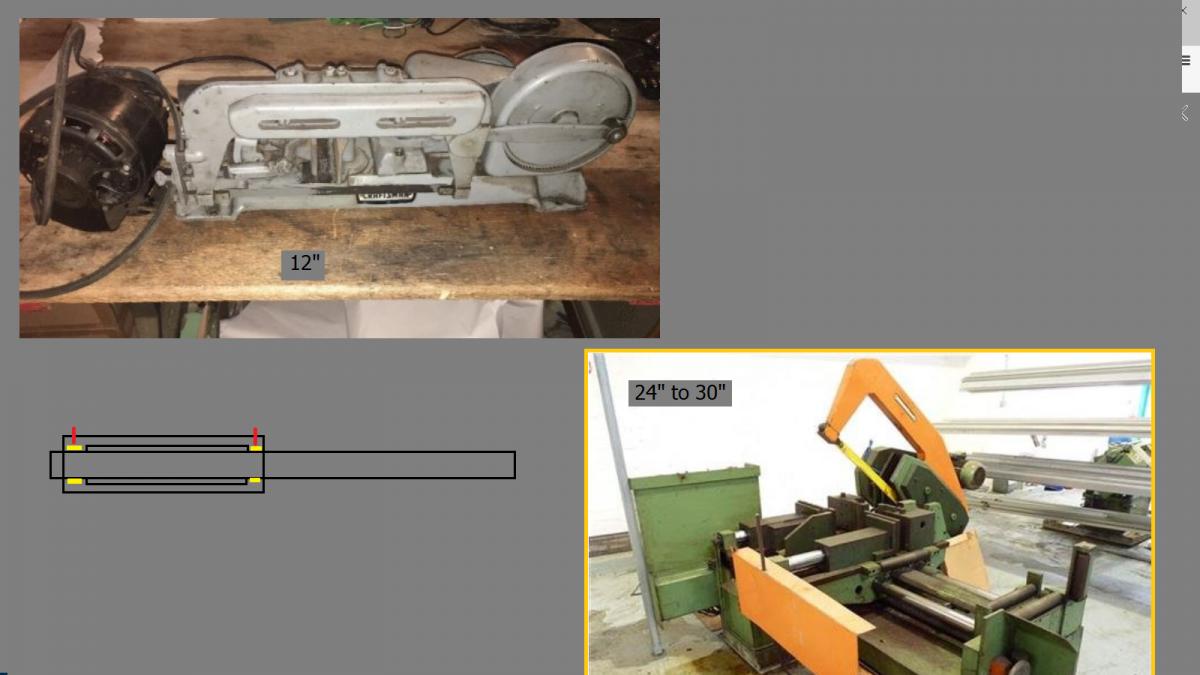
    The most important feature in hacksawing, physical or mechanized, is to lift the blade on the return stroke and preserve the cutting edges from rolling in or chipping out. Like a file, they only cut in one direction. Usually the lift is coupled to the crank and con-rod action as an over-centering motion and deflect the frame upward. The feed rate is controlled easily by pawl(s) and ratchet teeth. Feed pressure can be adjusted by a sliding weight. Power hacksaws are compact and even the little versions with 12" hand hack blades work nicely. Size wise, they cover an incredible range of capacity. Power Hack Saw help needed-hacksaws.jpg
    I've edited the jpeg with a crude sketch of a slide bar that will regulate your concerns with friction. It depicts inside of the slide relieved of full contact with bar, brass, nylon or other non-galling 'gibs' and setcrews to take up eventual wear. Though sketch is from overhead, the same arrangement is suitable for the closure, or top plate. This could easily be assembled, if you haven't access to a mill, from flat bar. The bar itself deserves a good flat stoning on sides subject to motion.
    Other mechanical considerations; cutting speed, many run 60 <> strokes per minute with 12" blades, too fast with a longer blade. Elsewhere a recommendation of 100' feet per minute with coolant is right on. Designing a little bit of range wouldn't hurt a bit. Hacksaws excel at heavier sections if you can locate blades of proper pitch (teeth per inch or mm).
    A swiveling vise jaw, at least on the moving side.
    A gap below the bed to 'park' the blade, and where it reciprocates before shut off.
    A work stop for repetitive cuts.
    Build height on a cart to match height of a table you could use it with, or benchtop with cribbing to keep longer stock level. If a cart is chosen, put two wheels on back legs to aid transportation.
    Infeed table proportions seem to run 2 or 3 times the jaw capacity. That will help positioning stock for better square cutting in the vertical plane.
    Last edited by Toolmaker51; Oct 4, 2017 at 11:02 AM. Reason: photo comparision, other additions
    Sincerely,
    Toolmaker51
    ...we'll learn more by wandering than searching...

  8. #6

    Join Date
    Apr 2017
    Location
    Ithaca, NY
    Posts
    9
    Thanks
    0
    Thanked 2 Times in 1 Post

    Google 'straight line machines' to find one that might work for you.

    Quote Originally Posted by garage nut View Post
    Looked at all the different ideas on here for making a "Power Hack Saw".
    Ended up liking the idea of the one with a frame at the back more than the conventional "Slide" type.

    Think there is going to be too much play on the slide and if you set it tight enough to stop the play a lot of power will be used just to overcome the friction.

    Has anybody got some dimensions for this type of saw?

    Basic givens...
    300mm x 25 Starett 14T blade
    Stroke 200mm to use maximum of the blade.
    That means the crank moving the blade has to be 100mm.
    That dictates that the pivot for this crank must be about 120mm above the base plate.
    Link from crank to saw blade frame also about 120mm.

    Just going to cut this all 1:1 from cardboard and figure out the frame and rear frame dimensions.

    Was thinking of using bearing ends as the bearings of the rear frame, setting them up so I can use their tread to fine tune the saw to cut square.

    Anything major I am missing?


    Actually, slide bar machines are most suitable for these machines. Using the slide bar as the reference the crank that drives the connecting rod to extend and return the blade holder shaft center needs to be set so that it is below the location of the point where the connecting rod connects to the moving blade carrier, and the rotation direction is set so the blade is drawn in the cutting direction, pulled, as the crank end of the connecting rod is moving over the the top of its travel, the blade is then moving at a relatively slow speed. As the crank continues its rotation it is pushing the blade away and the connecting rod is angled up to the blade carrier, reducing the down pressure on the blade and reducing wear on the teeth as they back off. In commercial machines, there is a cam and ratchet mechanism that actually lifts the blade off the work on the return stroke so as not to wear down the teeth. without a lift mechanism, the teeth will be worn down quickly. With a hardened steel tooth blade, I would recommend limiting blade cutting speed to 100 surface speed per minute for maximum blade life without coolant, and maybe 150 sfpm if flood coolant is used.

    The best source for design information may be the patent office, and since most, if not all relevant patents are no longer enforcable, you are free to copy the devices exactly. In the US, even a still valid patent does not prohibit you from making one for your personal use, you just can't make them to sell. I don't know anything about the patent law elsewhere.

    The slide bar free play can be eliminated by using a leaf spring on one side and under the bottom of the slide bar in the moing carrier, and grease on the slide bar.
    Last edited by whome; Oct 3, 2017 at 09:13 PM.

  9. #7
    Jon
    Jon is offline Jon has agreed the Seller's Terms of Service
    Administrator
    Supporting Member
    Jon's Avatar
    Join Date
    Jan 2012
    Location
    Colorado, USA
    Posts
    28,433
    Thanks
    8,489
    Thanked 44,287 Times in 13,044 Posts
    Quote Originally Posted by whome View Post
    In the US, even a still valid patent does not prohibit you from making one for your personal use, you just can't make them to sell.
    We often see people saying that we are allowed to reproduce patented inventions for personal use; I would criticize you for repeating this, but I've made the same mistake myself! After researching it more thoroughly, here's what I think is happening:

    First of all: US patent law forbids making or using patented inventions, even for personal use. These days, this is usually for a period of 20 years.


    More: https://www.law.cornell.edu/uscode/text/35/271

    Why do we get this wrong so frequently? My theory: it's caused by conflating patent law with the fair use doctrine of copyright law. Certain uses of copyrighted material are considered to be perfectly legal "fair use". There are four factors used to weigh fair use in copyright:

    1. purpose and character of the use
    2. nature of the copyrighted work
    3. amount and substantiality
    4. effect on the market

    The "purpose and character" factor specifically includes whether the use is commercial or non-profit. And of course the "effect on the market" factor focuses on commerciality. So, if you have a non-profit use of a copyright that's not significantly impacting the market of the copyrighted work, you often have a strong claim to fair use.

    Here's the rub: the concept of fair use applies to US copyright law, but NOT to US patent law. I'm not sure why this is, but I think that's the source of the frequent confusion.

    Internet armchair lawyering aside: litigation over someone making a patented device for personal use is extremely rare, and usually not cost-effective. The worst I've ever seen, in almost two decades on forums, is a patent owner complaining to a forum admin about someone posting a how-to about making the patent owner's invention. It is almost never worthwhile to sue over this type of hobbyist use.

    I believe there is also another nuance regarding making patented inventions solely for the purpose of research, but I would need to confirm this with an IP lawyer before understanding it fully. Let me know if anyone knows more about this.

    I agree with all of your other points. The vast majority of patents are expired, searching patents is a great way to get ideas, and - in a healthy society - the government wants people to examine all of the public patent documents and drawings so that we can advance each others' inventions.
    New: BuildThreads.com - 300+ build posts/day (with photos)

  10. The Following 2 Users Say Thank You to Jon For This Useful Post:

    DIYer (Oct 5, 2017), Paul Jones (Oct 5, 2017)

  11. #8
    Supporting Member olderdan's Avatar
    Join Date
    Jun 2016
    Posts
    811
    Thanks
    1,479
    Thanked 1,785 Times in 520 Posts

    olderdan's Tools
    Take a look at myfordboy blog and online resources: Compact Power Hacksaw
    He sells plans for £10 for a super compact machine and just watching the video may help in your quest.
    Good luck.

  12. The Following User Says Thank You to olderdan For This Useful Post:

    garage nut (Oct 4, 2017)

  13. #9
    Supporting Member Frank S's Avatar
    Join Date
    Aug 2015
    Location
    Peacock TX
    Posts
    12,611
    Thanks
    2,677
    Thanked 11,100 Times in 5,384 Posts

    Frank S's Tools
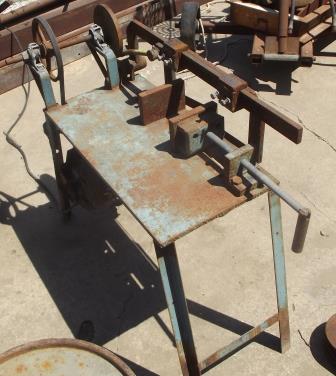
    Here is my power hacksaw made around 38 years ago patterned off of the ones I made and showed guys how to make nearly 50 years ago I probably copied plans for it from an article found in an old Popular Science or Popular Mechanics magazine
    Power Hack Saw help needed-dscf7150c.jpg
    click on the link for more pics. http://www.homemadetools.net/forum/o...turns-up-43102
    Hard to see in the pictures but the motor was salvaged from an old swamp cooler
    Last edited by Frank S; Oct 4, 2017 at 02:21 AM.
    Never try to tell me it can't be done
    When I have to paint I use KBS products

  14. The Following User Says Thank You to Frank S For This Useful Post:

    Paul Jones (Oct 5, 2017)

  15. #10
    Supporting Member garage nut's Avatar
    Join Date
    Jul 2017
    Location
    Port Elizabet, SA
    Posts
    246
    Thanks
    92
    Thanked 464 Times in 115 Posts

    garage nut's Tools
    Only need this machine to cut slugs off bar stock to use in my lathe. It is a very small lathe and the chuck throat is only 20mm.

    So anything bigger than that I have to cut to roughly the correct length before starting the job. very seldom anything bigger than 100mm.

    Tubing, angle iron d cutting at angles is left to my abrasion wheel cut off machine. also made it myself and have served me for about 30 years and the only thing I will change is to fit a proper vice to it. Will post a pic..

    Also building a ring roller to do 60mm pipe for an excosceletal (how ever you spell that ??)car I am building, but caught in a bit of chicken egg situation as I need one machine to build the other

Thread Information

Users Browsing this Thread

There are currently 1 users browsing this thread. (0 members and 1 guests)

Bookmarks

Posting Permissions

  • You may not post new threads
  • You may not post replies
  • You may not post attachments
  • You may not edit your posts
  •