Free 186 More Best Homemade Tools eBook:  
New: 300+ fresh build posts/day from 275 forums → BuildThreads.com

User Tag List

Page 1 of 2 1 2 LastLast
Results 1 to 10 of 12

Thread: Recovering a "dead" lithium battery

  1. #1
    Supporting Member jdurand's Avatar
    Join Date
    May 2019
    Location
    Krasnodar Krai, Russian Federation
    Posts
    1,504
    Thanks
    135
    Thanked 889 Times in 498 Posts

    jdurand's Tools

    Recovering a "dead" lithium battery

    Most tools that use lithium batteries have built in battery protection circuits and sometimes even a microprocessor.

    The protection circuit and possibly microprocessor draw power from the battery, even when it's "off". It's not a lot of power, just a very slow drain.

    Well, if you leave the tool/battery pack laying around long enough, especially if it wasn't fully charged, it's going to run down.

    Herein lies a problem. There's 4 major trip points for lithium cells, for lithium polymer (common ones), 4.2 V = full charge, stop all charging.

    4.0 V is typically the "start recharging" if the charger was left plugged in.

    around 3V is where the protection circuit cuts off the power to the tool. So, to the tool the battery is dead, the user grumbles and goes to find where he left the charger.

    But, there's one more very important trip point. It can vary but let's say it's 2V. Remember the protection circuit is still drawing a little power, even if it cut off power to the tool. The battery will eventually drain below this point.

    Now, even if you plug in the charger, the protection circuit will NOT allow you to charge it. It's seen as an error. The user curses, tosses the battery pack out and buys a new one.

    However, if you are not accident prone and have the appropriate tools, you can fix this if it hasn't gone too far.

    *** WARNING! DANGER! DO NOT TRY THIS AT HOME! TRAINED PROFESSIONAL ON CLOSED TRACK! ***

    You can open up the battery pack, verify the low voltage condition of the battery (note, if there's multiple cells this gets more complicated), and then with a constant current power supply apply a charge directly to the battery cell. The charge current should be low, no more than 10-25% of the rating of the cell (a 1000mA cell would be charged at 100-250mA). The power supply voltage should have been set to the correct multiple of about 3.5V per cell.

    MONITOR THE VOLTAGE, it shouldn't take long for the cell voltage to climb up close to 3. Disconnect the power supply and connect the regular charger. If all goes well, the charger will take over and bring the battery back to life.

    I just had to do this with a battery pack spot welder. Can't make a battery pack if the battery in the welder is dead!


  2. The Following 7 Users Say Thank You to jdurand For This Useful Post:

    ductape (Oct 11, 2025), emu roo (Oct 14, 2025), metric_taper (Nov 6, 2025), nova_robotics (Oct 14, 2025), PJs (Oct 16, 2025), rebuilder1954 (Oct 14, 2025), Tule (Nov 6, 2025)

  3. #2
    Supporting Member
    Join Date
    Dec 2022
    Location
    Midwest US
    Posts
    389
    Thanks
    261
    Thanked 287 Times in 170 Posts

    ductape's Tools
    It seems like a good idea for the battery management circuitry to just shut down and stop drawing power before the pack gets to the point where it can't be recharged with the normal method, then wake up when plugged in. I'm not an EE so may just be showing my ignorance.

  4. The Following 2 Users Say Thank You to ductape For This Useful Post:

    emu roo (Oct 14, 2025), nova_robotics (Oct 14, 2025)

  5. #3
    Supporting Member jdurand's Avatar
    Join Date
    May 2019
    Location
    Krasnodar Krai, Russian Federation
    Posts
    1,504
    Thanks
    135
    Thanked 889 Times in 498 Posts

    jdurand's Tools
    Quote Originally Posted by ductape View Post
    It seems like a good idea for the battery management circuitry to just shut down and stop drawing power before the pack gets to the point where it can't be recharged with the normal method, then wake up when plugged in. I'm not an EE so may just be showing my ignorance.
    While true, that is not normally the case. Almost all battery packs use one of only a couple of different chips or the microcontroller in their product that also does other things. Essentially nobody has any incentive to do it differently.

  6. The Following 2 Users Say Thank You to jdurand For This Useful Post:

    emu roo (Oct 14, 2025), PJs (Oct 16, 2025)

  7. #4
    Supporting Member
    Join Date
    Sep 2018
    Posts
    2,920
    Thanks
    13,819
    Thanked 1,776 Times in 999 Posts

    nova_robotics's Tools
    Quote Originally Posted by ductape View Post
    It seems like a good idea for the battery management circuitry to just shut down and stop drawing power before the pack gets to the point where it can't be recharged with the normal method, then wake up when plugged in. I'm not an EE so may just be showing my ignorance.
    They do, but the problem is even the circuit to disconnect takes a tiny bit of current. A DW01 is a super common little low-voltage cutoff chip, and it's quiescent current (nerd speak for the amount of current something draws when it's off) is around 3 micro amps. So 3 millionths of an amp. Normally this is smaller than the self-discharge of the battery so we don't care. But it all adds up and eventually destroy the cell if you leave it long enough.

  8. The Following User Says Thank You to nova_robotics For This Useful Post:

    emu roo (Oct 14, 2025)

  9. #5
    Supporting Member jdurand's Avatar
    Join Date
    May 2019
    Location
    Krasnodar Krai, Russian Federation
    Posts
    1,504
    Thanks
    135
    Thanked 889 Times in 498 Posts

    jdurand's Tools
    Quote Originally Posted by nova_robotics View Post
    They do, but the problem is even the circuit to disconnect takes a tiny bit of current. A DW01 is a super common little low-voltage cutoff chip, and it's quiescent current (nerd speak for the amount of current something draws when it's off) is around 3 micro amps. So 3 millionths of an amp. Normally this is smaller than the self-discharge of the battery so we don't care. But it all adds up and eventually destroy the cell if you leave it long enough.
    And it's even worse if they use their microcontroller in place of the DW01. I think that's the problem with the battery welder, they mention they have all sorts of over temp and over current protections for the battery. So, they probably do it all with their processor and that would be why this ran down in about 6 months.

  10. The Following User Says Thank You to jdurand For This Useful Post:

    emu roo (Oct 14, 2025)

  11. #6
    Supporting Member jdurand's Avatar
    Join Date
    May 2019
    Location
    Krasnodar Krai, Russian Federation
    Posts
    1,504
    Thanks
    135
    Thanked 889 Times in 498 Posts

    jdurand's Tools
    [tech talk below]

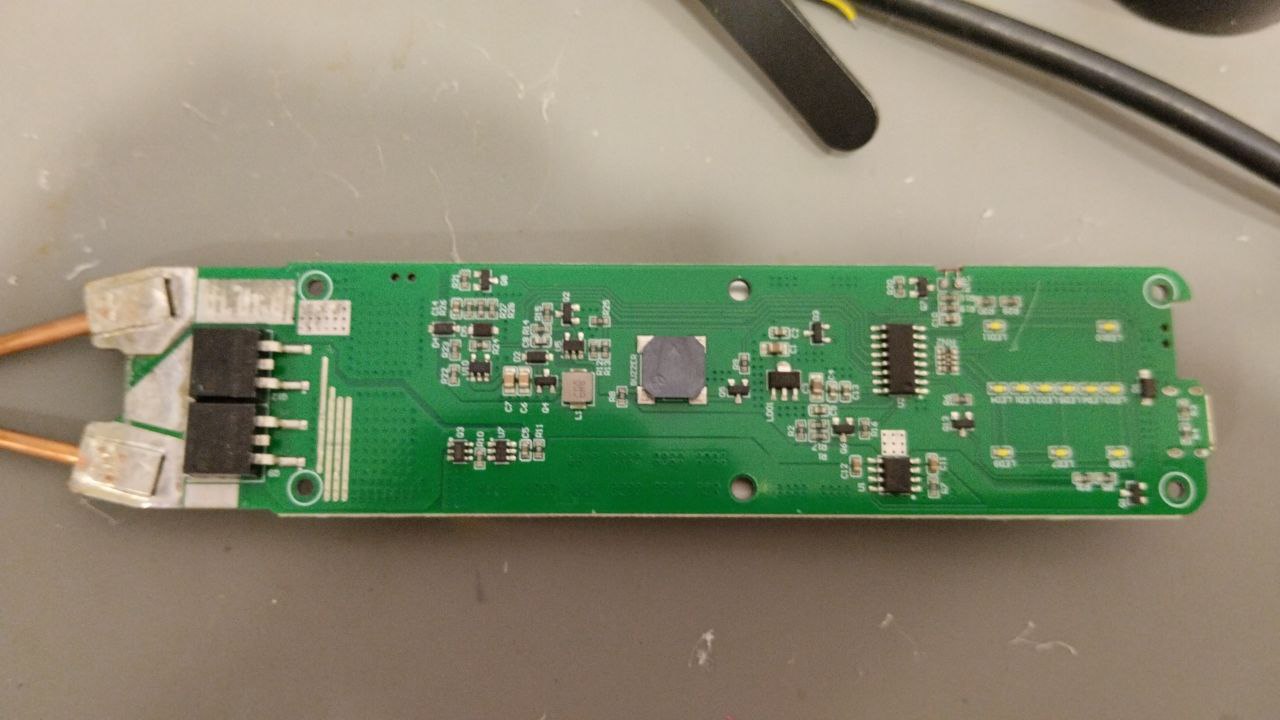
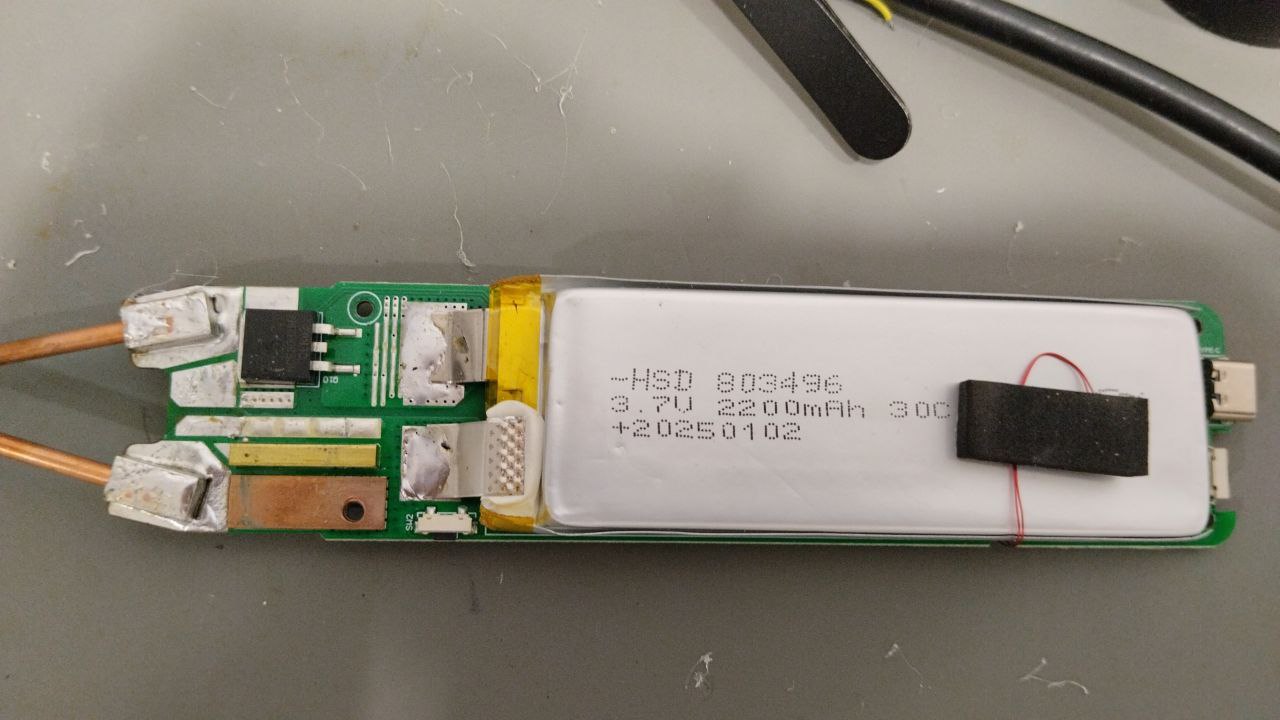
    Thinking about this some more, I went and looked at the PCB. I suspect there isn't any standard DW01 on this. This has 3 big FETs to switch the battery to the welding probe. A protection chip would need some sort of FET in series with the battery. To completely disconnect the battery, that would be 3 more big FETs with associated losses across them, probably unacceptable in cost, board space, and functionality of the welder.

    Now, a good engineer would have either had the DW01 disconnect the power to the processor and associated circuitry or at the very least have the processor kill power to the switching regulator and other stuff on the board. Then go into deep sleep until 5V from the USB wakes it back up. It would still have the problem of the battery eventually dropping below the BOD point keeping the processor from waking on USB plug-in. That, too, can be dealt with but I think this might be a bit deep in battery control for whoever designed this. Still, overall it's not bad... just have to keep it charged.

    They did, amazingly, put the 5.1k resistors on the USB-C socket. It's rare to see that.

    Pictures of the welder below.

    Recovering a "dead" lithium battery-photo_2025-10-14_19-19-46.jpg

    Recovering a "dead" lithium battery-photo_2025-10-14_19-19-51.jpg
    Last edited by jdurand; Oct 14, 2025 at 10:43 AM.

  12. The Following 3 Users Say Thank You to jdurand For This Useful Post:

    emu roo (Oct 14, 2025), nova_robotics (Oct 15, 2025), PJs (Oct 16, 2025)

  13. #7
    Jon
    Jon is offline Jon has agreed the Seller's Terms of Service
    Administrator
    Supporting Member
    Jon's Avatar
    Join Date
    Jan 2012
    Location
    Colorado, USA
    Posts
    28,433
    Thanks
    8,489
    Thanked 44,287 Times in 13,044 Posts
    Congratulations jdurand - your lithium battery recovery method is the Tool Tip of the Month for October 2025!

    This is a useful tip for saving a lithium battery that is down but not out.

    Some more good tool tips from October:

    Sacrificial Boards by Make Things
    T-Type Tap Wrenches by Mook
    Ammonia Fuming by Make Things
    Machining Angled Pockets by Mook

    To enter your tool tip in our monthly contest, just post it here in the Tool Tips and Tricks subforum.

    jdurand - we've added your Tool Tip to our All Tool Tips of the Month winners post. And, you'll now notice the tool tip award in the awards showcase in your postbit, visible beneath your username:


    And, you'll be receiving a $100 prize, in your choice of Amazon, PayPal, or bitcoin. Please PM me your current email address and prize choice and I'll get it sent over right away.

    Congrats again
    New: BuildThreads.com - 300+ build posts/day (with photos)

  14. The Following User Says Thank You to Jon For This Useful Post:

    jdurand (Nov 4, 2025)

  15. #8
    Supporting Member metric_taper's Avatar
    Join Date
    Mar 2017
    Location
    Marion, Iowa
    Posts
    760
    Thanks
    281
    Thanked 410 Times in 266 Posts

    metric_taper's Tools
    Quote Originally Posted by jdurand View Post

    *** WARNING! DANGER! DO NOT TRY THIS AT HOME! TRAINED PROFESSIONAL ON CLOSED TRACK! ***
    The reason for this warning, you may damage that cell by overcurrent or overvoltage breakdown of the insulator that prevents the cell from going into thermal runaway,
    This can result in the unwatched charging, burning the location to the ground. Cheap import batteries are known to do this as well (any advice relative to repairing battery packs, for affordable cells?).
    We foolishly trust these compact high energy density bits of technology to not burn, just saw a video of a dog that burned the house down biting the phone on the couch, the homeowner video to watch their canines during the day remotely, did not save them from loosing the shoe biter.
    And the recent warnings of charge battery banks going into thermal runaway on aircraft. Fireball from overhead stowage, and the guy looks at his bag next to the fireball and has no clue what to do ..... HEAD THIS WARNING!

  16. #9
    Supporting Member metric_taper's Avatar
    Join Date
    Mar 2017
    Location
    Marion, Iowa
    Posts
    760
    Thanks
    281
    Thanked 410 Times in 266 Posts

    metric_taper's Tools
    Quote Originally Posted by jdurand View Post
    [tech talk below]


    Now, a good engineer

    I look at value engineering as bad juju, especially if it's intended to fail in a predetermined MTBUR. (all personally owned human appliances)
    In my working days, my management would keep saying "better is the enemy of good enough", as you know, there are engineers with the mental condition, that keep making changes preventing release on schedule.
    They got this to work at the price point, that it's disposable.

  17. #10
    Supporting Member jdurand's Avatar
    Join Date
    May 2019
    Location
    Krasnodar Krai, Russian Federation
    Posts
    1,504
    Thanks
    135
    Thanked 889 Times in 498 Posts

    jdurand's Tools
    Quote Originally Posted by metric_taper View Post
    The reason for this warning, you may damage that cell by overcurrent or overvoltage breakdown of the insulator that prevents the cell from going into thermal runaway,
    This can result in the unwatched charging, burning the location to the ground. Cheap import batteries are known to do this as well (any advice relative to repairing battery packs, for affordable cells?).
    We foolishly trust these compact high energy density bits of technology to not burn, just saw a video of a dog that burned the house down biting the phone on the couch, the homeowner video to watch their canines during the day remotely, did not save them from loosing the shoe biter.
    And the recent warnings of charge battery banks going into thermal runaway on aircraft. Fireball from overhead stowage, and the guy looks at his bag next to the fireball and has no clue what to do ..... HEAD THIS WARNING!
    Quite true. Just because cells have protection circuitry (hopefully!) doesn't mean they can be abused. Storing a lot of power in a small space is dangerous no matter what. Be very careful working with lithium batteries!

    BTW, the most dangerous part of the battery is the polymer, NOT the lithium. Odd but true.

Thread Information

Users Browsing this Thread

There are currently 1 users browsing this thread. (0 members and 1 guests)

Bookmarks

Posting Permissions

  • You may not post new threads
  • You may not post replies
  • You may not post attachments
  • You may not edit your posts
  •