Free 186 More Best Homemade Tools eBook:  
New: 300+ fresh build posts/day from 275 forums → BuildThreads.com

User Tag List

Page 1 of 2 1 2 LastLast
Results 1 to 10 of 18

Thread: Warco Saddle Stop

Hybrid View

  1. #1
    Supporting Member editor@glue-it.com's Avatar
    Join Date
    Apr 2017
    Location
    UK
    Posts
    291
    Thanks
    40
    Thanked 524 Times in 146 Posts

    editor@glue-it.com's Tools

    Warco Saddle Stop

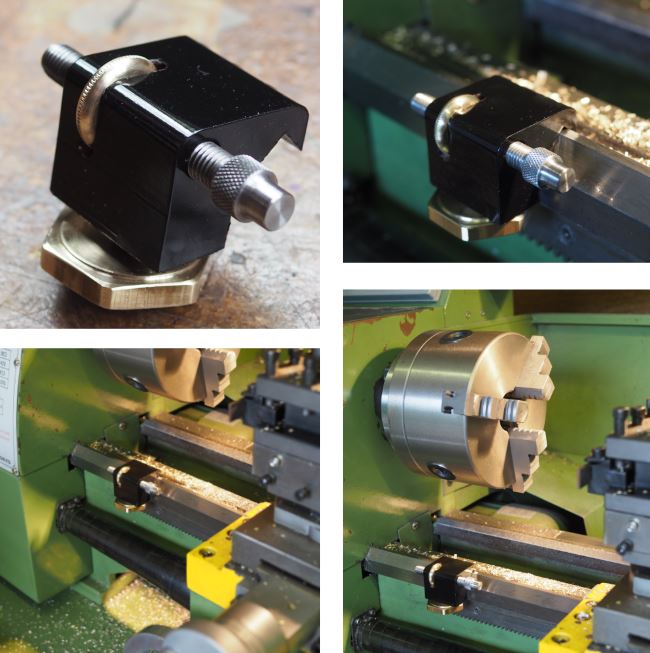
    Although I'm not a big fan of lathe saddle stops I've got to the point where I thought it might be a good idea for certain repeat tasks and hence I've set out and made this for the Warco WM240B lathe.

    Warco Saddle Stop-saddle-stop-012.jpg

    The result is a cast iron block that hangs over the saddle and locks with a nut. The stop itself then is a threaded bar that has a simple locking knurled wheel. All quite simple to make and more details are here: Warco Saddle Stop

  2. The Following 14 Users Say Thank You to editor@glue-it.com For This Useful Post:

    emu roo (Jul 2, 2025), high-side (Jan 14, 2019), Home-PC (Dec 30, 2020), HUMARIA (Dec 31, 2020), Jon (Jul 23, 2018), Miloslav (Mar 21, 2019), Paul Jones (Jul 23, 2018), PJs (Jul 22, 2018), rossbotics (Jul 24, 2018), Seedtick (Jul 23, 2018), Stevohdee (Jul 27, 2018), suther51 (Jul 23, 2018), Tule (Jan 10, 2019), zarembak (Jan 9, 2019)

  3. #2
    Supporting Member scrdmgl's Avatar
    Join Date
    Oct 2013
    Location
    Toronto, Ontario, Canada
    Posts
    26
    Thanks
    5
    Thanked 51 Times in 18 Posts

    scrdmgl's Tools

    Stop Ends

    Hi Nigel:

    Excellent design and finish of the components. I only have a suggestion for you. Any and all stops (lathe saddle, milling vise, etc.) are better provided with a round or convex contact area. The idea being that is easy for chips and any other debris, to stick to a flat surface messing up the accuracy of the location. Less so to the said end thus shaped.

    Cheers

    Jorge
    Last edited by scrdmgl; Jul 23, 2018 at 04:54 PM. Reason: Text repeated

  4. The Following User Says Thank You to scrdmgl For This Useful Post:

    emu roo (Jul 2, 2025)

  5. #3
    Supporting Member suther51's Avatar
    Join Date
    Jul 2016
    Posts
    380
    Thanks
    219
    Thanked 183 Times in 136 Posts
    There have been several stops posted that I have taken notice of, so by chance you are the one that I will ask sense I finally have enough motivation to post a question about them. I do not believe that I have yet seen a post that clearly shows how the stop clamps to the ways of the lathe. Perhaps a picture of the clamp side will be answer enough. Does the clamp or lock nut simply register on the underside of the ways? To be honest I have not owned my lathe long enough to have thought to look at the underside of the ways to see how much of a ledge is there. My lathe is a 12x32 enco of 1990 vintage. Just getting started with it. Finding out that "good condition" can have a more varied meaning than I would have thought. Oh well live and learn. Thanks in advance.
    Eric

  6. #4
    Supporting Member Frank S's Avatar
    Join Date
    Aug 2015
    Location
    Peacock TX
    Posts
    12,612
    Thanks
    2,677
    Thanked 11,101 Times in 5,385 Posts

    Frank S's Tools
    Eric, good condition is a poorly over used term when someone sells a machine.
    Particularly if they are not a machinist or have not operated the machine in question. To them good condition may mean everything moves or it switches on and runs.
    Rarely if ever are any spec sheets supplied stating current tolerances, back lash, run-out etc
    I've found some machines for sale claiming to have been refurbished only to find out the seller had done the refurbishment using little more than cleaning solvents and spray paint. I have even bought some if the price was right and the paint job was good quality, Knowing that as long as there wasn't too much wrong with it I could scrape square and tighten up where needed and make a decent machine out of it
    Never try to tell me it can't be done
    When I have to paint I use KBS products

  7. #5
    Supporting Member scrdmgl's Avatar
    Join Date
    Oct 2013
    Location
    Toronto, Ontario, Canada
    Posts
    26
    Thanks
    5
    Thanked 51 Times in 18 Posts

    scrdmgl's Tools
    How true it is Frank. The same word or definition, can have a different meaning for many people. That is akin as saying "an honest politician" when in fact is a contradiction in terms.

    Cheers

    George

  8. #6
    Supporting Member Frank S's Avatar
    Join Date
    Aug 2015
    Location
    Peacock TX
    Posts
    12,612
    Thanks
    2,677
    Thanked 11,101 Times in 5,385 Posts

    Frank S's Tools
    Most of the stop blocks I have used or encountered clamped like I have shown in the drawing picture
    Warco Saddle Stop-carriage-stop-block.jpg
    The basic block is milled to fit the way the clamp has a raised fulcrum to connect to the block held in place by a simple bolt from underneath
    Some blocks will have the thread in the clamp and the bolt passing from the top .
    the clamp will extend as far as required under the bottom of the way. usually depending on the size of the lathe it could be a little as .250" or as much as an inch or more.
    Never try to tell me it can't be done
    When I have to paint I use KBS products

  9. The Following 2 Users Say Thank You to Frank S For This Useful Post:

    Home-PC (Mar 19, 2021), Paul Jones (Jul 23, 2018)

  10. #7
    Supporting Member rossbotics's Avatar
    Join Date
    Dec 2013
    Location
    Florida
    Posts
    731
    Thanks
    1,019
    Thanked 1,871 Times in 462 Posts

    rossbotics's Tools
    Quote Originally Posted by editor@glue-it.com View Post
    Although I'm not a big fan of lathe saddle stops I've got to the point where I thought it might be a good idea for certain repeat tasks and hence I've set out and made this for the Warco WM240B lathe.

    Click image for larger version. 

Name:	saddle-stop-012.jpg 
Views:	1466 
Size:	81.0 KB 
ID:	24861

    The result is a cast iron block that hangs over the saddle and locks with a nut. The stop itself then is a threaded bar that has a simple locking knurled wheel. All quite simple to make and more details are here: Warco Saddle Stop
    Looks great, you did a nice job of it

    Doug
    Comments are always welcome
    Doug

    Subscribe to my you tube channel

    https://www.youtube.com/channel/UCDD..._as=subscriber


    Tool Plans for Sale by rossbotics


  11. #8
    Supporting Member suther51's Avatar
    Join Date
    Jul 2016
    Posts
    380
    Thanks
    219
    Thanked 183 Times in 136 Posts
    I took the opportunity to stop by my shop while walking the dog to night. The ledge under the way on the lathe is 1/4 inch. Adequate I should think. But this brings up another question, the total depth of the ledge is actually 11/16. The difference is accounted for by the presence of a gear rack. Now I have yet to find an answer for the existence of 2 means of powering the carnage up and down the ways, lead screw and gear rack. Lead screw would be more accurate I am thinking. Could the gear rack be for broaching? Take more stress? It has much more lash than the screw. Is this some sort of chineesium lost in translation? I have down loaded the owners manual for the enco and the apparent grizzly clone but found nothing there. Any thoughts would be appreciated. Thanks
    Eric

  12. #9

    Join Date
    May 2016
    Posts
    17
    Thanks
    1
    Thanked 18 Times in 11 Posts
    Quote Originally Posted by suther51 View Post
    I have yet to find an answer for the existence of 2 means of powering the carnage up and down the ways, lead screw and gear rack. Any thoughts would be appreciated. Thanks
    Eric
    Apologies for my tardy reply, but I don't see any other answer to your question. I trust that your use of the word "carnage" is a typo and not an accurate reflection on the "good condition" machine you bought!

    Most "professional" manual lathes have both rack and leadscrew features fitted. Some very small lathes may dispense with the rack, and their leadscrews are permanently coupled to the saddle - a handwheel on the end of the leadscrew moves the carriage. Once we get to CNC machines, all bets are off.

    RACK:
    A handwheel on the apron drives the lathe saddle through some gearing which ends in the pinion that engages with the rack. This provides for "quick and dirty" movements of the saddle along the bed, irrespective of whether the lathe spindle is rotating or not. I have also seen some lathes with very heavy tailstocks equipped with a system for racking the tailstock roughly into position before using the tailstock quill for more finely controlled movement. On some very large machines, the rack movements may even be motorised.

    LEADSCREW:
    The leadscrew is usually coupled to a set of gears (often in a gearbox mounted in front of the headstock) that allows the leadscrew to rotate in a fixed ratio to the rotation of the lathe spindle - the ratio being set by the gear train selected. The apron usually carries a "split nut" mechanism which allows the lathe saddle to be coupled (or un-coupled) with the leadscrew as required. This is how we are able to cut threads and also provides for saddle fine feeds. Professional machines often save wear on the leadscrew by providing a separate saddle drive system.

    So the short answer is: rack for quick and dirty movements, leadscrew for slower movements in direct ratio with spindle rotation.

    Don't underestimate the potential of the handwheel-operated rack feed system. I have been able to produce balls of adequate quality when the quantities and time available did not warrant making a dedicated ball-turning attachment, by roughing out with combined cross- and rack feed and finishing with a file followed with an emery polish.

    I hope this helps you.

  13. The Following User Says Thank You to Papa Smurf For This Useful Post:

    Toolmaker51 (Sep 29, 2018)

  14. #10
    Supporting Member suther51's Avatar
    Join Date
    Jul 2016
    Posts
    380
    Thanks
    219
    Thanked 183 Times in 136 Posts
    Thank you for the reply. I likely did not articulate my question well, what confuses me is the ability to select power to the rack instead of the lead screw by flipping a lever on the apron. Powering the carriage with the lead screw makes scenes to me for accuracy. But when the rack is powered through the gear box the motion is jumpy and inconsistent. This all makes me wonder why some thing more than hand power on the rack might be needed. Thanks
    Eric

Thread Information

Users Browsing this Thread

There are currently 1 users browsing this thread. (0 members and 1 guests)

Tags for this Thread

Bookmarks

Posting Permissions

  • You may not post new threads
  • You may not post replies
  • You may not post attachments
  • You may not edit your posts
  •