
 LinkBack URL
 About LinkBacks

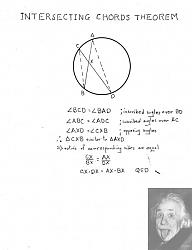
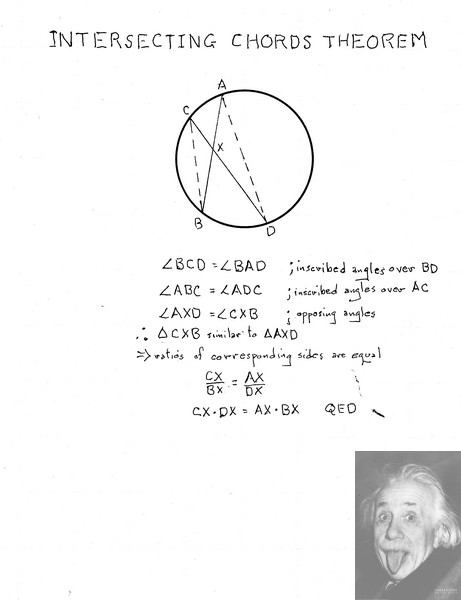
Attached is a proof of the Intersecting Chords Theorem.Originally Posted by Saltfever

This proof makes use of some features of geometry not necessarily known to the average reader. At the risk of boring our more mathematically adept readers, I'll provide some explanations...
Two sorts of angles can be constructed in a circle. A central angle has its vertex at the center of the circle. An inscribed angle has its vertex on the circumference of a circle.
Two inscribed angles that subtend the same span on the circumference are equal.
An inscribed angle that subtends the same span as a central angle has a measure half of that of the central angle.
Both of these can be proved but, for the work here they are assumed true. (I don't want to get into an endless sequence of proofs that extend all the way back to geometric postulates/axioms (self-evident features accepted as true without proof).
Two triangles are congruent if their corresponding sides are equal in length, and their corresponding angles are equal in measure. To prove congruence you need to prove three corresponding items of the triangles are equal and at least one of those items must be a side.
Two triangles are similar if and only if corresponding angles have the same measure. If two triangles are similar, their corresponding sides will be proportional. An example might help here... All 30-60-90 triangles are similar but, in general, not congruent (unless they have an equal side). However, the ratio of the short side to the hypotenuse in all of them will be 0.5, the sine of 30 degrees.


 Reply With Quote

Bookmarks