
 LinkBack URL
 About LinkBacks


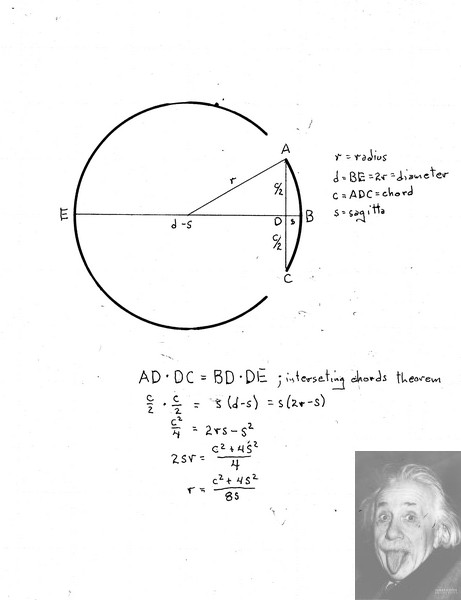
I was surprised that no one asked how I arrived at the formula I used in the original post. It's not obvious from casual inspection how one can calculate the radius knowing only the chord and the sagitta.
So, I documented the derivation and it's shown in this diagram...
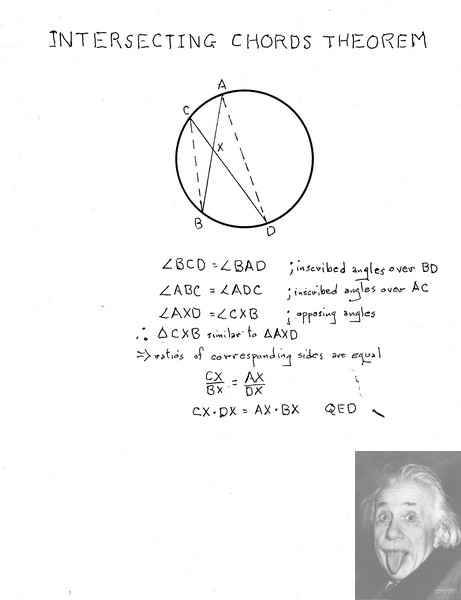
The starting point for the derivation uses something termed the "Intersecting Chords Theorem". Despite the fact that it's discussed in Euclid's Elements, many folks are unaware of this very useful geometry tool. Basically, it says that if two chords intersect inside a circle, the product of the two parts of each chord are equal. Again, this isn't terribly obvious so the proof is given here...
The proof uses the fact that two triangles are shown to be similar. Similar triangles are not the same as congruent triangles. In congruent triangles both the corresponding sides and angles match. In similar triangles, only the angles match. All 30-60-90 triangles are similar but they're not all congruent.
Similar triangles do have a useful property that's exploited in the proof of the intersecting chords. The ratios of corresponding sides in two similar triangles are equal. Returning to the 30-60-90 example, the ratio of the side opposite the 30 degree angle to the hypotenuse in both triangles is the sine of 30 degrees regardless of the scale of the triangles.


 Reply With Quote

Bookmarks