Free 186 More Best Homemade Tools eBook:  
New: 300+ fresh build posts/day from 275 forums → BuildThreads.com

User Tag List

Results 1 to 6 of 6

Thread: Seeking Heat Treat oven input

Hybrid View

  1. #1
    Supporting Member hemmjo's Avatar
    Join Date
    Feb 2017
    Posts
    3,301
    Thanks
    410
    Thanked 2,131 Times in 1,230 Posts

    hemmjo's Tools
    Thank you for your valuable input. I am familiar with heat treating processes but not the specific temperatures as those are available in reference materials. My first introduction to the processes came through my uncle who was a metallurgical engineer. I still have his collection of technical reference materials, BUT, I have do not know specific types of steel I have collected. My actual working experience comes from 35 years of teaching Industrial Technology. Some of those years were spent introducing students to industrial processes, among those processes; machining, forging, casting, annealing, hardening, tempering. We did not have any sophisticated equipment. As you mentioned we annealed by heating in the gas forge to a certain color, turning off the forge, and covering the vent hole with a firebrick.

    Our heat treating was simply, heat in the forge, watch the color, quench in water, emery off the scale, and temper over a hot hunk of iron while watching the colors move down the shaft of the screw driver or chisel. I realize it needs to be a much more precise process for most manufactured products that need heat treatment.

    In my situation, I have done repairs on heavy equipment for years, I have a considerable pile (100's of pounds) of worn or broken pins, large broken axle shafts, leaf springs, worn cutting edges from earth working equipment, worn or broken hydraulic cylinder shafts, etc. All of this is good steel, but too hard to machine with my capabilities.

    I should have been more specific, the main purpose for oven is to be able to anneal this steel. I may in the future be able to do hardening and tempering, but the first step in this is getting the steel annealed.

    From your comments on temperature variations in the furnace due to corners, etc, I am thinking that the more rounded shape of the chamber will be a good thing. The only 90˚ corners will be at the top and bottom. Do you feel there will be a much more significant difference in temperature with the vertical vs horizontal? The completed chamber will be about 6" dia, X 9" long. I have enough materials to make 2 chambers so I can stack them if necessary to make the chamber 18" long.

    John

  2. #2
    CanBeDone's Avatar
    Join Date
    Oct 2019
    Posts
    43
    Thanks
    0
    Thanked 38 Times in 18 Posts
    Hi John,
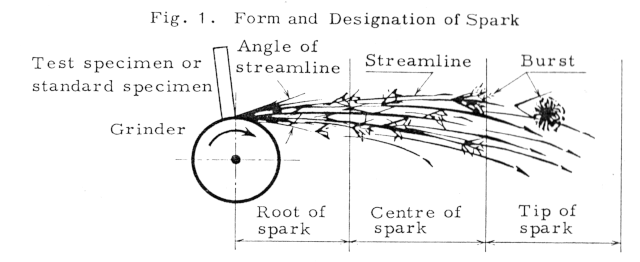
    Now you sound no longer as someone acting out of an industrial / commercial environment, and that permits me to relax standards of accuracy: I give you tips that in my experience will work, but I do not accept responsibility if something goes wrong. With that firmly understood, get yourself a copy of Japanese Industrial Standard JIS G 0566: Method of Spark Test for Steels. This standard provides a means to roughly sort steel by its chemical composition, by just observing the color and shape of the sparks produced with a grinding wheel. With that in hand, you can group your steel supply into what can be quenched and tempered successfully with primitive means, and those that cannot.
    Seeking Heat Treat oven input-sparktest.png
    Restrict yourself to carbon steel, i.e. steel that produces bright orange sparks and plenty of bursts. Steels producing dark red sparks are high alloy steels and not suitable for heat treatment with primitive means.

    Then, build your furnace with two or even three heating zones, zones that can be controlled individually so that you get a better temperature profile. If I read the picture of your furnace correctly, it is heated by open, uninsulated electric wires. Because they are uninsulated, safe operation mandates they are present in the walls, not in the floor or ceiling / door. With this design, ceiling and floor will be colder than the heated walls - how much requires measurements. Scale falling off your steel will otherwise cause short circuits.
    There was recently on this forum a suggestion to use the heating elements from domestic ovens to build a heat treatment furnace, over a central core made from a stainless steel pipe, which in turn is insulated using aluminum silicate fiber blankets. That would be my preference, since it could be build for 100-200 dollar , plus the cost of the pipe.
    But since you already have the bricks, in your place I would explore the idea of dispensing entirely with a PID controller, heat with gas, and control forge temperature entirely by controlling gas and air flow. The big advantage of a gas powered furnace is it heats up much faster than an electrically powered one, but leave it alone unattended for an extended time?

    Lastly, I would take a K-type thermocouple (chromel-alumel), attach its measuring tip to a small block of steel, and measure the temperature distribution over the length and height of the furnace. Then I would know where to place my steel piece.

  3. The Following 2 Users Say Thank You to CanBeDone For This Useful Post:

    hemmjo (Nov 19, 2019), Little Rabbit (Nov 20, 2019)

Thread Information

Users Browsing this Thread

There are currently 1 users browsing this thread. (0 members and 1 guests)

Bookmarks

Posting Permissions

  • You may not post new threads
  • You may not post replies
  • You may not post attachments
  • You may not edit your posts
  •