 LinkBack URL
 About LinkBacks
I would have loved to listen to those ladies talk...





I would have loved to listen to those ladies talk...



Polish firefighters in museum. Not really sure what we have here. I found it posted on social media describing them as dusting paintings. A machine translation of the original page in Polish describes this as "Museum service during fire fighting exercises."
Fullsize image: https://diqn32j8nouaz.cloudfront.net...e_fullsize.jpg

New: BuildThreads.com - 300+ build posts/day (with photos)
baja (Jun 13, 2020)
I hope they don't turn the water on or him and the ladder will come down...
Drew1966 (Jun 13, 2020)
That truck appears to be a CT electric probably a 1 ton or maybe a 1 1/2 ton
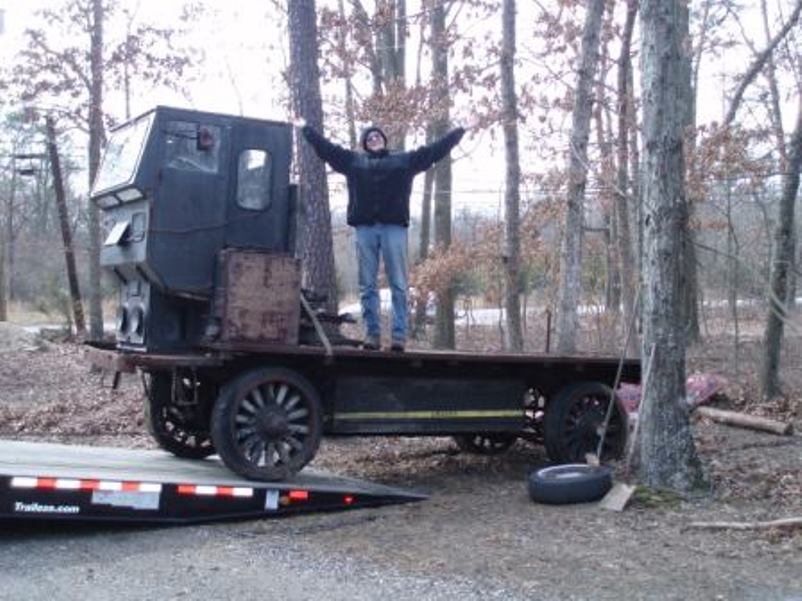
A friend of mine owns one and it will be brought to me in the upcoming months to either store or hopefully we will go ahead and restore it
here is his take on the history of the CT electric trucks ha has dome some extensive research on the matter
20 CT Electric's were used during the night time hours from 1916 up into 1962 to haul 10 ton loads of paper and two hauled coal. Mine was number 14 and was used to haul coal. At least I believe so based on the piles of small coal chips found everywhere in the cab. This truck sat outside for too many years.
The truck is powered by four 60V 200 AMP GE electric motors. One on each wheel. Each motor should produce 16 hp for a total of 64 hp. The truck is geared out to 12 MPH.
It was purchased from the 3'rd (4th) owner, depending on how you want to count them. The first owner was the Curtis Publishing Company. The second was an individual who completed a two truck purchase from Curtis, numbers 14 and number 16. It was then sold to a gentleman who intended to restore it but passed away before any thing was done to it. One of his relatives inherited it and I purchased it from them. Or so I think. I also received the very first title the state of PA. issued to it.
This is the truck when I picked it up. Everybody tells me its so ugly only a mother could love it so I guess I'm a SAP I think it looks neat. It's been called the vending machine!
I found this interesting link to an engineering handbook from 1921 and it has a lot of information on electric vehicles prior to 1921. I purchased the book and I'm waiting on the mailman.
I've decided, at least for now, that I'll preserve it rather than restore it. Its a unique piece of American history and I'd like to preserve that as it existed. My plans are to replace the wood bed around the edges. Red Oak 2" thick, that'll be needed to refasten the steel band that goes around the edge of the bed. Theres a 1/4 inch steel plate on top of it. Next I'm going to see what I can do to rejuvenate, rebuild or what ever is necessary to get the batteries back into working condition. The batteries have always been rebuilt vs replaced. Huge wooden battery boxes. Nine in all.
I've removed the cab and I intend to set it up as a display on the back of the truck. It'll help show the changes the truck went through during it's life. Charlie Wacker designed the cab he was a long time ATHS member and has passed on. There is quite a bit in print about him and his family's truck body building business and I'll post what I can as I find it. Heres a little teaser,,
Nice old truck. I couldn't help thinking of a long time ATHS member (who has since passed on) by the name of
Charlie Wacker --he was a genuine character who was a "pistol" in his eighties -- I can't imagine how he was in his youth. Anyway, his grandfather started a body works near Philadelphia over a 100 years ago and Charlie worked there his whole life . What he didn't know about truck bodies, wasn't worth knowing. One of his pet peeves was restored trucks from the early part of the 20th century with finely finished wooden bodies, that is, the wood was stained and clear coated or varnished. Charlie ALWAYS pointed out that the bodies were NEVER done this way, but rather painted, as you have done. Charlie would have told you, "You done in right"
One of the books I have tells this story, from "The Illustrated Encyclopedia of American Trucks and Commercial Vehicles" by Albert Mroz.
1907 -1928 _ The Commercial Truck Company of America was founded in 1907 in Philadelphia Pa. The vehicles were battery powered electric, although a few were gasoline-electric hybrids were also built by 1915. For 1908 the company advertised itself as the Commercial Truck Company, and showed a 35 passenger omnibus as well as a 30 passenger sight seeing coach. Already by late 1907 a 3-ton and a 5-ton chassis were available.
Other early models consisted of a 1/2 -ton to 3 1/2-Ton capacity. The 1/2-ton delivery van sold for $2200. The larger models used General Electric motors geared to each rear dual-wheel. The 3 1/2 ton truck had a wheelbase of 114 -inches and weighed 10,000 lbs. Top speed was 7 MPH.
By 1912 C.T. trucks were available in six different capacities from 1/4-ton to 5-ton. Worm-drive was adopted in 1913. The gasoline-electric hybrid tractor was introduced in 1915 and continued to be built but only for two years. A 6-ton model was added in 1921, and lighter models were improved. Most of the heavier models had four-wheel-drive with an electric motor mounted on each wheel.
As an example C.T.electric trucks were successfully operated in Philadelphia by the Curtis Publishing Company. A fleet of 22 was used by the publisher of Jack and Jill, Holiday, Ladies Home Journal, and Saturday Evening Post. Two of the trucks were used exclusively to haul coal, while the other 20 delivered the periodicals throughout the city. Loaded with 10 tons of paper and traveling at 10 mph, they silently plied the streets in the early morning hours with nary a puff of exhaust. Curtis used the reliable C.T. fleet as late as 1962. By that time, the trucks were over 40 years old on the average. They still used the original 85 Volt 10 amp drive systems that consisted of an electric motor in each wheel.
By 1928 C.T. offered 12 different models to chose from, but the diminishing market for slow electric trucks with a limited range forced C.T. to be acquired by the Walker Vehicle Company, an electric truck builder that lasted until 1942.
I am completely amazed at the numbers of electric and hybrid trucks made before the 1930's. I have compiled a list of those who made electric commercial vehicles using just one source.
A & B The American and British Manufacturing Co. (hybrids)
ACF/ACF-Brill/Brill (Hybrids)
Ahrens-Fox
Ajax Electric
American Electric
American Lafrance (hybrids)
Andover
Anheuser-Busch
Argo
Asprooth-Leoni Electric
Atlantic
Auto-Car (not to be confused with Autocar)
Autocar
Automatic Electric
Bailey Electric
Baker
Baker (2)
Battronic
Beardsley
Blue Bird
Borland
Brecht
Broc Electric
Bronx
Buffalo
Buffalo Electric
Caffrey Electric
Calectric Delivery
Cantono Electric
Capitol
Capitol (2)
Carl
Champion
Champion (2)
Champion Electric
Chicago Electric
Clinton E Woods Motor Vehicle Co.
Collins
Columbia
Connersville
Couple-Gear
CT (Commercial Truck Co) (electric and hybrid)
Custer Electric
Dayton
Detroit Electric
Detroit Taxicab
Dunlap
Edison
Eldridge (hybrid)
Electric Vehicle
Electrocar
Electro-coach
Electromobile
Elwell-Parker
Ewbank (hybrid)
Fifth Avenue Coach
Fisher (hybrid)
Fritchle Electric
Gas-Electric (hybrid)
General Electric
GMC
Great Western (hybrid)
Greene
General Vehicle
Hewitt-Lindstrom
Hunter Electric
Illinois Electric
JactoJenkins
Joliet
Joly &Lambert
Kelland
Knickerbocker
Lansden
Lansing
Leoni
Loomis
Milburn
Morris & Salom
Morrison
M & P
Munson (hybrid)
Nordskog Electric
OB
Ohio Electric
Oldsmobile (first electric vehicle built in 1887)
Phipps- Grinnell
Piercy (hybrid)
Pittsburg
Pope-Waverly
Purity
Quadray
Quadru (hybrid)
Rauch & Lang
Riker
Roland (hybrid)
Sampson (Hybrid) (the Road Train an 18 wheeler in 1910)
Standard (hybrid)
Steinmetz Electric
Storms
Studebaker
Synnestvedt
Tek-Truk
Thorne
Turbine
Universal Gas Electric (hybrid)
Urban
Van Auken
VEC
Versare
Voltacar
Wagenhals
Walker
Ward
Washington
Waverly
Westcoaster
Wood
Woods
So it appears there were many electric commercial vehicles built before 1930, Where did they end up?
Never try to tell me it can't be done
When I have to paint I use KBS products
12bolts (Jun 14, 2020), Toolmaker51 (Jun 14, 2020), volodar (Jul 19, 2020)

Thanks for that write up Frank. What type of batteries are in your truck?
Cheers Phil
Its not my truck it belongs to my friend who owns the Prevost RVOriginally Posted by 12bolts

The batteries are the original Edison batteries and are over 100 years old out of the 9 batteries I think he said that at least 6 of them were still in rebuildable condition.
they are nickel iron or Ni-FE the same type that were used in submarines for a long time.
he had decided that after he sells his house in CT. he and his wife are thinking about picking out a spot in the North woods where I have a meadow like clearing pour a pad there and he and I will build a pole shed for them to park the Rv under for when they are not traveling playing merry campers
I have done some preliminary research on the Edison batteries and believe that I can duplicate them if he decides to restore the CT rather than just preserve it This part of Texas is a whole lot better place to preserve than the salt humid air of Connecticut where it is currently located
Never try to tell me it can't be done
When I have to paint I use KBS products
Beserkleyboy (Jun 14, 2020)
Frank, What a wonderful old truck! ...and another project one day, like you don't already have a long enough list! Cheers
Jim

I would assume/hope they used air to blow the dust off.
This just plain odd. Looks staged, they really are not in 'turn-out' gear, regardless the era. So, dusting seems logical, barely. Can't get my head around what term to google with for some enlightening tidbit either. And very probable their pump is centrifugal or bellows, but that hose is flat as a pancake.
Sincerely,
Toolmaker51
...we'll learn more by wandering than searching...

I don't know how they do things in Poland but I'll wager that Getty and the Guggenheim would never blow dust off any artwork on display only to have it redeposit on another. Small, delicate, handheld, low-flow vacuums yes, but never brass fire hose nozzles near a Caravaggio.
---
Regards, Marv
Smart phones are to people what laser pointers are to cats
Homo sapiens is a goal, not a definition
Toolmaker51 (Jun 13, 2020)
There are currently 6 users browsing this thread. (0 members and 6 guests)
 Posting Permissions


 Reply With Quote
Bookmarks