 LinkBack URL
 About LinkBacks
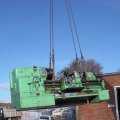
Wheel boring at the Wheel and Axle Division of the Carnegie-Illinois Steel Corporation. August, 1950.
Fullsize image: https://diqn32j8nouaz.cloudfront.net...r_fullsize.jpg






Wheel boring at the Wheel and Axle Division of the Carnegie-Illinois Steel Corporation. August, 1950.
Fullsize image: https://diqn32j8nouaz.cloudfront.net...r_fullsize.jpg
New: BuildThreads.com - 300+ build posts/day (with photos)


re Post *620......
Interestingly configured machine, unlike any known to me, outside IIRC a 'Nicholson' rotary mill.(?). This somewhat more correctly a 'lathe' than a common VBL that traverses over centerline on gantry like ways. The quill carries spindle, suspended by counterweight, in a rise/ fall headstock. Normally the 'headstock' is rough positioning, quill for feed rate.
I don't see evident means of traverse, though yoke on right side suggests that axis, equaling a cross slide. The rest of it fairly conventional, clutch pedals, shift levers, pinion driven table etc.
Properly fixtured and clamped, this work of boring would be accomplished quickly.
With an eye on production, and sufficient capital, custom built machine tools were commissioned more often than realized. That very same specialization though makes seeing one a rarity.
Sincerely,
Toolmaker51
...we'll learn more by wandering than searching...
cmarlow (Dec 11, 2021)

I was thinking the yoke thing with the chain on it looked more like a small crane for putting the wheels in position to be bored. Or are we looking at a different part of the machine?
Potentially and logically a crane yes. It's perspective is misleading, examination says it could be long enough to reach centerline, making aforementioned fixturing all the more effective, not tying up overhead crane, forklift etc. Hanging ~900 pounds from center isn't such a small crane for manual handling; there is a spool of chain at the end.Originally Posted by cmarlow

Sincerely,
Toolmaker51
...we'll learn more by wandering than searching...
cmarlow (Dec 11, 2021)


Chances are that it was built by Newton Machine tool Works of Phil. Specifically made as a Wheel Boring Machine in various sizes determined by the wheel diameter capacity. NMT specialized in single purpose machine tools.
Here's the modern version, hardly changed in principle.
Last edited by Isambard; Dec 11, 2021 at 08:35 PM.
cmarlow (Dec 11, 2021), nova_robotics (Dec 13, 2021)

Tensile machine in the South 40 Area. NASA, 1966.
Fullsize image: https://diqn32j8nouaz.cloudfront.net...a_fullsize.jpg

New: BuildThreads.com - 300+ build posts/day (with photos)
remember you only win if the shell is broken off and the nut is not harmed.

Mechanical deflection measuring ring, used several like that on smaller machines we built, converted most to strain-gauge rings as easier to calibrate load-cells, spent several years rebuilding load-cells at Lloyd Instruments, often using recovered stress beams that I straightened and annealed, many making 0.5 grade after doing so with beam that had only barely made 2% grade before. Got to be a dab hand at eraser balancing the strain gauges too. With have similar 4 lead screw monsters in our civils lab here.
It must be the horizon vs flat earth debate going on elsewhere on HMT.org...LOL............that phrase will not Google!. Breakdown please? We're still trying to integrate 'bit of kit', 'grub screw' 'damp squib' and my personal campaign to sub 'lurgy' for plandemic.
Good News; 'make out' been etched in stone for ages, both usages.
Sincerely,
Toolmaker51
...we'll learn more by wandering than searching...
A 'dab hand' means I got quite good at, 'eraser balancing' is using a hard rubber ink eraser, as one might have used at school between the chalk board and computer era's, to gently remove metal from the strain gauges to bring the bridge into perfect balance before interfacing with any electronic zero correction which could introduce errors and potentially reduce span and spot accuracy across the load cells range. This was often an issue with new load cell beams with new strain gauges that had drifted/shifted zero during the mounting bond bake process, due to lack of annealing prior to mounting the strain gauges the beam would often relax slightly and shift the zero, even at quite low heat some thinner beams for low range cells would change even if they had been annealed, a kind of black art much like RF can be.
Toolmaker51 (Dec 14, 2021)
There are currently 1 users browsing this thread. (0 members and 1 guests)
 Posting Permissions




 Reply With Quote

Bookmarks